Jonathan Levi - Septimania
Здесь есть возможность читать онлайн «Jonathan Levi - Septimania» весь текст электронной книги совершенно бесплатно (целиком полную версию без сокращений). В некоторых случаях можно слушать аудио, скачать через торрент в формате fb2 и присутствует краткое содержание. Год выпуска: 2016, Издательство: The Overlook Press, Жанр: Современная проза, на английском языке. Описание произведения, (предисловие) а так же отзывы посетителей доступны на портале библиотеки ЛибКат.
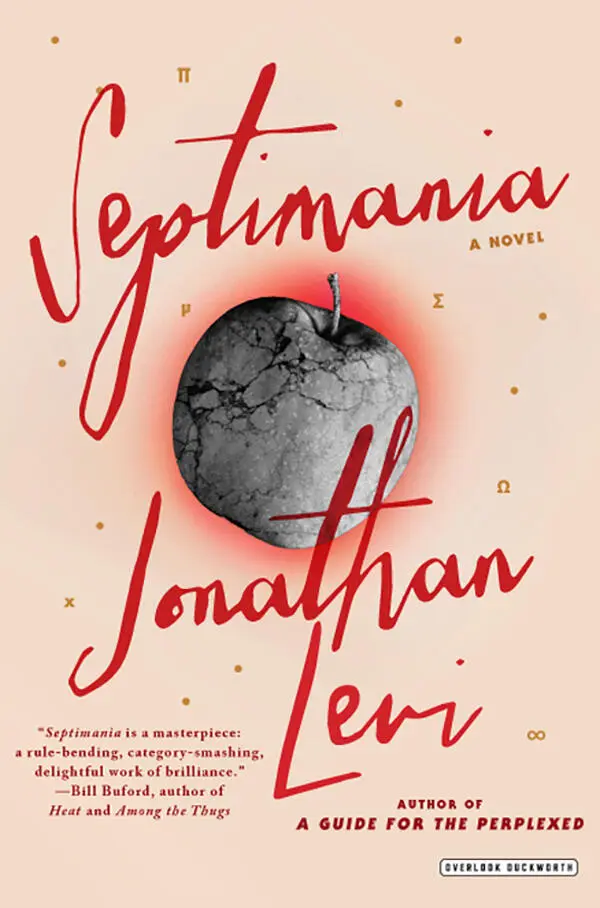
- Название:Septimania
- Автор:
- Издательство:The Overlook Press
- Жанр:
- Год:2016
- ISBN:нет данных
- Рейтинг книги:4 / 5. Голосов: 1
-
Избранное:Добавить в избранное
- Отзывы:
-
Ваша оценка:
Septimania: краткое содержание, описание и аннотация
Предлагаем к чтению аннотацию, описание, краткое содержание или предисловие (зависит от того, что написал сам автор книги «Septimania»). Если вы не нашли необходимую информацию о книге — напишите в комментариях, мы постараемся отыскать её.
Over the next fifty years, Malory’s search for Louiza leads to encounters with Pope John Paul II, a band of lost Romanians, a magical Bernini statue, Haroun al Rashid of Arabian Nights fame, an elephant that changes color, a shadowy U.S. spy agency and one of the 9/11 bombers, an appleseed from the original Tree of Knowledge, and the secret history of Isaac Newton and his discovery of a Grand Unified Theory that explains everything. It is the quest of a Candide for love and knowledge, and the ultimate discovery that they may be unified after all.
Septimania — читать онлайн бесплатно полную книгу (весь текст) целиком
Ниже представлен текст книги, разбитый по страницам. Система сохранения места последней прочитанной страницы, позволяет с удобством читать онлайн бесплатно книгу «Septimania», без необходимости каждый раз заново искать на чём Вы остановились. Поставьте закладку, и сможете в любой момент перейти на страницу, на которой закончили чтение.
Интервал:
Закладка:
“Sorry,” Malory apologized, worming his body off the stranger’s and fiddling uncomfortably to disentangle the Universal Organ Tuner from the man’s waistband. “ Mi dispiace, ma … ”
“American?” The man was breathing heavily.
“Sorry,” Malory apologized again, wishing he wouldn’t. “No. British. English.”
“So—” The man pulled himself into a sitting position on the floor, back against the balustrade. “You British come all the way to Rome to play organs and wake me up at … what the fuck is the time?”
“Not exactly,” Malory said.
“Not exactly?” the man said. “ Fututi pizda matii! ” The man laughed and wiped his eyes with thumb and forefinger.
“Sorry,” Malory said, “I don’t speak much Italian yet.”
“Not Italian,” the man said. “Rumanian. It means ‘fuck the …’” He stopped and turned to Malory. “Do you have a mother?”
“Actually,” Malory said, “she died some years ago.”
“In that case,” the man said, “I won’t waste the explanation, or curse the private parts of a dead woman.”
“You are Rumanian?” Malory asked.
“Not exactly,” the man said with an actor’s attempt at sobriety that quickly gave way to more laughter. He reached into the breast pocket of his jacket and pulled out a pair of rimless glasses. “What are you not exactly doing up here?” He tweezed the glasses over the back of his ears and onto his helpless eyes. Malory realized that the apparition breathing heavily and laughing lightly next to him on the organ loft floor was essentially harmless.
“I was planning on tuning the organ, actually.”
“Actually?”
“This piece of metal”—and Malory held up the Universal Organ Tuner—“is what I use to scrape and bend the pipes. Put them in tune.”
“Not to rescue Rumanians?” The man took the tuner from Malory and scratched the end of his nose.
“Not exactly,” Malory laughed. And he thought that it had been a while since he had laughed and a long while since he had laughed at himself. “What does it mean to be not exactly Rumanian?”
“So,” the man began, “you have heard of Dracula?”
“Mmm,” Malory said.
“Don’t worry,” the man said. “I’m not a biter. It’s just to give you a geographical idea of how fucked my part of Rumania is — fucked by the Ottomans, fucked by the Hungarians, the Austrians, the vampires, and, most recently, the Red Star Pioneers of the Soviet Union and its finger puppets, Monsieur and Madame Ceauşescu.” He handed the metal back to Malory. “I come from a place that has been scraped and bended, but is not exactly in tune.”
Malory had little grasp of Eastern European history. But it occurred to him that the man’s voice itself was out of tune. In the months that had followed his discovery of Louiza and the Pip, Malory’s own internal tuning had become so acutely wired that he felt the need — like Charlie Chaplin with his spanners in Modern Times —to take his own bent piece of metal and tune the horns of cars, the cries of seagulls, the whistle of the wind, to tune the world. And the voice that came to him first from the organ case and now from beside him on the floor of the organ loft of Santa Maria sopra Minerva was out of tune in a way that was unsettling.
“But you didn’t come here, I mean to Rome, for a tuning.”
“Not exactly,” the man said, but this time he didn’t laugh. “Back in Rumania, I was a little bit of a big shot. Which means Ceauşescu let me direct Shakespeare and Chekhov three or four times a year, and I had enough friends in the Securitate to keep me tranquilized with Carlsberg and Camels.”
“But you left.”
“I left,” the man said, “because I followed La Principessa .”
“ La Principessa ?” Malory asked. “Is she living inside the pipe case, too?”
“Living?” the man looked full at Malory. “You think I am living there?” It seemed to Malory that he was on the verge of laughing, but something more painful arrested the impulse. “I only came up here to get a little sleep. La Principessa ,” he continued, “at this moment is in the Ospedale Fatebenefratelli, preparing to give birth.”
“Congratulations,” Malory said, “I mean, I assume …”
“That the baby is mine? I assume too,” the man said. “It is no consolation.” The man pulled himself standing and turned to face into the vacuum of the church. “I told her,” he said in a whisper mixed with a low bass undertone, “if it is a girl, you must give her away before I fall in love with her. If it is a boy, I will strangle it with my own hands.”
“ La Principessa is your wife?”
The man pulled Malory to his feet.
“You tune organs. You also play?”
“Well …”
“You will play something for me. Something for La Principessa and the baby.”
Malory sat once more on the bench, the Rumanian beside him. Once again, he brought the little finger of his left hand down on the B-flat and introduced the theme of i = u , MALORY = LOUIZA, this time without interruption. Lucky Rumanian, Malory thought. In the seven months of absence, the seven months of searching, Malory had named not two, but three of the children he would have with Louiza. If he ever found her.
But as he played, another note crept into the improvisation, a note that hadn’t been part of the melody in any of the many variations he had played over the past seven months. It was a low F-sharp, two octaves below middle C, a note that had its own force, its own gravity. The note came from a different scale, and added a discordant voice, especially when played with the toe of Malory’s left boot on the far reaches of the pedals. As surely as the Rumanian had taken his place on the bench next to Malory, so had the low F-sharp taken its place in the music. MALORY = LOUIZA was unimaginable without this note.
Malory finished. His hands sat in his lap, his feet dangled from the bench. Only the whir of the motor for the bellows could be heard in the distance.
“Tibor,” the man said softly. “My name is Tibor.”
“Malory,” Malory managed to breathe, even though his lungs were exhausted.
“Malory,” Tibor said, placing his large palm on Malory’s shoulder. “Malory, you saved me this morning.”
“Saved you?”
“Come with me to La Principessa and save my child.”
Malory had left Cambridge and traveled to Rome against all reason, thrown himself across Europe with only the vague instructions in the letter from his grandmother and the dim light of a single afternoon’s memory of Louiza to guide him. He had spent a restless and ultimately torturous night in the very cell where Galileo had endured the worst of the Inquisition. And yet, at this very moment, with the touch of the man’s hand, with the touch of Tibor’s hand, all the pain in his neck and back, all the uncertainty about Louiza drifted away from his body and out the drafty walls of Santa Maria. Tranquility replaced terror.
Tibor. Even the man’s voice changed with the sound of his name — Tibor. It came into tune, on that low F-sharp. That low F-sharp reminded Malory of another sound, a note he remembered from fifteen years before, a sleeping giant from the foothills of the Pyrenees, a note that Malory identified with a care and affection he had heard only a few times and long ago. In the organ loft, Malory felt that he had found someone who might take seriously his quest for the lost Louiza. Maybe, even, a friend.
“Come, Malory,” Tibor said, and turned towards the door to the organ loft. Malory thought he should make an excuse. He had an organ to tune. There was an appointment with a lawyer, Signor Settimio — his grandmother’s letter had been vague. There were reasons why it made sense for Malory to stay in the organ loft of Santa Maria sopra Minerva and continue to do what he was doing before this Tibor appeared. Instead, Malory let himself be pulled by this new acquaintance, this new sensation. He stood up from the organ bench. He opened the flap of his Kit Bag, put the Universal Tuner back in its place, and swung it over his shoulder.
Читать дальшеИнтервал:
Закладка:
Похожие книги на «Septimania»
Представляем Вашему вниманию похожие книги на «Septimania» списком для выбора. Мы отобрали схожую по названию и смыслу литературу в надежде предоставить читателям больше вариантов отыскать новые, интересные, ещё непрочитанные произведения.










Обсуждение, отзывы о книге «Septimania» и просто собственные мнения читателей. Оставьте ваши комментарии, напишите, что Вы думаете о произведении, его смысле или главных героях. Укажите что конкретно понравилось, а что нет, и почему Вы так считаете.