Jonathan Levi - Septimania
Здесь есть возможность читать онлайн «Jonathan Levi - Septimania» весь текст электронной книги совершенно бесплатно (целиком полную версию без сокращений). В некоторых случаях можно слушать аудио, скачать через торрент в формате fb2 и присутствует краткое содержание. Год выпуска: 2016, Издательство: The Overlook Press, Жанр: Современная проза, на английском языке. Описание произведения, (предисловие) а так же отзывы посетителей доступны на портале библиотеки ЛибКат.
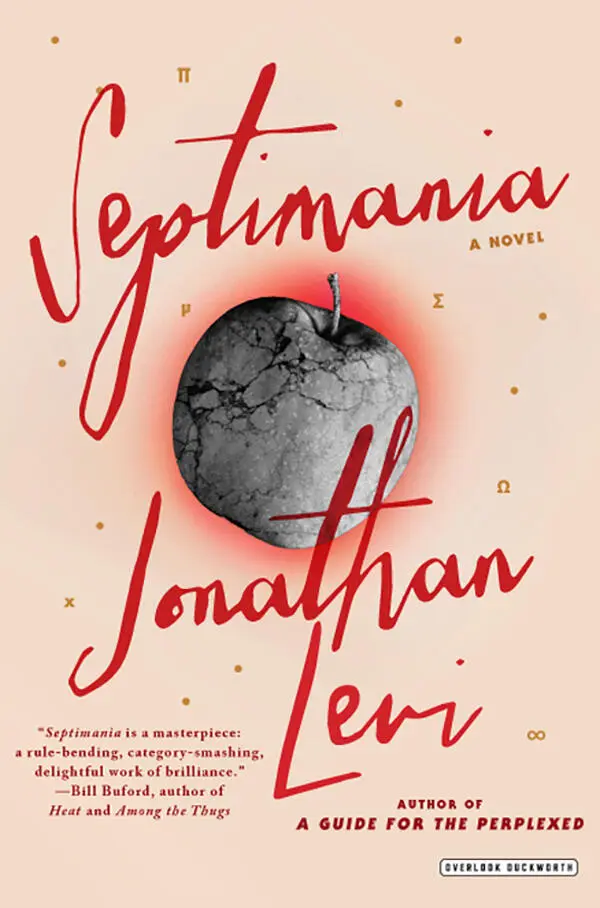
- Название:Septimania
- Автор:
- Издательство:The Overlook Press
- Жанр:
- Год:2016
- ISBN:нет данных
- Рейтинг книги:4 / 5. Голосов: 1
-
Избранное:Добавить в избранное
- Отзывы:
-
Ваша оценка:
Septimania: краткое содержание, описание и аннотация
Предлагаем к чтению аннотацию, описание, краткое содержание или предисловие (зависит от того, что написал сам автор книги «Septimania»). Если вы не нашли необходимую информацию о книге — напишите в комментариях, мы постараемся отыскать её.
Over the next fifty years, Malory’s search for Louiza leads to encounters with Pope John Paul II, a band of lost Romanians, a magical Bernini statue, Haroun al Rashid of Arabian Nights fame, an elephant that changes color, a shadowy U.S. spy agency and one of the 9/11 bombers, an appleseed from the original Tree of Knowledge, and the secret history of Isaac Newton and his discovery of a Grand Unified Theory that explains everything. It is the quest of a Candide for love and knowledge, and the ultimate discovery that they may be unified after all.
Septimania — читать онлайн бесплатно полную книгу (весь текст) целиком
Ниже представлен текст книги, разбитый по страницам. Система сохранения места последней прочитанной страницы, позволяет с удобством читать онлайн бесплатно книгу «Septimania», без необходимости каждый раз заново искать на чём Вы остановились. Поставьте закладку, и сможете в любой момент перейти на страницу, на которой закончили чтение.
Интервал:
Закладка:
Fra Mario turned a key. A door opened across from Michelangelo’s Savior. A staircase appeared, next to it a pegboard holding the business end of the bell ropes. Malory followed Fra Mario — one flight of steps, two flights, back and forth up the shaft of the campanile . The tower smelled of damp and the droppings of small things that scurried just out of sight through the cracks and holes and nests in the walls at their approach. The corkscrewed spire of San Ivo appeared through one slit of the tower, the saucepan lid of the Pantheon through another. The more Malory climbed, the more he began to wake up, and both were torture. He wondered what he was doing following Fra Mario, who kept murmuring forse oggi and climbing like William Tell. He wondered, as he turned a corner up the narrowing staircase, whether some Inquisitor, or perhaps the ghost of Galileo himself, was waiting to push him and Fra Mario off the top of the campanile in a scientific auto-da-fé, and which one of them would hit the gypsies first.
But as he turned the corner, the sun shot a ray through the window and fractioned the morning into the seven colors of the rainbow. The full spectrum spread across the wall of the staircase in front of Malory, a sign as powerful as the vision of St. Michael with his sword that converted the Roman Constantine to Christianity.
Light, Malory thought. Prism. Newton.
The pot of gold at the end of Malory’s rainbow, however, was merely a door into the dusty choir room. The hall was broad and high-ceilinged, lit through a rank of dusty and leaded windows, furnished with a pair of upright pianos and an opened trunk of water-stained surplices, a room that had clearly not been used in some time or, if used, set aside as storage for rancid hymnals guarded by poorly painted and forgotten bishops. At the far end, Fra Mario held open a tiny Wonderland door. Malory stepped through the opening.
“ Forse oggi ,” Fra Mario said, “ ma adesso l’organo. ” With the finality of real hope, he retreated into the choir room, pulling the door shut.
The case was a fluffy bit of baroque panna cotta , a gift from a Borghese prince who was more aesthete than musician. The organ itself, like the one Malory had advised Trinity College to purchase, was a Metzler, built by a Swiss burgher who believed organs were created to play Bach and not Iron Butterfly. Swiss organs, like Swiss watches, trains, knives, and, for all Malory knew, fondue burners, ran fine as long as they were tended by fastidious Swiss organ tuners or confused British organ scholars. Leave them for a few years in the variable humidity and smog and waxy perfume of a Roman church and, well, they would need work.
Still, without playing the organ, without backing it out of the garage, driving it around the corner, and listening to its particular purr as it ran the preludes and fugues, it was impossible to know the soul of the organ and prescribe the appropriate therapy. A faded cinquecento case with its birthmarks long dissolved by years of damp and pigeon shit might disguise an instrument of genius, as well-tuned now as it was the century it was installed. A sparkling canary and forest-green façade, on the other hand, could mask a scrapyard of rusted pipe and moldy wood fit more for a Duchamp fountain than a Dominican church. Malory had a fondness for these mismatches, the puzzles, the illegitimate offspring of budget and architecture. It was time to tune his attention and speak to this particular bastard.
He emptied his Kit Bag one weight at a time onto the music stand. First the Book of Organs, next the Universal Tuner. Finally, Malory pulled out a 35-millimeter reliquary that had no mass, but which still contained the weight of Malory’s hope. Malory flipped one switch, and the light over his keyboard warmed the neglected ivory. He flipped another, and the electric motor twenty feet away behind the pipes began to wheeze air into the lungs of the instrument. The hum of power vibrated confidence through the organ bench up Malory’s body and into his fingers. The organ of Santa Maria sopra Minerva might be broken, but chances were it was playable. There was no point in gentling up to the keyboard, testing it with a tentative finger, one note at a time. Not when the stops, the manuals, the pedals, the pipes, the very bellows themselves were crying out for release. It was time for music. It was time for improvisation. i = u. Malory = Louiza. Malory raised his left hand six inches above the keyboard and brought it firmly down on the first letter of Louiza’s name.
“ Fututi pizda matii! ”
Malory pulled his hand off the keyboard. The note faded to silence. He raised his left hand and brought it down on the B-flat once again.
“ Fututi pizda matii! ” The noise came from the organ case. The bottom rank of pipes, the sixteen-footers. Right register, wrong language.
“ Scusi? ” One of about twelve words Malory knew in Italian. But there was no response. He looked over the parapet of the organ loft. The church was empty. Malory turned back to the bottom manual and pressed the B-flat again.
“ Cazzo! ” No doubt about it. A human voice. Not a voice or vocabulary he associated with Fra Mario or the aged Dominicans.
“ Chi è? ” Malory slid down the bench, his eye on the door to the choir room and the spiral stairs. “Hello?” No answer, just the muffled sound of movements behind the pipes.
And then Malory saw the handle on the door to the pipe case turn, the door open. A figure stepped out of the pipe case and around the corner of the 16-footers. There was such a stoop to the man’s appearance that Malory at first imagined he was one of those Victorian creatures from Dante’s Inferno , damned for some sin Malory could hardly remember, swinging his head by the hair like a lantern at waist height. The man’s hair itself was medievally long, bog dark, and streaked with darker still, matted, nicotined, uncombed, and tangled past the shoulders, circling like a wet dog into a beard that seeped into the vague middle of his chest. He was dressed entirely in black — black t-shirt, black jeans, black jean jacket, black boots, all as wrinkled as the hair and as menacing as the hobnails of the bovver boys who hung around the clove-scented exit of the Taboo Disco Club on St. Andrew’s Road back in Cambridge and threw uncomprehending foreign students into oncoming traffic. Exhausted by Galileo’s bed, confused by Fra Mario’s Italian, Malory’s brain was without the oxygen to register fear, surprise or much of anything.
“ Che cazzo fai? ” The man pushed himself off the organ case and cracked his back, sending a rifle shot of an echo through the arches of the church. Erect, the man stood at least six feet tall, Malory thought, maybe double that. “ Che cazzo fai qui? ” and the apparition stumbled away from the pipes and towards Malory on the organ bench.
The only exits available to Malory were between the giant’s legs or over the balustrade of the organ loft, fifty feet to the stone nave of Santa Maria sopra Minerva. Malory slid carefully down the organ bench as the man approached. But the closer the man came and the more Malory slid, the further he put himself from any reasonable solution. At the end of his options, Malory grabbed his Kit Bag and his Universal Organ Tuner and stood.
He hadn’t meant to hold the Universal Tuner, a piece of metal nine inches long — pointed and ridged of course — in a threatening pose, as if he were, in fact, one of those very bovver boys in front of the Taboo Disco Club. And he hadn’t meant to tread with his own boot on the low C pedal of the organ. But in one movement, Malory’s theatrical gesture and the low C of the organ, which let forth a roar like the unleashed menagerie of Noah’s Ark, so surprised and so overwhelmed the giant, that he fell against the balustrade of the organ loft and began to pivot backwards over the edge. And that equal and opposite reaction so surprised Malory that it wasn’t until the last rumble of the low C died away in the fissures of the church that Malory realized he had somehow lunged forward and caught the giant by the belt with the Universal Organ Tuner. He was stretched out at full length, the toes of his own boots caught painfully, if securely, by the bench. His two hands gripped in agony the rough metal that had served all sorts of other purposes in the twenty years since he had found it in a field near Narbonne, but never to hold two men away from certain death on the floor of a Dominican church in Rome. Forse oggi , Malory thought. Forse oggi , gravity will have its way. And the sadness that he would die without seeing Louiza again was unimaginable. But just as Malory felt the last of the Universal Organ Tuner begin to slip through his hands, the giant pivoted his torso up with another echoing crack, and fell onto the floor of the organ loft, with Malory somehow on top of him.
Читать дальшеИнтервал:
Закладка:
Похожие книги на «Septimania»
Представляем Вашему вниманию похожие книги на «Septimania» списком для выбора. Мы отобрали схожую по названию и смыслу литературу в надежде предоставить читателям больше вариантов отыскать новые, интересные, ещё непрочитанные произведения.










Обсуждение, отзывы о книге «Septimania» и просто собственные мнения читателей. Оставьте ваши комментарии, напишите, что Вы думаете о произведении, его смысле или главных героях. Укажите что конкретно понравилось, а что нет, и почему Вы так считаете.