Jonathan Levi - Septimania
Здесь есть возможность читать онлайн «Jonathan Levi - Septimania» весь текст электронной книги совершенно бесплатно (целиком полную версию без сокращений). В некоторых случаях можно слушать аудио, скачать через торрент в формате fb2 и присутствует краткое содержание. Год выпуска: 2016, Издательство: The Overlook Press, Жанр: Современная проза, на английском языке. Описание произведения, (предисловие) а так же отзывы посетителей доступны на портале библиотеки ЛибКат.
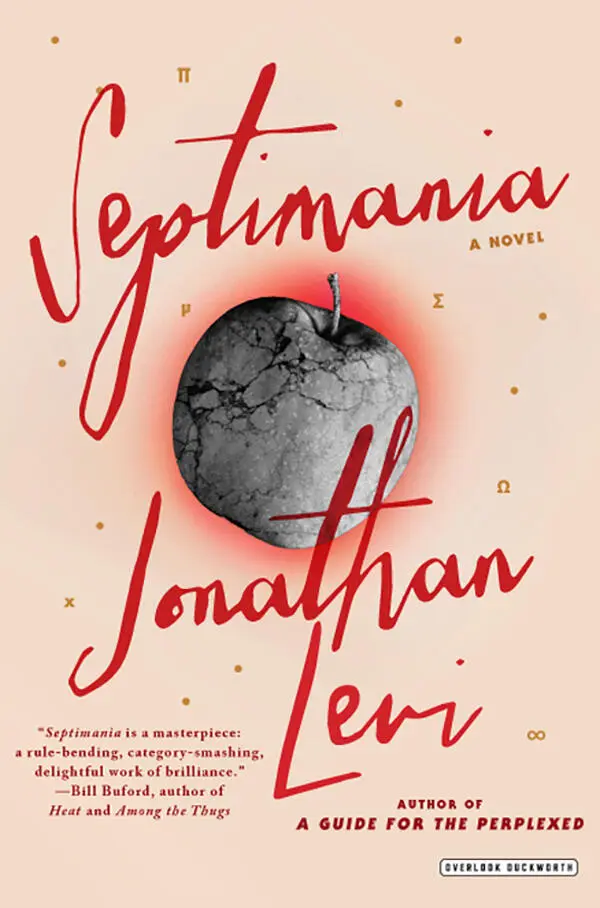
- Название:Septimania
- Автор:
- Издательство:The Overlook Press
- Жанр:
- Год:2016
- ISBN:нет данных
- Рейтинг книги:4 / 5. Голосов: 1
-
Избранное:Добавить в избранное
- Отзывы:
-
Ваша оценка:
Septimania: краткое содержание, описание и аннотация
Предлагаем к чтению аннотацию, описание, краткое содержание или предисловие (зависит от того, что написал сам автор книги «Septimania»). Если вы не нашли необходимую информацию о книге — напишите в комментариях, мы постараемся отыскать её.
Over the next fifty years, Malory’s search for Louiza leads to encounters with Pope John Paul II, a band of lost Romanians, a magical Bernini statue, Haroun al Rashid of Arabian Nights fame, an elephant that changes color, a shadowy U.S. spy agency and one of the 9/11 bombers, an appleseed from the original Tree of Knowledge, and the secret history of Isaac Newton and his discovery of a Grand Unified Theory that explains everything. It is the quest of a Candide for love and knowledge, and the ultimate discovery that they may be unified after all.
Septimania — читать онлайн бесплатно полную книгу (весь текст) целиком
Ниже представлен текст книги, разбитый по страницам. Система сохранения места последней прочитанной страницы, позволяет с удобством читать онлайн бесплатно книгу «Septimania», без необходимости каждый раз заново искать на чём Вы остановились. Поставьте закладку, и сможете в любой момент перейти на страницу, на которой закончили чтение.
Интервал:
Закладка:
“Perhaps as the hero of many of the Thousand and One Nights , the tales the young and inventive Scheherazade told her husband Prince Shahryar on her wedding night and for three years of nights following to keep him from hacking her in two, the way he had divided his adulterous first queen and her paramour.”
“Yes! That’s it!” Isaac said. “Sinbad, the Magic Bag of Judar. There was a time when I read more than mathematics and dreamed of more than stars.”
“One night,” I continued, “Haroun al Rashid dreams that he orders the palace gardeners to find him the sharpest axe in all the city of Baghdad. Armed with this handle of summer ash and this blade of winter steel, the Caliph marches into the garden, determined to cut down every standing tree, from fig to cherry, from oak to walnut. One by one, he hacks and hews, until the garden is nothing but kindling and dust. All that remains is an apple tree, a tree as unremarkable as the one supporting our backs, a beardless sapling with its promise still to come. In his dream, Haroun grips the handle and raises the axe above his head and prepares to strike. Suddenly an old man appears before him. Snatching the axe from Haroun, the old man lifts it above his own head — as King Shahyar would over his faithless queen — and hurls it at the noble brow of the Caliph with such force that blood spurts all over his face and beard and flows down onto his ivory robes.
“Haroun al Rashid recognizes the old man as a djinni of the wood, a sacred forester, and falls upon his knees praying for mercy and swearing to nurse the sapling, to water it himself, to prune its branches, that it might shoot up into a leafy tree. No sooner has the oath left his mouth, than the Caliph awakes. Touching his brow, he sees that there is, indeed, blood on his face. Haroun is certain, with the absolute certainty of a Caliph, that the dream was far from ordinary.
“Even though it is the middle of the night, Haroun rings for a servant and summons a Jew named Benyamin, known for his skill in interpreting dreams. Benyamin asks for ink and quill and transcribes the dream of the Caliph. He calculates the value of each word according to the Jewish system of gematriya, assigning a number to each letter of the alphabet, a sum for every word, and then makes a complex analysis of the sentences and the formula of the dream as a whole. But while he is calculating, searching for the number whose abstract power will unlock the secret of the Caliph’s dream, Benyamin is thinking of his grandson, a remarkable boy of fifteen years, who is also susceptible to bad dreams.”
“They both have my sympathies.” Isaac puffed once, twice.
“The grandson,” I continued, “was the son of the King of the Jews in Exile. What the Hebrews of Baghdad called Resh Galuta, the Exilarch. It had been several hundred years since the Babylonians drove the Jews out of the land of Israel. They had settled more or less comfortably in Persia, where the rulers, pagan and Muslim alike, gave them free rein in matters ranging from the preparation of food to the celebration of death. King of the Jews was a hereditary title that traced its ancestry, as did Jesus Christ himself, back to King David, the musician and adulterer.”
“Very good!” Isaac handed me the pipe and smiled. “David was always one of my favorites.”
“‘My Prince,’ Benyamin explains to Haroun, ‘in the house of the Exilarch my daughter lives with her husband and her son. One day, insha’allah, my grandson, now the youngest of the princely house of David, will follow the path of his father and become King of the Jews himself. But my daughter worries. I myself worry that this sapling already has enemies among your people, among my people, among people we cannot yet imagine, who are sharpening their axes, waiting for the right moment to chop him down.’
“‘Enemies?’ the Caliph asks. ‘What enemies? You are as an uncle to me.’
“‘My Lord,’ Benyamin answers. ‘This very night, before your guards came to my door and requested my presence at the palace, my grandson awoke from a troubled sleep and ran to my bed.’
“‘Another bad dream?’ Haroun asks.
“‘The very same dream that Your Excellency related to me,’ Benyamin answers and bows low.
“‘This boy, your grandson,’ the Caliph asks, clearly moved. ‘What do they call him?’
“‘Your highness,’ Benyamin answers. ‘They call him by a name whose gematriya equals the sum total of your dream. They call him Gan. Which in Hebrew, as you know, means garden.’
“Immediately, without making his own calculations, Haroun al Rashid orders his guards to bring Gan to the palace. Over the course of days and weeks, the lad distinguishes himself before the Caliph and his grandfather with his learning and displays extraordinary powers of intellect and courtesy. One afternoon, though stung by a wasp while in the presence of the Caliph, Gan forbears to drive it away by so much as the movement of a finger, in deference to his royal master. The Caliph showers gifts upon the boy. Then and there he installs him above and beyond his own father — though Gan has yet to attain his sixteenth year — as King of the Jews in captivity, as the Exilarch.”
“While his father was still alive?” Isaac says, passing me the pipe for the briefest of moments. “A rather Republican concept.”
“Yet even as Haroun al Rashid is setting the seven-jeweled crown upon the youngster’s head,” I continue, without relinquishing the pipe, “a messenger arrives in Baghdad from the South of France.”
“The letter from your Jewish butcher!” Isaac shouts. Unamused, his mother shuffles back into the cottage.
“The letter comes with the seal of Prince Charles and his father King Pepin. They ask Haroun to send them a king for their new kingdom, a gardener to tend their garden a thousand miles away.”
“Gan!” Isaac smiles.
“Precisely,” I smile back. “Haroun al Rashid turns pale at the request and touches his forehead. His dream, his young sapling, stands before him in the full light of day. He knows that to cut the tree means disaster. Yet Haroun’s sense of diplomacy and politics shake his certainty. And so he prepares to go …”
“To Septimania?”
“Ah! Now you are curious.” I offer the pipe back to Isaac, but he is in the full flow of the distraction I intended. He is the one, I have no doubt. “Shall we make the journey?”
1/5
 UON GIORNO, DOTTORE .”
Malory opened one eye. A shaft of pre-dawn light. A grizzled buzz cut, a twisted nose, a tortured breath. One friar, a Roman friar, backed by stone and shadow — Fra Mario, was that his name? Malory closed his eye. Through one ear he heard the shuffle of feet in the cloister, the polyphony of baritone virgins.
“ È tempo ,” Fra Mario said. More chanting, more shuffling. Tempo for what? But the Roman friar was gone.
THE VICAR HADN’T SAID MUCH AT THE GRAVESIDE.
“I am merely a messenger,” he said, wiping his hands with a handkerchief that mixed the scent of lavender with the fenny pong of the loam that covered his grandmother’s remains. “Mrs. Emery, you may know, was not technically a member of the parish.”
“Yes,” Malory said, with surprise at his own anti-clerical passion.
“Whistler Abbey itself belongs to some distant foundation. But there is an inheritance for you — what it is, I haven’t a clue. Your grandmother gave me this envelope some time ago. To hand over to you on the event of her death.”
Читать дальшеИнтервал:
Закладка:
Похожие книги на «Septimania»
Представляем Вашему вниманию похожие книги на «Septimania» списком для выбора. Мы отобрали схожую по названию и смыслу литературу в надежде предоставить читателям больше вариантов отыскать новые, интересные, ещё непрочитанные произведения.










Обсуждение, отзывы о книге «Septimania» и просто собственные мнения читателей. Оставьте ваши комментарии, напишите, что Вы думаете о произведении, его смысле или главных героях. Укажите что конкретно понравилось, а что нет, и почему Вы так считаете.