Jonathan Levi - Septimania
Здесь есть возможность читать онлайн «Jonathan Levi - Septimania» весь текст электронной книги совершенно бесплатно (целиком полную версию без сокращений). В некоторых случаях можно слушать аудио, скачать через торрент в формате fb2 и присутствует краткое содержание. Год выпуска: 2016, Издательство: The Overlook Press, Жанр: Современная проза, на английском языке. Описание произведения, (предисловие) а так же отзывы посетителей доступны на портале библиотеки ЛибКат.
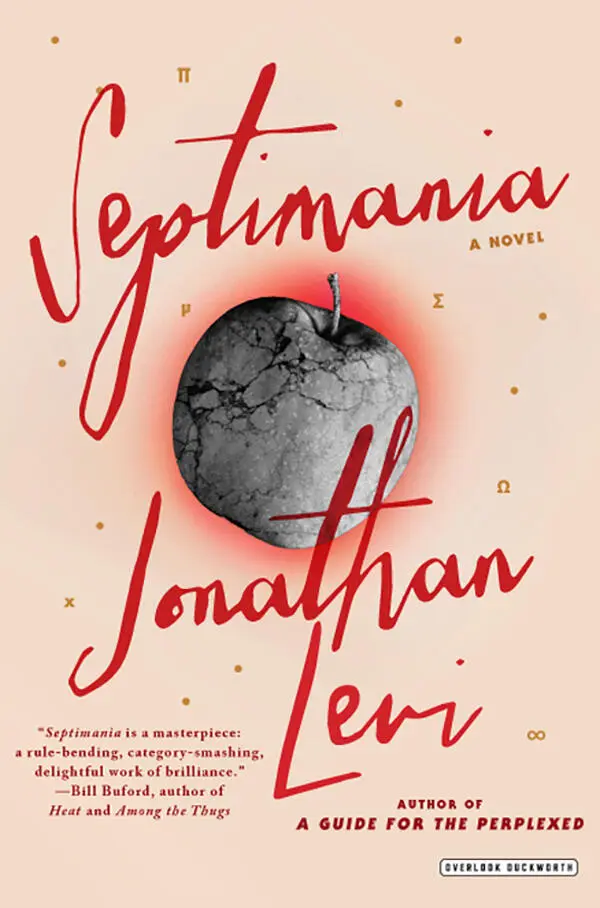
- Название:Septimania
- Автор:
- Издательство:The Overlook Press
- Жанр:
- Год:2016
- ISBN:нет данных
- Рейтинг книги:4 / 5. Голосов: 1
-
Избранное:Добавить в избранное
- Отзывы:
-
Ваша оценка:
Septimania: краткое содержание, описание и аннотация
Предлагаем к чтению аннотацию, описание, краткое содержание или предисловие (зависит от того, что написал сам автор книги «Septimania»). Если вы не нашли необходимую информацию о книге — напишите в комментариях, мы постараемся отыскать её.
Over the next fifty years, Malory’s search for Louiza leads to encounters with Pope John Paul II, a band of lost Romanians, a magical Bernini statue, Haroun al Rashid of Arabian Nights fame, an elephant that changes color, a shadowy U.S. spy agency and one of the 9/11 bombers, an appleseed from the original Tree of Knowledge, and the secret history of Isaac Newton and his discovery of a Grand Unified Theory that explains everything. It is the quest of a Candide for love and knowledge, and the ultimate discovery that they may be unified after all.
Septimania — читать онлайн бесплатно полную книгу (весь текст) целиком
Ниже представлен текст книги, разбитый по страницам. Система сохранения места последней прочитанной страницы, позволяет с удобством читать онлайн бесплатно книгу «Septimania», без необходимости каждый раз заново искать на чём Вы остановились. Поставьте закладку, и сможете в любой момент перейти на страницу, на которой закончили чтение.
Интервал:
Закладка:
Malory folded the letter and returned it to the envelope. He unbuck led the flap of the Kit Bag and searched for a suitable burial place for the envelope, far away from the pocket of hope and the 35-millimeter canister with the Pip. But as he was rummaging, he felt the unfamiliar crinkle of tissue paper. The vicar was stuck in his exegesis, so Malory investigated some more and pulled a packet out of the Kit Bag. With the packet came a scent — the scent of the four-thousand-year-old yew in the churchyard, the scent of his mother, of Old Mrs. Emery, that reminded him of that brief interlude half a year ago in the cool light of the second pew, when he had descended from the organ loft and his discovery of Louiza to find his grandmother waiting for him. The packet was his grandmother’s gift to him, a gift that had lain dormant and undisturbed in the bottom of his Kit Bag for seven months.
Pulling back the tissue paper, Malory saw that the gift was a book.
It was a book, a book bound in leather that had cracked and faded into a light black, of a size and shape that felt immediately of another age and place. It was a notebook, Malory saw, not more than a few inches to each side, perhaps fifty pages deep, with a musty smell, distinct from the damp of the organ loft. Embossed on the front cover of the notebook in a faded gold no bigger than a thumbprint, there was a seal. It was a capital S within a seven-sided border. There was something ancient about the sign, older than the notebook itself, smacking of troubadours and damsels: the S fenced in the heptagon like a unicorn that had escaped from some medieval tapestry. Like the white-haired Mrs. Emery.
Malory opened the notebook. It was filled with an ink whose antiquity nearly melded with a paper that had browned with the centuries. At first blush, the writing seemed to be Italian in a hand too ornate for Malory to read. Every page or so was headed by a date, although the dates were scribbled in a way that made it difficult to tell numbers from letters, sixes from b ’s or g ’s. A diary, a journal of sorts.
Malory turned the pages slowly, and then he began to turn faster. One word stood out from the others within the ornate scrawl. It was a word sometimes alone on a page, sometimes repeated. A word that was a name, a name that occasionally didn’t appear for many entries. But it was a name that he knew well enough that no manner of scribbled hand could disguise it.
“Isaac!” Malory whispered. One of the parishioners looked up from a back pew, but the vicar went on rumbling.
Malory continued turning the pages. He looked at the dates at the tops of the entry pages, at the numbers of the dates again. Yes, it was possible, it was very possible that the numbers began with a “1” and then a “6,” and, if so, that the diary or journal — since that is what the notebook most nearly appeared to be — was written in the 1600s. That the Isaac was his Isaac, his Newton.
“ Un giardino, un albero. ” Malory read the first words of the first entry with some effort, and then further down the page, “Isaac.” But Newton was no gardener, Malory thought, flipping randomly through the rest of the Chapbook. What garden? Whose tree?
And then he saw it.
The last page. The final page of the diary was written in a different handwriting from the rest of the journal, a hand he recognized in a language he understood. It was the hand of the Old Isaac Newton, the Old Man, long after the youthful discoveries of 1666, his annus mirabilis , long after the triumphs and the celebrations, the paranoias and the lawsuits against Leibniz and Boyle, long after his term in Parliament and his stint at the Mint, his leadership of the Royal Society, his descent into alchemy and the Book of Revelations and his calculations of the End of Time. There was no disputing the identity of Isaac now. This last page was written in English by Isaac Newton in his hand, the hand of a man close to death.
This was a diary, a journal written in Italian by a friend of Newton’s, so it seemed. A friend who had known Newton all his life, perhaps until the end. And on the final page of the journal, a sentence written in Newton’s own hand — and no one knew Newton’s handwriting better than the Newton Scholar ( ex- Newton Scholar, Malory thought with a pang) of Trinity College, Cambridge.
“ I have found the One True Rule that guides Mathematics, ” Malory read, “ the One True Rule that guides Science, that guides the Universe .”
Malory read again. And again. Newton had found a single rule? Had refined his Laws of Thermodynamics and Optics and Calculus and Gravity into a single rule?
“ I have found the One True Rule,” Malory read. “But the Rule is too weighty to fit on one page of this Chapbook .”
Malory looked at the top of the page. There was no date written in Newton’s hand. The last entry in Italian was dated sometime in 1692. Malory knew 1692. He knew it was the year before the fifty-year-old Newton suffered what was clearly a nervous breakdown. Malory had read the correspondence left by the Master and Head Porter of Trinity from that year. He knew that Newton was incapable of writing in 1693. This was not the handwriting of the Newton of 1693. This was the shaky penmanship of a much older man, perhaps of the Newton on his deathbed in 1727. And the rule? If, before he died, Newton had actually found the One True Rule that guides the universe, then he had found something even Einstein couldn’t find, the Holy Grail of modern mathematics and physics, the Unified Field Theory. It would be the single point from which all science follows, the single cause for all that came after Creation. It would be God. Not the three-part God of the Trinity that Newton despised, but the One God in whom Newton believed the way Malory believed.
Malory wasn’t entirely certain what he believed. But he saw himself laying the Chapbook down on the desk of Aubrey Potts — he must ask Antonella to translate the Italian straight away — and not only winning a PhD, but also finding Louiza as part of the equation. Malory rubbed the Chapbook like an oil lamp and pondered the research ahead, the papers he would publish, the books, the Nobel Prize in Physics. The scientists of the twentieth century had turned their backs on Newton as they searched for a Unified Field Theory. Now Malory would show them that his Newton had beaten them to the punch. Newton knew something, Malory was sure of it, that would turn gravity on its head, that would bounce the apple back up from the ground to its nostalgic stem. Simplex sigillum veri— the simple is the sign of the truth. No more High Tables. No more colloquia. One work. One girl. Find the One True Rule, and he would find the One True Girl.
And then he heard the vicar.
“All ends are good ends. All ends are bad ends.” The vicar had put away the received wisdom and was improvising his own eulogy.
Malory sat up on the organ bench, set the Newton Chapbook beside him and wondered what improvisation of his own would suit this discovery. Perhaps something based on Newton’s name?
“Although not technically a member of this congregation,” the vicar continued, “and although born on distant shores, our dear departed cousin chose to make Whistler Abbey her home and the Church of St. George her resting place.”
But what other name could he use, Malory wondered, as a counterpoint to Newton. Perhaps—
“Mrs. Emery—”
And at the sound of that name, the part of Malory’s brain that was digesting his dismissal from his PhD, from his Organ Scholarship, from the Newton Rooms next to the gate of Great Court, Trinity College; the part that had barely begun to taste the discovery of the Newton Chapbook with its possibilities of redemption and salvation, emptied in one great sluice and filled with the even greater wash of his own stupidity.
Читать дальшеИнтервал:
Закладка:
Похожие книги на «Septimania»
Представляем Вашему вниманию похожие книги на «Septimania» списком для выбора. Мы отобрали схожую по названию и смыслу литературу в надежде предоставить читателям больше вариантов отыскать новые, интересные, ещё непрочитанные произведения.


Обсуждение, отзывы о книге «Septimania» и просто собственные мнения читателей. Оставьте ваши комментарии, напишите, что Вы думаете о произведении, его смысле или главных героях. Укажите что конкретно понравилось, а что нет, и почему Вы так считаете.