Jonathan Levi - Septimania
Здесь есть возможность читать онлайн «Jonathan Levi - Septimania» весь текст электронной книги совершенно бесплатно (целиком полную версию без сокращений). В некоторых случаях можно слушать аудио, скачать через торрент в формате fb2 и присутствует краткое содержание. Год выпуска: 2016, Издательство: The Overlook Press, Жанр: Современная проза, на английском языке. Описание произведения, (предисловие) а так же отзывы посетителей доступны на портале библиотеки ЛибКат.
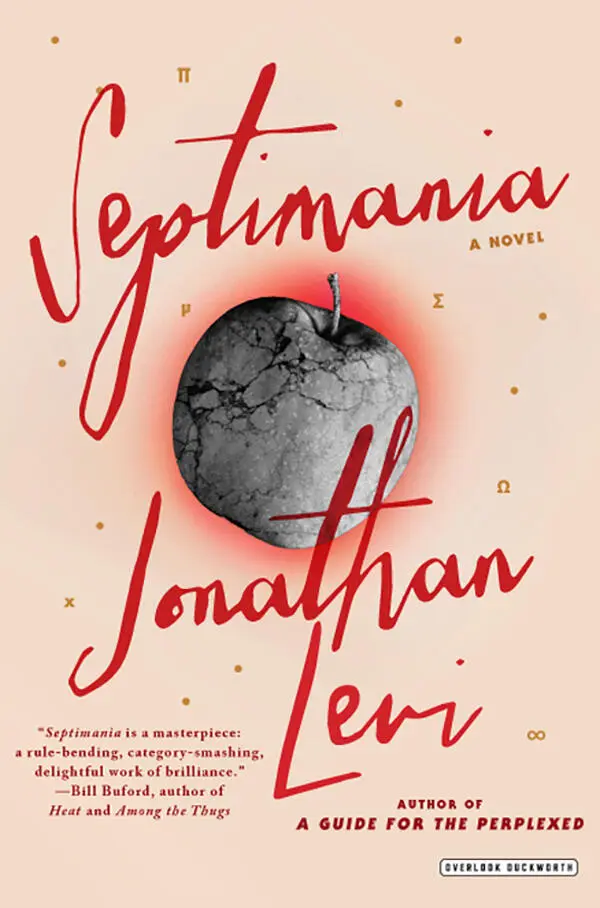
- Название:Septimania
- Автор:
- Издательство:The Overlook Press
- Жанр:
- Год:2016
- ISBN:нет данных
- Рейтинг книги:4 / 5. Голосов: 1
-
Избранное:Добавить в избранное
- Отзывы:
-
Ваша оценка:
Septimania: краткое содержание, описание и аннотация
Предлагаем к чтению аннотацию, описание, краткое содержание или предисловие (зависит от того, что написал сам автор книги «Septimania»). Если вы не нашли необходимую информацию о книге — напишите в комментариях, мы постараемся отыскать её.
Over the next fifty years, Malory’s search for Louiza leads to encounters with Pope John Paul II, a band of lost Romanians, a magical Bernini statue, Haroun al Rashid of Arabian Nights fame, an elephant that changes color, a shadowy U.S. spy agency and one of the 9/11 bombers, an appleseed from the original Tree of Knowledge, and the secret history of Isaac Newton and his discovery of a Grand Unified Theory that explains everything. It is the quest of a Candide for love and knowledge, and the ultimate discovery that they may be unified after all.
Septimania — читать онлайн бесплатно полную книгу (весь текст) целиком
Ниже представлен текст книги, разбитый по страницам. Система сохранения места последней прочитанной страницы, позволяет с удобством читать онлайн бесплатно книгу «Septimania», без необходимости каждый раз заново искать на чём Вы остановились. Поставьте закладку, и сможете в любой момент перейти на страницу, на которой закончили чтение.
Интервал:
Закладка:
That was his grandmother in the box, his grandmother in the coffin at the altar. His grandmother was dead. No amount of looking or not looking would bring her back to life. His last surviving link to any family — gone, and he’d never known her. Never even known enough to understand that no one else would have requested that he be awakened to play whatever he liked at her funeral. His improvisation had been all about himself and Louiza. No rationalization could expand to identify Malory with his grandmother and make LOUIZA = MALORY = EMERY. The Old Lady, late of the second pew, added up to considerably more than either he or Louiza.
IT WAS ENTIRELY WITHOUT SURPRISE THAT LOUIZA FOUND HERSELF LEAVING the towpath and ducking around the fading branches of the Orchard, across the road, and up a flight of leafy steps to St. George’s Church. The nave was empty. Two sawhorses stood forgotten at the altar. Louiza took a seat in the second pew and looked up at the Byzantine mosaics of gold and scarlet and aqua. The English sun had leached much of the pigment from the stained glass. But one ray shone through to Louiza’s feet, to a lone cushion, a hassock stuffed with straw, perhaps from a recent cutting. The weaving on it was unlike the others. No sign of crosses or lambs. Only a tree, a single tree, a single northern apple tree, green foliage spread out in full against a golden background of late-summer barley.
A kick from her belly roused Louiza from contemplation of the hassock in the second pew. Her eyes lifted. There was the ladder she had climbed seven months earlier. It was a challenge, at the very least, for Louiza to climb to the organ loft. Yet foot over foot, sidesaddle in respect for the belly, she ascended one rung at a time.
“Come,” she said to her belly, “let’s see if we can find your father.”
Of course Malory was no longer at the organ. Nor was he up in the steeple. But when Louiza followed the murmur of voices and took her belly over to the churchyard side of the steeple and peered down through the slats, she saw Malory at the head of a grave, standing next to the vicar.
“There he is.” She rubbed her right hand around the dome of her belly. “That’s Malory. Can you say Malory ?” Another kick in answer. Malory looked thinner than when Louiza had seen him last, his hair a little longer. She thought, even from the height of the steeple, that he could do with a bath. The vicar was speaking to Malory. Malory’s eyes were fixed on the pit before him, on the spade of the gravedigger, whose chunk and clink made it difficult for Louiza to hear their conversation. But there was one word Louiza heard, that the baby in her belly heard.
“Rome.”
“Rome?” Louiza repeated out loud.
Malory looked up at the steeple. The baby kicked.
The vicar handed an envelope to Malory.
“Everything is inside,” the vicar said. “Instructions, explanations, a note of introduction to the Do-mi-ni-cans—” The vicar pronounced the syllables, each tasting worse than the one before. “And of course, the train ticket to Rome.”
“Rome,” Malory said, shocked by his own shock.
Louiza knew he couldn’t see her between the slats, but it seemed that he was looking straight at her. She took a step back and glanced out the slats to her left. Two people were walking from the towpath by the river through the Orchard. Two. The Cottagemates.
“Come,” she said to her belly, lowering herself down the ladder. The baby kicked. “Rome.”
1/4
3 September 1666 10 p.m.
 ’d like to return to a subject you raised before dinner.”
Darkness had fallen. Isaac’s mother had long since cleared away the mug of soup and loaf of bread. Once more the pipe, once more two backs against the tree. Isaac had been distracted throughout the meal. I knew what he would say.
“Septimania,” he said, and let the smoke from the pipe rise into the hesitant moonlight. “Earlier, you mentioned Septimania.”
“I did.” I smiled and took the pipe from his distracted hand. I had, indeed, planted the seed.
“Prithee explain,” Isaac said. “Is this Septimania a place or a disease?”
“Judge for yourself.” I handed the pipe back to Isaac and looked up to the moon for guidance. I had traveled for the better part of a month from Rome to England in search of a savior for my kingdom. All I needed was the right story to water the seed of Isaac’s curiosity.
“In the first years of the siege of the Franks,” I began, “the year of Our Lord 752, Order still held the innocent hand of Hope in the market town of Narbonne along the northwest coast of the Mediterranean Sea. All was in balance between the Muslims and the Jews. There were two of everything — two houses of worship, a mosque and a synagogue; two ritual baths, one for Muslim women, the other for Jewish; two schools; two markets; two guilds of craftsmen; and two houses of slaughter. Ibn Suleiman at the eastern gate facing Mecca was the Muslim butcher. And at the western gate, Yehoshua ben Gabriel chopped for the Jews.
“From his father, the young Yehoshua had learned the laws of kashrut, how to slaughter animals in the manner the Jews called kosher. His father taught him about the rope around the hind hooves, the quick slice at the throat. His father taught him to measure a knife, to balance a cleaver, to check the lungs for scarring, to separate the permitted organs and reserve the kidneys and intestines for the Franks, to name the joints, the cuts, the sirloins, the brisket. The profession of shochet went back in Yehoshua’s family to the Temple of Solomon, when butcher and priest were the same man, holy and filthy all in one.
“From his mother, Yehoshua learned to wash away the blood and the shit. From his uncle, he learned explosions, the gases that expand the unpunctured abdomens of frightened animals. He learned that the bladder of a stillborn lamb made the sharpest sounding bombs. Even louder were the discarded udders of a dairy cow that had milked her last.
“The explosions scared his sisters and annoyed his mother on the airless Sabbath afternoons when the smell of the shore, salt mixing with the rotting bodies of forbidden crustaceans, rose over the walls of Narbonne along with the adolescent laughter of Yehoshua’s Muslim and Jewish friends, all ringing on the same pitch, musically indistinguishable.
“From the Frankish children in the distant countryside, he learned a song:
Butcher kills the cattle,
Butcher kills the flocks,
Butcher, Butcher keep your knife
Away from Christian cocks.
“From the dogs he learned survival.
“The western gate in front of Yehoshua’s slaughterhouse was the best-traveled entrance into and exit out of the city, facing Toulouse and Carcassonne and the paths through the mountains to Sepharad. It was the first stop for the shepherds, the final stop for the soldiers of the Muslim Caliph of Cordoba who ruled Narbonne. There were many times that Yehoshua fried a last supper of sheep’s liver with fermented apple for the quartermaster and his whore, as his father loaded the army wagon with the hindquarters and tripe that were permitted the Muslims and their soldiers but not the Jewish people. Yehoshua became rich, within the limits of Jewish wealth. He married, fathered three girls and a boy. His father died. He became richer still.
“His son Moses was born the day the Caliph of Cordoba ordered the gates of Narbonne closed. It was in the 4513th year since the creation of the world according to Yehoshua’s Jewish calculator, which the Caliph calculated as 133 years from the flight of his Prophet from Mecca to Medinah, and Pepin the King of the Franks reckoned at 752 after the death of his God. This same Pepin also reckoned Narbonne would make a good seaport for his kingdom. For a while, the soldiers of the Caliph dissuaded this Frankish inclination, and the family of the Jewish farmer Solomon Ben David, who in the summer grazed his cattle along the salt marshes to a distance of several leagues to the west and in the winter fed them only apples in the belief that the wisdom of the Tree of Knowledge would filter through the several stomachs and udders of his cattle into the Jews of Narbonne, was able to bring its animals to Yehoshua’s slaughterhouse. But within a few months, it became clear to the Caliph of Cordoba that Pepin had designs upon his city and that closed gates saved lives. The family of Solomon Ben David brought his herd into Narbonne, where he bedded down fifty head of cattle and twice that number of sheep and goats in pens attached to Yehoshua’s house that he had erected and stocked with apples and grain with the foresight of someone who believes that all adversity is temporary.
Читать дальшеИнтервал:
Закладка:
Похожие книги на «Septimania»
Представляем Вашему вниманию похожие книги на «Septimania» списком для выбора. Мы отобрали схожую по названию и смыслу литературу в надежде предоставить читателям больше вариантов отыскать новые, интересные, ещё непрочитанные произведения.









Обсуждение, отзывы о книге «Septimania» и просто собственные мнения читателей. Оставьте ваши комментарии, напишите, что Вы думаете о произведении, его смысле или главных героях. Укажите что конкретно понравилось, а что нет, и почему Вы так считаете.