Greg Jackson - Prodigals - Stories
Здесь есть возможность читать онлайн «Greg Jackson - Prodigals - Stories» весь текст электронной книги совершенно бесплатно (целиком полную версию без сокращений). В некоторых случаях можно слушать аудио, скачать через торрент в формате fb2 и присутствует краткое содержание. Год выпуска: 2016, Издательство: Farrar, Straus and Giroux, Жанр: Современная проза, на английском языке. Описание произведения, (предисловие) а так же отзывы посетителей доступны на портале библиотеки ЛибКат.
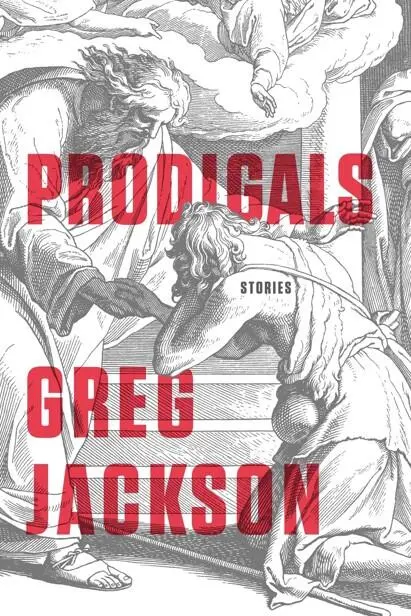
- Название:Prodigals: Stories
- Автор:
- Издательство:Farrar, Straus and Giroux
- Жанр:
- Год:2016
- ISBN:нет данных
- Рейтинг книги:4 / 5. Голосов: 1
-
Избранное:Добавить в избранное
- Отзывы:
-
Ваша оценка:
Prodigals: Stories: краткое содержание, описание и аннотация
Предлагаем к чтению аннотацию, описание, краткое содержание или предисловие (зависит от того, что написал сам автор книги «Prodigals: Stories»). Если вы не нашли необходимую информацию о книге — напишите в комментариях, мы постараемся отыскать её.
A filmmaker escapes New York, accompanied by a woman who may be his therapist, as a violent storm bears down. A lawyer in the throes of divorce seeks refuge at her seaside cottage only to find a vagrant girl living in it. A dilettantish banker sees his ambitions laid bare when he comes under the influence of two strange sisters. A group of friends gathers in the California desert for one last bacchanal, and a journalist finds his visit to the French country home of a former tennis star taking a deeply unnerving turn.
Strivers, misfits, and children of privilege, the restless, sympathetic characters in Jackson's astonishing debut hew to passion and perversity through life's tempests. Theirs is a quest for meaning and authenticity in lives spoiled by self-knowledge and haunted by spiritual longing. Lyrical and unflinching, cerebral and surreal,
maps the degradations of contemporary life with insight and grace, from the comedy of our foibles, to the granular dignity of experience, to the pathos of our yearning for home.
Prodigals: Stories — читать онлайн бесплатно полную книгу (весь текст) целиком
Ниже представлен текст книги, разбитый по страницам. Система сохранения места последней прочитанной страницы, позволяет с удобством читать онлайн бесплатно книгу «Prodigals: Stories», без необходимости каждый раз заново искать на чём Вы остановились. Поставьте закладку, и сможете в любой момент перейти на страницу, на которой закончили чтение.
Интервал:
Закладка:
My grandfather wanted to be a physicist, an astronomer, and although I knew him as a secular man it doesn’t seem possible to me that someone turns his attention to the stars without a flicker of longing for the cosmos — the greater order of which our lives are a part — and the romantic’s intuition that passion lives in a ramshackle outpost on the banks of the unknown. I sometimes wonder whether his forebears, German-Jewish burghers who lived not far downriver from Johann Peter Hebel along the Rhine, consulted the compendium in which the writer’s Kalendergeschichten appeared, stories that alongside the almanac itself put forward the idea, and with it the mythology, of a world suited to the orderliness of the cosmos, a natural and social symmetry. I wonder whether this legacy then trickled down, for if Hebel’s genius lies, as one great rememberer has written, in taking the perspective of the stars themselves, so that they tell not the emblazoned story of our grandeur but of our insignificance, as the life of the planet, seen from a celestial distance, settles into a music of the spheres, a tectonic fidgeting, a not-living, not-dying ecology, a word that means, most literally, the study of a house , a bound order, a family — we must all still take the house into which we are born, our mother’s house, our father’s house, and from the inside out build our own.
And if I asked Misty why she couldn’t find her place she might say, “I was waiting for love,” and then, laughing, “But don’t think I envy lovers. Lovers are idiots. Only someone in love would name a child Mirabella.” And if I saw my grandfather with Ruth or Cynthia in an unguarded moment, talking quietly in the study, I might know their grievance was no more than love, a wild rage at finity, at how we tell ourselves there will be time to mend our ruptures and know one another, and there never is. And if the intimacy Gaby and I share is more than one could hope for and still not enough, what then? What does this say? And if in eulogies we tell stories of the times we knew the deceased, hunting down the words to summon what they meant to us, is this remembering, a form of living, or is it only the sunyata of the dead, an unknown hollow we describe by the contours of a vacancy? For if true remembering were possible, would it not involve seeing the world through my grandfather’s eyes, a boy born during World War I who could recall the milkman’s horse lying dead on the cobblestones where it collapsed climbing their hill in the Bronx, who watched Murderers’ Row — Ruth, Gehrig, “Long Bob” Meusel, Earle Combs — from the platform of the el with his own grandfather on his way home from school, his grandfather’s hands, he would remember, perfumed with the oils he sold, bergamot, cedar, clove, and geranium, a man who as a widower lived with them on the steep and pastoral street at the end of which the shell-shocked veterans gathered at the hospital’s iron gates, taunting and enticing my grandfather as he passed, that dark metal fence looming over his youth, one spent in thrall to science and to his idol, Frank Oppenheimer, five forms ahead of him in school, a guiding light whom my grandfather and his best friend, Ithiel, revered as boys before growing up themselves, going off to college, traveling together to Mexico as young men out of school for the summer, climbing Popocatépetl and hearing Trotsky speak — Ithiel was a communist then — at a meeting hall where attendees put their revolvers on a table by the door, this just a few years before Trotsky was shot and killed, returning at the end of the summer, my grandfather, to the musty lecture halls of New England from which he would emerge two years later engaged to my grandmother, a woman he would stay married to until her death sixty years later and whose courtship had consisted of reading to each other on a riverbank from Ulysses , that great eddy in the onflowing tide of entropy, a tide soon to wreck the world again in bloodshed, a war my grandfather would spend at a research lab on Long Island developing radar and where, on that fateful August morning in 1945, he would do the math with a colleague to confirm the lunatic destruction of which we were indeed now capable, a datum central to reality henceforth, and so to the life of his newborn daughter, my mother, and those of his children to follow and his grandchildren, but then he had been the one to travel years before to identify his uncle’s body in the nowhere hills of western Pennsylvania, a salesman who had died on the train to Chicago the very day he and his wife adopted their first child, a cousin my grandfather would never know, and perhaps he knew from this first lesson, or should have known, the vicious derailments life has in store, things that would ultimately know nothing of his inner weighing of compromise and possibility and hope, what the quality of love he had for the people he loved was like — felt like — what pride or disappointment he felt in them or in himself, getting into bed at night thinking he might have spoken up more bravely or loved more fiercely, as we all do, or that he might have lived another life altogether, and why not; and if he had, would the white-capped waves in the bay look different to him now, what does he see when they catch the sun, can we know, or when he stood at the helm of his sailboat named for an old slave munity, or sailed into prewar Europe with his sister and caught that first glimpse of a foreign land, how did the words of Ulysses strike him on the tongue of the woman he would soon marry in secret two months before their wedding — as confronting a fundamental uncertainty? as an insistent affirmative? — and what did he see when he was left alone with the strange candlelit faces of his children and grandchildren, arguing and laughing at the dinner table, these people who were him and also not him and destined to live lives mysterious to his own, what did he hope the world might become as his life went on and finally extinguished, trying to make more right decisions than wrong, trying to balance the love we owe one another with the inevitable and proper love we must save for ourselves?
And if I am to stay in the water of this skybound bay, looking for an anchor attached to nothing, I hope you will believe me that at a wedding by a pond, I was not a romantic or a sap to see in the consummatory kiss a flicker of the metanarrative’s grandeur, or a straining into the absence that suggests it could still have a place, the first lone voice that rises up to answer the dithyramb, the bondage of our curiosity, this, here , after a moment’s quiet for the life of the pond, the choral frogs and boatmen, the turtles and skimmers, the dragonflies that skitter, the vipers, the doves.
Acknowledgments
Thank you:
Ann Beattie, Georges, Anne, and Valerie Borchardt, Rachel Brooke, Deborah Eisenberg, the Fine Arts Work Center, Nina Frieman, Laird Gallagher, Elizabeth Gordon, Debra Helfand, Yuka Igarashi, Jonathan Lippincott, the MacDowell Colony, Matthew Neill Null, Andrew Palmer, Jon Parrish Peede, Sigrid Rausing, Sarah Scire, Peng Shepherd, Lorin Stein, Christopher Tilgham, the University of Virginia MFA Program, VCCA, Allison Wright.
This book owes a singular debt to the wisdom, labor, and encouragement of Eric Chinski, Bella Lacey, Alexis Schaitkin, Samantha Shea, and Deborah Treisman.
It is my great fortune to count you as readers and friends.
A Note About the Author

Greg Jackson’s work has appeared in The New Yorker, Granta , and the Virginia Quarterly Review . He has been a fiction fellow at the Fine Arts Work Center in Provincetown and a resident at the MacDowell Colony, and he holds an MFA in creative writing from the University of Virginia. Prodigals is his first book. You can sign up for email updates here.
Интервал:
Закладка:
Похожие книги на «Prodigals: Stories»
Представляем Вашему вниманию похожие книги на «Prodigals: Stories» списком для выбора. Мы отобрали схожую по названию и смыслу литературу в надежде предоставить читателям больше вариантов отыскать новые, интересные, ещё непрочитанные произведения.



Обсуждение, отзывы о книге «Prodigals: Stories» и просто собственные мнения читателей. Оставьте ваши комментарии, напишите, что Вы думаете о произведении, его смысле или главных героях. Укажите что конкретно понравилось, а что нет, и почему Вы так считаете.