Greg Jackson - Prodigals - Stories
Здесь есть возможность читать онлайн «Greg Jackson - Prodigals - Stories» весь текст электронной книги совершенно бесплатно (целиком полную версию без сокращений). В некоторых случаях можно слушать аудио, скачать через торрент в формате fb2 и присутствует краткое содержание. Год выпуска: 2016, Издательство: Farrar, Straus and Giroux, Жанр: Современная проза, на английском языке. Описание произведения, (предисловие) а так же отзывы посетителей доступны на портале библиотеки ЛибКат.
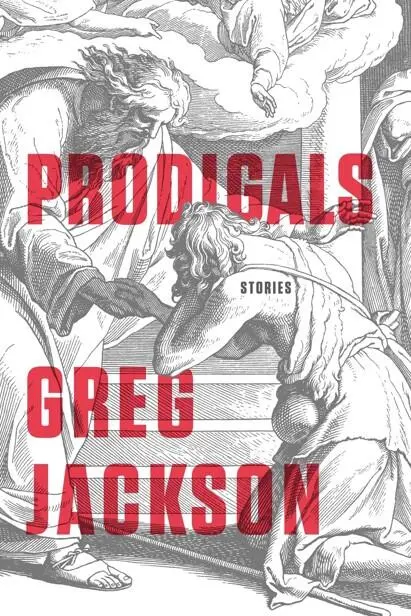
- Название:Prodigals: Stories
- Автор:
- Издательство:Farrar, Straus and Giroux
- Жанр:
- Год:2016
- ISBN:нет данных
- Рейтинг книги:4 / 5. Голосов: 1
-
Избранное:Добавить в избранное
- Отзывы:
-
Ваша оценка:
Prodigals: Stories: краткое содержание, описание и аннотация
Предлагаем к чтению аннотацию, описание, краткое содержание или предисловие (зависит от того, что написал сам автор книги «Prodigals: Stories»). Если вы не нашли необходимую информацию о книге — напишите в комментариях, мы постараемся отыскать её.
A filmmaker escapes New York, accompanied by a woman who may be his therapist, as a violent storm bears down. A lawyer in the throes of divorce seeks refuge at her seaside cottage only to find a vagrant girl living in it. A dilettantish banker sees his ambitions laid bare when he comes under the influence of two strange sisters. A group of friends gathers in the California desert for one last bacchanal, and a journalist finds his visit to the French country home of a former tennis star taking a deeply unnerving turn.
Strivers, misfits, and children of privilege, the restless, sympathetic characters in Jackson's astonishing debut hew to passion and perversity through life's tempests. Theirs is a quest for meaning and authenticity in lives spoiled by self-knowledge and haunted by spiritual longing. Lyrical and unflinching, cerebral and surreal,
maps the degradations of contemporary life with insight and grace, from the comedy of our foibles, to the granular dignity of experience, to the pathos of our yearning for home.
Prodigals: Stories — читать онлайн бесплатно полную книгу (весь текст) целиком
Ниже представлен текст книги, разбитый по страницам. Система сохранения места последней прочитанной страницы, позволяет с удобством читать онлайн бесплатно книгу «Prodigals: Stories», без необходимости каждый раз заново искать на чём Вы остановились. Поставьте закладку, и сможете в любой момент перейти на страницу, на которой закончили чтение.
Интервал:
Закладка:
Me: We’d been flirting all day. She lived in the exact opposite direction from you. I mean it’s understood, right, what offering to walk someone home in that context means?
Gaby: You thought the walk was a euphemism.
M: Indeed.
G: But then it wasn’t.
M: It was not. That is correct.
G: And when you realized it wasn’t a euphemism, was just itself …
M: Look, you don’t want to fall on either side. You don’t want to be the cynic who disallows the possibility of sincerity. You also don’t want to be the rube who doesn’t know when something’s a joke.
G: Mm-hmm.
M: I’m not going to lose sleep over it. We were in different stories is all.
G: It sounds to me like no one was going to lose any sleep over it. Everyone was going to get to sleep nice and early, and wake up refreshed and—
M: …
G: You were in different stories is all.
M: I was in a different story. I had to throw out the whole plot arc I was working with.
G: Which was?
M: I was talking in this gentle, breathy voice, trying not to say anything too weird.
G: The voice you do when it’s a girl on the phone.
M: The part of the dramatic structure narratologists call “rising action.”
G: Eww.
M: That was funny!
G: How many narratology puns do I get to look forward to in this conversation?
M: How many is too many?
G: So you’re walking along, telling yourself some story that ends in sweet, foreign, dawn-welcoming butt sex …
M: Go on.
G: And then you reach the front door, hang out there — what? — I’m guessing five, ten minutes trying to feel out the situation. And finally she says she’s tired, gives you a kiss on the cheek, and goes in. And you have to walk home. And your story has come crashing down. And your life has no point—
M: No, that’s where you’re wrong. My life was fine. I had to start telling myself a new story is all.
G: Which we do all the time.
M: Which we do all the time. And which is fine so long as the metanarrative endures.
G ( a beat, squinting ): And the metanarrative again, just so we’re clear?
M: What it sounds like, I think. The fundamental Platonic form of narrative. The prime fabric of meaning.
G: What has significance for us. What we’re about.
M: Yeah, sort of. Though maybe more like a scaffold. A particular shape in which any one narrative has to fit.
G: And how do we know if one fits?
M: That’s what I’m saying, I guess. It’s more like a feeling we get when something doesn’t fit. Then we worry the thing until it does. But some things come along, right, that just refuse to fit, and in defying the scaffold they wake us up to the whole apparatus.
G: Like you’ve been on autopilot, yeah, without taking the time to figure out what the metanarrative is, just sort of assuming that if you do more or less what other people seem to be doing it’ll figure itself out?
M: Right.
G: Then, boom! You just gave the ten best years of your life to corporate law.
M: And you realize nobody really cares. Nobody’s, like, proud of you. The world’s kind of done patting you on the back, scratching behind your ears.
G: But you’re not broke.
M: You’re not broke, it’s true.
G: You have a lot of television options to scroll through while you’re wondering if maybe musical theater wasn’t your passion all along.
M: Some totally decent scotch.
G: And you get drunk and bone a stranger who’s not your type and— Surprise, that didn’t help!
M: And you quit your job and travel in India.
G: Ashram, roshi, et cetera.
M: And you come back and volunteer at a hospice.
G: Which is actually a really great thing to do.
M: I have, you know, zero doubt.
G: But corporate law is just the low-hanging fruit, right?
M: Yeah, no, it’s all of us.
G: It just comes in different forms, at different times?
M: One that happens to most of us, I think, is the moment when you’re getting older and it hits you that you don’t really have a “home” anymore. And you think: What is a home , really? Did I ever have one? Do I need one?
G: The difference between a house and a home.
M: Mm … Say more.
G: The house is the physical object. The home is that object inside a narrative.
M: The difference between a walk and a walk .
G: Between mushrooms and mushrooms .
M: Are you feeling anything?
She nodded. I was beginning to feel something too. The psilocybin had begun gently thrumming the surface of the day. The field below us, blanched in sunshine, was not changing exactly, but it was taking on different emphases. The conceptual had begun to recede, so that the trees, for instance, appeared to me more as the visual elements that made them up and less as the thing we call “tree.” A patch of reddish berries, which I had never noticed in the leaves across the yard, were now the first thing I saw each time I looked up. They seemed to push into the visual field and as the effect deepened, faint mists transpired before me, as though a haze disclosed by the light, the day grew brighter, the clouds spun and broke apart, piercing white, an animate lace whose definition at their wispy edges could only be called preternatural. I laughed, and then I wasn’t sure why I’d laughed. Gabrielle said that it was in this state and this state alone that black velvet art began to make sense to her.
The thing that happens to me most profoundly on psychedelics, the reason I occasionally do them, in fact, and what happened to me that afternoon for a good two hours or so during the deepest part of the trip, is that my sense of connection to the metanarrative deserts me. Maybe it’s more accurate to say that in seeing the possibility of this connection foreclosed, I become aware of something I didn’t know was taking place, an unconscious process, a limbic subroutine, an autonomic checking-in the brain seems regularly to perform to square what you are doing with the context of the day, the week, the still broader context of the year, your life, what you care about and hope to achieve, how you see yourself and how you hope to be seen. It is in watching this process break down that you become conscious of it, the failure of some mechanism to catch at the appropriate point, and the sensation is not unlike waking repeatedly from a dream without having realized you were asleep.
This has been my experience, in any case, and it isn’t exactly pleasant. It is instructive, though, I think, to step outside future-directed life, to feel the past slip away, and to confront who you are unmoored from history and intention. It can be frightening. You’re left with very little when these things go. But it opens some brief window on the phenomenology of being alive, of living inside a head, and it offers a fleeting glimpse of the metanarrative unmasked as demiurge, as idol, which if you’re like me you must punish from time to time, smash and sweep from the Ka’aba. The pristine emptiness, when you’ve done this, can seem to verge on holiness.
The worst part of a trip, we can probably all agree, is the moment when you’ve come down enough to realize you are not down all the way. Gabrielle and I are throwing a Frisbee in the yard, watching it glimmer metallic shades as it zips between us, when this moment comes. Gaby lets the Frisbee fall behind her without making any effort to catch it.
“I’m going to do yoga now,” she says.
“Okay,” I say, and because I dislike even thinking about yoga, I decide to take a walk instead of chatting with her while she limbers up. I put on a shirt. I get my phone, some earbuds. I pick out a podcast to listen to. I feel briefly lucid as I set off down the street. It is a lightly wooded residential street, with a few people out front watering their lawns. The occasional car passes slowly by. Once I see the people on their lawns and in their cars, however, and realize they see me, I am flooded with the certainty that they know I’m on drugs, which now that I’ve left the equivocal sphere of the house it seems I really am. But I compel myself to focus on the podcast, on Terry Gross’s familiar voice, her warm, brisk personality, and for about ten seconds I feel fine. I manage to smile at a father and daughter playing catch without, I believe, appearing unambiguously psychotic. And yet I can feel a small worry taking shape in me, a worry I can tamp down but not entirely ignore, and which takes the form of the following question posed to myself: Haven’t I been walking on this street an insanely long time? The right way to put it is that I have no idea how long I’ve been walking on the street, and being unable to reconstruct the experience with any temporal dimensionality feels akin to having been always walking on the street. It is not a long street, I know this for a fact. In either direction it runs into a perpendicular street and ends, measuring along its entire length at most eight hundred feet, a distance a world-class sprinter could cover in under twenty-five seconds. But because my walk is an iterative action and not a coherent experience — because it is not a walk so much as all the component parts of a walk — it does not seem possible, or at least inevitable, that I will ever reach the end of the street. And the more anxious this realization makes me, the more closely I attend to my progress, the rate of which, as a consequence of this heightened attention, seems correspondingly to diminish. And it is right around this time, experiencing the first licks of panic, that I realize my walk has become Zeno’s paradox.
Читать дальшеИнтервал:
Закладка:
Похожие книги на «Prodigals: Stories»
Представляем Вашему вниманию похожие книги на «Prodigals: Stories» списком для выбора. Мы отобрали схожую по названию и смыслу литературу в надежде предоставить читателям больше вариантов отыскать новые, интересные, ещё непрочитанные произведения.









Обсуждение, отзывы о книге «Prodigals: Stories» и просто собственные мнения читателей. Оставьте ваши комментарии, напишите, что Вы думаете о произведении, его смысле или главных героях. Укажите что конкретно понравилось, а что нет, и почему Вы так считаете.