Greg Jackson - Prodigals - Stories
Здесь есть возможность читать онлайн «Greg Jackson - Prodigals - Stories» весь текст электронной книги совершенно бесплатно (целиком полную версию без сокращений). В некоторых случаях можно слушать аудио, скачать через торрент в формате fb2 и присутствует краткое содержание. Год выпуска: 2016, Издательство: Farrar, Straus and Giroux, Жанр: Современная проза, на английском языке. Описание произведения, (предисловие) а так же отзывы посетителей доступны на портале библиотеки ЛибКат.
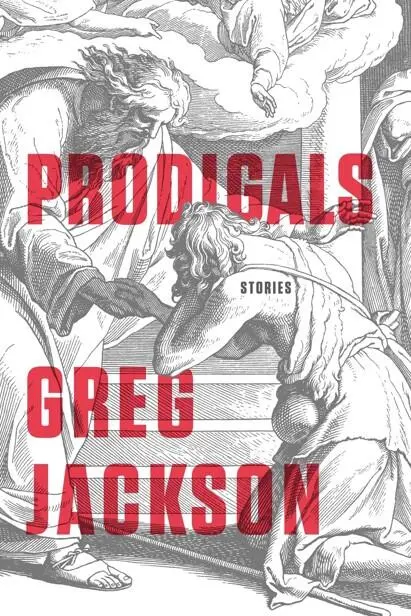
- Название:Prodigals: Stories
- Автор:
- Издательство:Farrar, Straus and Giroux
- Жанр:
- Год:2016
- ISBN:нет данных
- Рейтинг книги:4 / 5. Голосов: 1
-
Избранное:Добавить в избранное
- Отзывы:
-
Ваша оценка:
Prodigals: Stories: краткое содержание, описание и аннотация
Предлагаем к чтению аннотацию, описание, краткое содержание или предисловие (зависит от того, что написал сам автор книги «Prodigals: Stories»). Если вы не нашли необходимую информацию о книге — напишите в комментариях, мы постараемся отыскать её.
A filmmaker escapes New York, accompanied by a woman who may be his therapist, as a violent storm bears down. A lawyer in the throes of divorce seeks refuge at her seaside cottage only to find a vagrant girl living in it. A dilettantish banker sees his ambitions laid bare when he comes under the influence of two strange sisters. A group of friends gathers in the California desert for one last bacchanal, and a journalist finds his visit to the French country home of a former tennis star taking a deeply unnerving turn.
Strivers, misfits, and children of privilege, the restless, sympathetic characters in Jackson's astonishing debut hew to passion and perversity through life's tempests. Theirs is a quest for meaning and authenticity in lives spoiled by self-knowledge and haunted by spiritual longing. Lyrical and unflinching, cerebral and surreal,
maps the degradations of contemporary life with insight and grace, from the comedy of our foibles, to the granular dignity of experience, to the pathos of our yearning for home.
Prodigals: Stories — читать онлайн бесплатно полную книгу (весь текст) целиком
Ниже представлен текст книги, разбитый по страницам. Система сохранения места последней прочитанной страницы, позволяет с удобством читать онлайн бесплатно книгу «Prodigals: Stories», без необходимости каждый раз заново искать на чём Вы остановились. Поставьте закладку, и сможете в любой момент перейти на страницу, на которой закончили чтение.
Интервал:
Закладка:
I don’t remember how I made it back. I must have turned around, but honestly it’s all a blur. A blur not because it went by fast, but in the sense that the recording of a voice slowed down sufficiently no longer resembles a voice. I credit Terry Gross with getting me home, the grounding cadence of her speech, a metronomic standard by which my subjective experience of time was kept from veering into a fatal adagio. And soon enough — or, you know, whenever — I found myself back in the sunny yard, watching Gabrielle articulate her body in serpentine asanas, listening to Terry interview an author I like, and then an actress I like, as happy as a puppy and at peace, because what I understood just then was that Terry Gross’s voice was the voice of the metanarrative, demotic ur-parent, Catcher in the WHYY, the call of the shepherd returning me to the pastures of solicitude and moderation, that cultural plane on which the day’s horrific news — ecocatastrophe, civilizational conflict, postcolonial scarring, and our legacies of violence and extortion — was not diminished or ignored but existed in a strange vaporous adjacency to yuppie mores, triumphalist life narratives, midcult art, and an anachronistic fixation on jazz, this narrow-bandwidth refugium for temperamental decency and civic virtue and a heartbreaking reasonableness that seemed less and less like the earned wisdom of life than a tragic hope laid over it.
You should not have grown wise before you grew old . Was it my grandfather speaking to me, telling me to persist in my folly, the best way out being through, unless you happen to be standing right by an exit? Is what inaugurates an avant-garde really more than the moment when how it feels to be alive has deviated too far from our operative metanarratives, from what we have to understand and draw significance from the ceaseless welter before us, and when it seems no adult or authority is any longer capable of restoring order or putting things right because we lack even a language with which to name the problem, to place it before us, and to talk together as friends?
That afternoon, as the mushrooms left me gently in the sunlit grass, as I felt the old hierarchies reassert themselves — so that the things I could act upon came forward and those I could merely contemplate fell away — as time regained its normal speed, a speed that seemed almost a trance or deadness, the returning cognizance of how my life was changing felt to me like waking up into a dream. I would write books; people would discuss what to that point had been figments and private reveries, idle inventions — or so I hoped. And I do not mean dream in the sense of nightmare’s obverse, not a long-awaited joy or fantastical delight, but rather dream as pseudo-reality, as what resembles life but has no commerce with it. For if the substance of my work purported to be communication of some sort, the exploration and expression of what I found meaningful, my unshakable premonition was that its result would only be to clarify my perversity, deepen my sense of being misunderstood, and thereby accentuate my loneliness. If so, the prefigured fantasy was just a false dream of home. And I looked at Gaby, wondering again whether I hadn’t attached the wrong labels to my emotions long ago, as though I had puce and mauve backward, had never been corrected, and now were chasing some impossible chimera because I failed to see that all the things I felt for Gaby were love, full stop.
But it was not a moment to make reliable judgments, I suspected.
We spent the night in a nearby city, a pretty harbor town where, truth be told, I had once been born. We drank Belgian dubbels in a cellar bar where the decorative stonework peeked out of the walls and made a piping over low arched passageways. We discussed fame, celebrity, renown, what these things were and why we sought them. The beer had washed any last hallucinatory tincture from us, trading mistake for imprecision, and because we had both failed to read The Power Broker for the same class in college, an omission that ever after established Robert Moses as a favorite figure of informed discussion, I now raised his example as a perhaps-instructive case.
Me: Moses was a famous person. Powerful. People would have known who he was when he walked in the room.
Gaby: People were interacting with the idea of him as much as with him. Maybe even more so.
M: Right, and that’s clearly an important aspect of fame.
G: You’re a representative of the idea of you. Not the other way around.
M: Which is pretty fucked-up.
G: Especially when you consider that you’re probably only fractionally responsible for that idea.
M: But with Moses, right, short of his leading some truly lurid private life — which, having read the Caro, I think we can agree he did not — it’s not like people wanted to buy magazines to read about who he was dating, whether he’d gained or lost weight, his taste in vacation getaways.
G: Some of that was the era though.
M: Maybe.
G: —and you know the blinding glory of city-administration work.
M: My calendar this year, by the way: our nation’s top comptrollers, topless.
G: Ooh. I hear March is a total CPA’s wet dream.
M: He’s posed with like a lamb, a lion cub, and a double-entry ledger.
G: In a hammock.
M: In a windowless municipal alcove.
G: But so you’re saying people didn’t feel on intimate terms with Moses. His fame wasn’t bound up in enacting a social persona.
M: Which is probably exactly the difference between celebrity and fame.
G: And which is funny because a lot of what makes us interested in the celebrities as real people, right, is their always appearing to us as fictional people.
M: We want the fantasy. We also want the fantasy to be real.
G ( with a mischievous relish ): And we want to see them crash and burn.
M: Yeah. We want to see them crash and burn so we know they’re like us. And we want to see these perfect façades so we can imagine there’s some more exalted life out there.
G: A paradox.
M: Yup.
G: But there’s another contradiction too, because the more we tune in to this celebrity gossip, the more we realize they aren’t different from us, aren’t experiencing some, I don’t know, transcendent spiritual election.
M: Well, I think this is sort of where the dark turn comes.
G: I just got chills.
M: Because at some point it’s not about the fantasy anymore, right? It’s not about the thing we’re looking at. It’s about the fact that we’re all looking .
G: The most photographed barn in America.
M: Exactly.
G: And we want to be the barn.
M: It seems better than just staring at the barn.
G: Barn watching, the Amish call it.
M: Right in that sweet spot between hobby and venial sin.
G: Very strong prohibitions on coveting thy neighbor’s barn.
M: Thirteen-year-olds sneaking Architectural Digest into the outhouse …
G: But then why do we want to be the barn if we know it’s all bullshit fantasy? There are plenty of other ways to make money and get laid, right?
M: I think it comes down to a sense that if God’s not watching, maybe thirty million Americans are the next best thing.
G: That’s the dream.
M: Not necessarily a dream we quite articulate to ourselves, but yes.
G: So the longing behind celebrity worship, if I’m understanding you, is for proximity to God.
M: One way to put it.
G: Or …
M: Proximity to God’s absence. The innermost circle of our aloneness.
G: Ooh. You make it sound fun.
M: Dante’s ball pit.
G: I don’t think I made it to that ring. I got stuck with a gargoyle in a Velcro maze.
Читать дальшеИнтервал:
Закладка:
Похожие книги на «Prodigals: Stories»
Представляем Вашему вниманию похожие книги на «Prodigals: Stories» списком для выбора. Мы отобрали схожую по названию и смыслу литературу в надежде предоставить читателям больше вариантов отыскать новые, интересные, ещё непрочитанные произведения.









Обсуждение, отзывы о книге «Prodigals: Stories» и просто собственные мнения читателей. Оставьте ваши комментарии, напишите, что Вы думаете о произведении, его смысле или главных героях. Укажите что конкретно понравилось, а что нет, и почему Вы так считаете.