Greg Jackson - Prodigals - Stories
Здесь есть возможность читать онлайн «Greg Jackson - Prodigals - Stories» весь текст электронной книги совершенно бесплатно (целиком полную версию без сокращений). В некоторых случаях можно слушать аудио, скачать через торрент в формате fb2 и присутствует краткое содержание. Год выпуска: 2016, Издательство: Farrar, Straus and Giroux, Жанр: Современная проза, на английском языке. Описание произведения, (предисловие) а так же отзывы посетителей доступны на портале библиотеки ЛибКат.
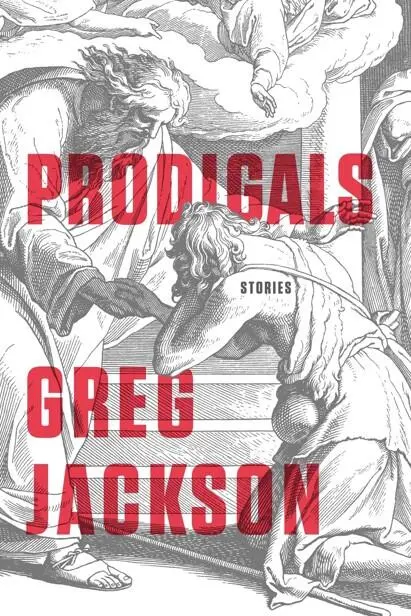
- Название:Prodigals: Stories
- Автор:
- Издательство:Farrar, Straus and Giroux
- Жанр:
- Год:2016
- ISBN:нет данных
- Рейтинг книги:4 / 5. Голосов: 1
-
Избранное:Добавить в избранное
- Отзывы:
-
Ваша оценка:
Prodigals: Stories: краткое содержание, описание и аннотация
Предлагаем к чтению аннотацию, описание, краткое содержание или предисловие (зависит от того, что написал сам автор книги «Prodigals: Stories»). Если вы не нашли необходимую информацию о книге — напишите в комментариях, мы постараемся отыскать её.
A filmmaker escapes New York, accompanied by a woman who may be his therapist, as a violent storm bears down. A lawyer in the throes of divorce seeks refuge at her seaside cottage only to find a vagrant girl living in it. A dilettantish banker sees his ambitions laid bare when he comes under the influence of two strange sisters. A group of friends gathers in the California desert for one last bacchanal, and a journalist finds his visit to the French country home of a former tennis star taking a deeply unnerving turn.
Strivers, misfits, and children of privilege, the restless, sympathetic characters in Jackson's astonishing debut hew to passion and perversity through life's tempests. Theirs is a quest for meaning and authenticity in lives spoiled by self-knowledge and haunted by spiritual longing. Lyrical and unflinching, cerebral and surreal,
maps the degradations of contemporary life with insight and grace, from the comedy of our foibles, to the granular dignity of experience, to the pathos of our yearning for home.
Prodigals: Stories — читать онлайн бесплатно полную книгу (весь текст) целиком
Ниже представлен текст книги, разбитый по страницам. Система сохранения места последней прочитанной страницы, позволяет с удобством читать онлайн бесплатно книгу «Prodigals: Stories», без необходимости каждый раз заново искать на чём Вы остановились. Поставьте закладку, и сможете в любой момент перейти на страницу, на которой закончили чтение.
Интервал:
Закладка:
I sit with my grandfather in the morning. The day is chilly, with dark gray clouds portending to the southwest. My grandfather wears a baseball cap and a windbreaker over his sweater. There is no discerning a body beneath the clothes.
“When we sailed…” It takes him time to get his sentences out. “Sometimes the propeller got … tangled … on seaweed, you know … and I’d — I’d dive down with a knife…”
“Yes,” I say, “and you’d cut the propeller free.”
He nods. “That’s right.”
I’ve heard these stories many times before. He had an Aqua-Lung aboard the boat, which he used for difficult jobs. Often, though, he just went in in his underwear with a snorkel and mask, a six-inch pilot knife, down into the frigid waters of a strange harbor while his family roused themselves in the morning haze off the ocean. At least once he got tangled up, unable to break free beneath the boat, and had to dive back down to find the line gripping him and cut it before he drowned. He had nearly died thinking of his family just above him, humming as they prepared breakfast, so close and yet unable to hear him on the far side of that insuperable medium. Things must not be so different for him now. But he hadn’t died that morning, of course, and he hasn’t died still. And I take his choice of topic, in its elliptical way, to mean he understands my foolish plan to go after the anchor, the impulse to pit one’s vitality against death, our heedless pursuit of what is always slipping beneath the surface. The first examples of writing, we are told, are inventories and accounts, records of the stores in granaries, the numbers in herds, trades, payments. Bookkeeping . A desire to keep track of things, to not forget.
I find Ruth in the study staring at an old computer, the monitor of which alone could flatten a corgi, and I knock on the doorframe.
“How do I turn a JPEG into an MP3?” she says.
“Hmm. I don’t think you do.”
“Francesca and Malcolm are coming tonight, you know.”
“Yes.” They are Ruth’s children, my cousins; soon the house will be teeming with the full extant family. Bill, Ruth’s husband, is flying in tomorrow from a work trip in Ireland. All these atoms of diverse energy, divergent lives and convergent genes, called together in these walls to confront the breadth of our mutual and utter incomprehension.
“I need you to take Denise to the ferry,” Ruth says.
“I know, I talked to Denise. For the record, I’m not a big fan of the whole ‘I need you to’ formulation.”
I expect Ruth to give me one of her lead-eyed looks, but her eyes are wide open and her face younger than I can remember it being in a long time. “It’s all just really hard,” she says.
“Do you want to tell me why you guys are still fighting?”
She shakes her head. “We forgot.”
I am stubborn. I have lived long enough to know that. My aunts are stubborn. My grandfather is stubborn. We are a stubborn family; we don’t agree, we disapprove, our esteem is hard to win, our affection hard to lose; our grudges linger even when we say they don’t. And yet, if on the surface the dispute between my aunts and their father drew on those stock issues of family and age, of control and the disposition of things , the deeper grievance, I have to believe, was what it always is — that our children are us and yet not us, that parents turn from gods to men and women at last to children, that in describing our nearest boundary with the world our families also measure the distance, the gulf, and that love always comes with conditions, even if these are only the limits of love.
We can’t forgive one another. To forgive our family would be to forgive the very strangeness of our being.
The sky has darkened and threatens rain as Denise and I wait at the ferry terminal. “You really going out there?” she says.
“I guess so.”
“Jesus. Well, easiest twenty bucks I’ll ever make.”
I ask if she’s going to see her husband and she says, Yup. How is he? Not good, she says, and because there’s nothing else to do she laughs. It looks like he only has weeks left, a month or two at the outside, and she moved here initially for him, for his work and to be near his family. She doesn’t know what’s next for her, where she’ll go. But then it’s the kids she’s really worried about. They’ve run off, disappeared into their young lives. They’re at the age when they’d be leaving anyway, but now they’re crashing cars, taking up with guys too old for them, fleeing to the far coast. It’s too depressing at home, and she’s not around.
“They don’t know what to do. I don’t either.”
What to say? Kids are always running away from home.
“Don’t ever think you’ve run too far to be welcomed back,” she says. “That’s what I’d say to them if I could.”
On our way out to the island the salt water swept up by the wind might as well be incipient rain. I watch Misty’s hair and jacket billow and blow around her, and it reminds me of a concert she and I once saw, the opening act for the band we’d come to see. It was some minor band I’d never heard of. The lead singer, a man with expressive lips and strawberry-blond hair, wore a full white-lace wedding gown and pallid makeup while he performed. The train of the dress swished around him as he danced and sang. He was in no way cool . This was what Misty and I had loved. Somehow you could tell he wasn’t just laughing at himself. It could have been a gimmick and it wasn’t. It was instead a kind of craziness, a kind of love. It was this or nothing — for him it was this or nothing, you could tell. And to writhe in a wedding dress and makeup before a sparse crowd there to see another band, to do this as a grown man, neither an idiot nor a clown, and to do it night after night without rising out of obscurity is the purest sort of conviction and bravery, I believe.
I am the one going in, we’ve decided. Misty and I trade places; she takes the wheel and steers the boat among the shallows by the rocks. I am already freezing in a thick sweatshirt.
“Can you see anything?” she says.
“No, it must be farther out.”
The muddled seabed fades as the water deepens, the submerged rocks fade. The translucent olive water interposes itself like rippling screens bearing grains of light. After debating for a bit where I should go in we settle on a spot. I strip down to my bathing suit and for a second, standing in the boat, feel like the smallest pebble in an infinite pool, the bay waters in the distance seeming not to meet but to join the sky at some unbroken axis mundi in the smoldering gray.
“I was in the park the other day and I heard these twelve-year-old girls calling each other ‘bro,’” Misty says. “They were like, ‘Chill out, bro.’ ‘Sweet, bro.’ ‘Let me see your phone, bro.’ It was hilarious.”
“At the playground a few weeks ago, I heard this eight-year-old boy yelling, ‘I’m tripping balls!’ Just throwing it out there to no one in particular.”
“We tripped some pretty serious balls when we were kids,” Misty says.
“True,” I say. It is true. “Watch me get hypothermia, bro.”
I dive in.
For the first minute the water grips me like a cryonic gel, glacial, faintly pinguid, then a numbness starts to fill me and bit by bit I lose track of the water and my body until we are one substance slipping through itself. I dive down five, eight feet and turn to see the surface above me as just a lighter shade in the impenetrable haze, the hull of the whaler as white and luminous as a belly, recalling to me, for the first time in years, how I used to look up at my grandfather and my mother as they swam laps above me in the pool, a small, spindly child, ducking below them when they went past, captivated by the currents, the bubbles and roil, at their bodies, the wild, horselike look in their eyes, the oxygenous contrails streaming from their noses, the primal mystery of my connection to them. We can overrate blood, surely, the stepped-up bases of our inheritance, the avarice of our genes, but I want to believe that we preserve the things we love, that we mustn’t glorify what is small, write our eulogies in the stars, or privilege any one scale to say that what befalls one of us befalls us all, or that we ever owe less than our attention.
Читать дальшеИнтервал:
Закладка:
Похожие книги на «Prodigals: Stories»
Представляем Вашему вниманию похожие книги на «Prodigals: Stories» списком для выбора. Мы отобрали схожую по названию и смыслу литературу в надежде предоставить читателям больше вариантов отыскать новые, интересные, ещё непрочитанные произведения.









Обсуждение, отзывы о книге «Prodigals: Stories» и просто собственные мнения читателей. Оставьте ваши комментарии, напишите, что Вы думаете о произведении, его смысле или главных героях. Укажите что конкретно понравилось, а что нет, и почему Вы так считаете.