Arnost Lustig - Lovely Green Eyes
Здесь есть возможность читать онлайн «Arnost Lustig - Lovely Green Eyes» весь текст электронной книги совершенно бесплатно (целиком полную версию без сокращений). В некоторых случаях можно слушать аудио, скачать через торрент в формате fb2 и присутствует краткое содержание. Год выпуска: 2003, Издательство: Arcade Publishing, Жанр: Современная проза, на английском языке. Описание произведения, (предисловие) а так же отзывы посетителей доступны на портале библиотеки ЛибКат.
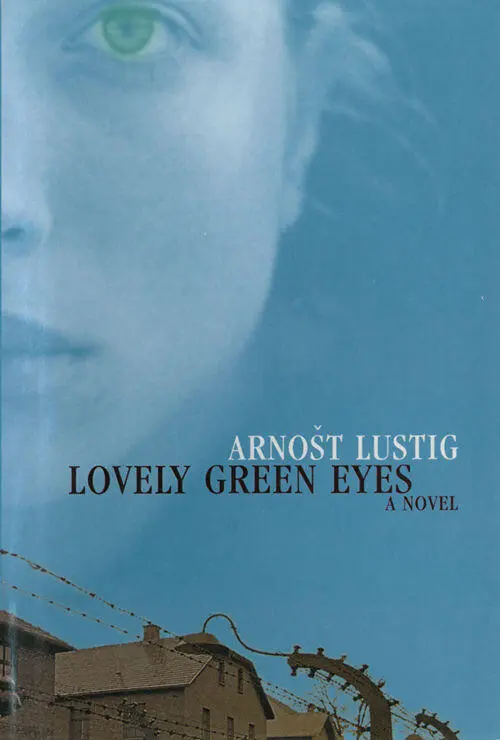
- Название:Lovely Green Eyes
- Автор:
- Издательство:Arcade Publishing
- Жанр:
- Год:2003
- ISBN:нет данных
- Рейтинг книги:4 / 5. Голосов: 1
-
Избранное:Добавить в избранное
- Отзывы:
-
Ваша оценка:
Lovely Green Eyes: краткое содержание, описание и аннотация
Предлагаем к чтению аннотацию, описание, краткое содержание или предисловие (зависит от того, что написал сам автор книги «Lovely Green Eyes»). Если вы не нашли необходимую информацию о книге — напишите в комментариях, мы постараемся отыскать её.
Lovely Green Eyes — читать онлайн бесплатно полную книгу (весь текст) целиком
Ниже представлен текст книги, разбитый по страницам. Система сохранения места последней прочитанной страницы, позволяет с удобством читать онлайн бесплатно книгу «Lovely Green Eyes», без необходимости каждый раз заново искать на чём Вы остановились. Поставьте закладку, и сможете в любой момент перейти на страницу, на которой закончили чтение.
Интервал:
Закладка:
They were sitting facing each other. The rabbi had two large comfortable armchairs. She stretched out her legs in front of her, while he tucked his under his chair.
Could he understand the Oberführer, nicknamed The Frog, if he credited him with a twisted brain? With sick ideas? If he likened him to a pig?
“We are like a stone in the swamp,” the rabbi said.
She did indeed feel a little like that.
“It was confusion,” the rabbi said next. “Evil pretended to be good, the filthy disguised itself as clean. Sickness was proclaimed health and the plague was pronounced fresh air. The decayed pretended to be fresh. The low acted as if it were exalted, stupidity as if it were wisdom. It’s all behind you now.”
The word “decay” recurred in the rabbi’s conversation every day. At night he dreamed of it.
“I could not be a just judge, even if I wanted to be.”
“Nor could I,” she agreed.
“No-one like you could.”
“Probably not.”
An understanding grew between them. The rabbi was her confessor and her mirror. She could identify with much of what he said, even though he spoke little. She enjoyed the fact that she didn’t have to watch every word or control her slightest movement.
“At first I didn’t know what was happening. In Terezin we were living almost normally — it was a transit station. But even in the east, at Auschwitz-Birkenau, I knew only a part of what was going on. No-one knew, except the girls they brought in for clerical duties in the Gestapo offices. They gassed these girls, after no more than six weeks, and then brought in new ones. But eventually I got to know. I felt as if I was in a camp in myself. Everyone who was there must have felt the same way. They left us together, but so that we were alone, separated from one another. I felt that I was surrounded by high-voltage wires, as though I was the last person on earth. And if it was a hill, then I stayed at the bottom. I didn’t need a panoramic view, I knew what was waiting for me. Those around me went to the gas chamber, one after another. Sometimes there was a short delay, but all of them in the end. Everything was temporary. There was only the now and the past, nothing that was yet to come.”
“… on our knees,” said the rabbi.
He asked himself whether the soul can refuse something which the body cannot refuse but must accept. In his mind he visited the place Skinny had described for him. He had never been in a brothel and regarded it as a place where men dropped their commitments. He knew what was written in the old books about Sodom and Gomorrah. Now Sodom had acquired a new name — Auschwitz-Birkenau, Feldbordell No. 232 Ost, Germany, Europe. It occurred to him that the Bible should be amplified by what people like Skinny brought back from the camps. Hadn’t the Bible been written by people not much older than Skinny? By ploughmen, carpenters and tanners, after the day’s work that was their livelihood? From the experiences they gathered, which did not lose their significance even after 2,000 years?
Yes, the line between good and evil, between the appropriate and the false, has been blurred, he thought. The boundaries have ceased to be clear. There is a long way from yes to no, and the end is not in sight.
He did not speak of the Ten Commandments, because he no longer considered them as all-embracing and all-applying, as the sum total of all that is under the stars, of what is allowed and what is forbidden, what one ought or ought not to do. He discovered the power and the curse of imagination. An inner voice told him that he could trust it. A terrible, sinful thought struck him: was there still a God, and if there was, was he not perhaps powerless?
As they sat in the twilight of the first of those ten days she spent at his house, Rabbi Schapiro said: “I would like to be in your place.”
“You wouldn’t,” she replied.
“We were living in a pagan world,” the rabbi whispered, but so that at least he could hear himself. “They had their personal god, their golden calf, their degenerate idea. They wanted to have and proclaim their hoarfrost giants as in their ancient times, and they found one. Their giant of evil.”
They both knew who he meant. He avoided uttering the name of the man he regarded as the personification of evil, the evil from which the devil arose; as the sum total and quintessence of all time, looking both back and forward, whose spirit continued to move through light and shade, noise and silence, enveloping them like a dark, invisible but perceptible cloud. Who would in future remember his date of birth in the quiet little Austrian town, feel sorry for his mother and his unknown father, and bless the accident that he had no children?
He saw evil producing the germs of further evil, as when a fire flares up and its sparks light new fires on all sides; a huge conflagration engulfing the whole world. He saw the face of the man with a small moustache, as he had appeared on countless pictures and postage stamps, in school books and newspapers, on posters at every street corner, in the windows of zealous champions of his ideas, a man with a shock of dark hair, with burning eyes almost screaming from their sockets. For a long while the rabbi kept his eyes closed, his eyelids marked by fine blue and blood-red veins, the lids purple from lack of sleep, from anxiety and fatigue, from the burden of evil.
He felt that evil had settled in him and on him, like sweat and dirt from an exhausting journey to a destination he had not yet reached and perhaps never would. The journey of Skinny, Hanka Kaudersovâ, in that coal-tender to Pecs in Hungary was only one part.
He didn’t have to disprove to himself that life was an obscure journey from birth to death, one on which only a handful of the chosen started out, travelled, and departed with dignity. Not many could keep their dignity while journeying. And so he looked at the girl from the army brothel, now in his house, as though through a window onto something he hadn’t seen before or perhaps even known existed.
Where were those good people, those strong people, those who knew what evil was when it was still in the bud? What questions will their children and their children’s children ask them some day? What will they ask those who did not know? The rabbi put this question to the void.
“Where were those who saw what was happening and closed their eyes to it? Who did not even open them when they woke up? What were they doing?”
No answer came back to him from the void, because the void does not even produce an echo. The rabbi thought of the unforgettable parables and elucidation of the Old Testament he had once admired so much, of the innumerable writings, the records of oral tradition, the wisdom of the wisest rabbis, the proverbs of Solomon, the songs of the Biblical poets, the clarity, clear-sightedness and power of truth uttered, come what may, regardless of those in power, by the prophets. That which transcended time and place with deceptive general validity, a boundless and universal validity.
In his mind’s eye he saw a goshawk flying over a field, diving down, from an enormous height that gave it a view far and wide, onto a small fieldmouse which had no idea of what threatened it until it was too late, until it was in the claws of the bird of prey. He could hear the rush of the bird’s wings and the squeak of the little mouse.
“Will all those with a conscience now have a hole in their soul?” the rabbi asked in a whisper. “Is modesty still a virtue or is it the false sister of excuse for those I know and do not know, and also for myself, if it relates to what cannot be explained, to what I do not attempt to explain?”
Skinny didn’t reply. She was digesting an ample midday meal after an even more ample dinner the previous evening.
Читать дальшеИнтервал:
Закладка:
Похожие книги на «Lovely Green Eyes»
Представляем Вашему вниманию похожие книги на «Lovely Green Eyes» списком для выбора. Мы отобрали схожую по названию и смыслу литературу в надежде предоставить читателям больше вариантов отыскать новые, интересные, ещё непрочитанные произведения.
![Корнелл Вулрич - Eyes That Watch You [= The Case of the Talking Eyes]](/books/32103/kornell-vulrich-eyes-that-watch-you-the-case-of-thumb.webp)








Обсуждение, отзывы о книге «Lovely Green Eyes» и просто собственные мнения читателей. Оставьте ваши комментарии, напишите, что Вы думаете о произведении, его смысле или главных героях. Укажите что конкретно понравилось, а что нет, и почему Вы так считаете.