Arnost Lustig - Lovely Green Eyes
Здесь есть возможность читать онлайн «Arnost Lustig - Lovely Green Eyes» весь текст электронной книги совершенно бесплатно (целиком полную версию без сокращений). В некоторых случаях можно слушать аудио, скачать через торрент в формате fb2 и присутствует краткое содержание. Год выпуска: 2003, Издательство: Arcade Publishing, Жанр: Современная проза, на английском языке. Описание произведения, (предисловие) а так же отзывы посетителей доступны на портале библиотеки ЛибКат.
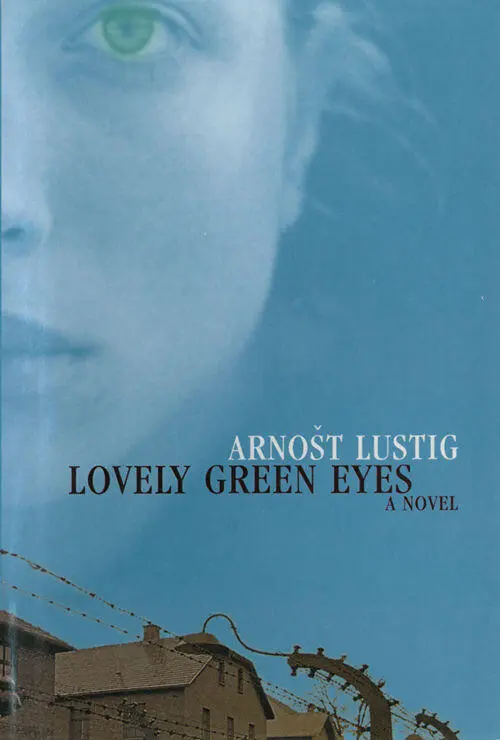
- Название:Lovely Green Eyes
- Автор:
- Издательство:Arcade Publishing
- Жанр:
- Год:2003
- ISBN:нет данных
- Рейтинг книги:4 / 5. Голосов: 1
-
Избранное:Добавить в избранное
- Отзывы:
-
Ваша оценка:
Lovely Green Eyes: краткое содержание, описание и аннотация
Предлагаем к чтению аннотацию, описание, краткое содержание или предисловие (зависит от того, что написал сам автор книги «Lovely Green Eyes»). Если вы не нашли необходимую информацию о книге — напишите в комментариях, мы постараемся отыскать её.
Lovely Green Eyes — читать онлайн бесплатно полную книгу (весь текст) целиком
Ниже представлен текст книги, разбитый по страницам. Система сохранения места последней прочитанной страницы, позволяет с удобством читать онлайн бесплатно книгу «Lovely Green Eyes», без необходимости каждый раз заново искать на чём Вы остановились. Поставьте закладку, и сможете в любой момент перейти на страницу, на которой закончили чтение.
Интервал:
Закладка:
On his forehead, at the corners of his eyes and his mouth, wrinkles had appeared which had not been there when she arrived, even though his own life in hiding could not have been without anxiety. His voice had gone deeper, hoarser and more excited. He looked at her with his head lowered as if each day he were seeing her for the first time.
She confided in the rabbi, but she did not complain. She was guided by Madam Kulikowa’s advice, perhaps more so than she would have liked. The Madam had taught her that anyone running herself down makes a mistake, anyone apologizing accuses herself at the same time. She was guided by a self-preserving principle, which told her when to draw the line. She did not want the rabbi to feel sorry for her. She spoke more of the other girls than of herself.
“What happened to you is what happened to all who were there,” the rabbi said.
“It did not happen to everyone.”
“You did what you had to.”
“Maybe.”
“We’ve got to live.”
“My father threw himself against the electric fence.”
“And your mother?”
“I think that they killed my mother.”
“As they killed your brother?”
“Yes.”
“They didn’t kill you.”
“I don’t know. Humiliating is like killing,” she replied.
“You were close to it.”
In the end the rabbi said: “I don’t want to blaspheme.” He was gripped by revulsion. He closed his eyes for three seconds. Perhaps he was praying. He had to pray for 15-year-olds who claimed to be 18. For a God who kept silent. He conceived a prayer which as yet had no text.
“If I asked you whether you’ve brought back something good from there, would you think I’d gone mad?”
“I would have told you myself: I’m no longer letting anything surprise me.”
He was startled by the marter-of-factness with which she had armed herself. Why had God chosen her for the right side on the railway ramp? To be one of 30 army whores? Did He breathe that defiance into her which she had clung to tooth and nail, not allowing herself to die?
“Perhaps,” he said.
“Perhaps what?” she asked.
“God is in you.”
The rabbi’s forehead was like the rucked carpet under his chair. His cheekbones protruded, covered only by thin skin. From Skinny’s green eyes sins were looking out at him, legends as old as man, smaller than history and deeper than memory.
On the tenth day she was afraid he might really go mad.
She regretted that she had told him how, on that first Friday, a soldier had planted his body on hers.
*
Rabbi Schapiro knew of children who had knocked at the door of Hungarian people they had never set eyes on, and these people had given them a hiding place. Those were the unknown, the self-effacing, who softened the face of the Christian world.
“No-one is without a face,” he said.
“No,” she agreed.
She remembered Obersturmführer Stefan Sarazin of the Waffen-SS, the longest serving member of Einsatzgruppe D, who loved to shoot rabbis. For him, one murdered rabbi was like ten murdered Jews. He had shown her a photograph of the unit in which he’d first served. It was like a school photograph, the boys still wet behind their ears, barely unleashed from their mothers’ apron strings. They belonged to one of four detachments of Einsatzgruppe D, which, together with Einsatzgruppen A, B and C, had in the course of one year, during their advance from the Oder to the Dnieper and Volga, murdered more than a million people.
Skinny and the rabbi could supplement this picture with photographs taken by the Allies that they’d seen, of the pits, filled with the bodies of people who, before their execution, had had to take off their clothes. Unforgettable scenes, of tumbled, waxwork-like bodies.
To Obersturmführer Sarazin death meant an intertwined mass of bodies whose approximate number he would record, with the help ofhis book-keeping corporal, and after affixing the unit’s seal, forward to Berlin, along with a crate packed with his victims’ belongings.
The Obersturmführer had told her: “We are a new culture.” They wished to have nothing to do with what had gone before.
The 17-year-olds from her transport had been made to run under a rope strung across part of the ramp, as soon as they had arrived. They had no idea what the test was for. The shorter ones, those who didn’t have to duck to get under the rope, like her girl cousin, went straight to the gas chamber.
The hungriest among the others picked up the rats the Hitlerjugend boys had left lying in the mud. Skinny decided not to tell the rabbi — not before supper — what they had eaten.
“What remains good and what is bad?” The rabbi said after a moment.
And then: “What we didn’t see didn’t exist.”
Not for the first time on that tenth day it seemed to her that the rabbi was talking in a confused way.
“Sometimes it’s better not to see,” she said.
“What makes you stronger — seeing or not seeing?”
He didn’t expect an answer from her; or for that matter, from himself. Even so, he felt guilt. Would anyone ever know more? Know the whole mosaic?
She didn’t have to tell him that the most credible testimony could be borne only by the dead, not by those like herself who had survived.
“It began a long time ago,” the rabbi said.
They had been having this kind of conversation every evening before supper, except that he had not been so feverish before. She urged herself to be patient, so that they could finally sit down at the table.
“Do I want from you something that no-one can ever explain to me?”
“It happened every day,” she said.
“You think so?”
“Some things can’t be explained,” she admitted.
Did the rabbi accept her as an adult? “Child,” he had said. That had been his first word to her. She wasn’t sure whether she wanted him to treat her as a child or as an adult.
“There are no words for it,” the rabbi answered.
Yes, so far there were no words for it, he repeated to himself.
Not once had the rabbi used the word prostitution. It had become for him, over the ten days she was with him, a metaphor for something greater than the fate of just one 15-year-old.
“Even the most sacred was desecrated,” he said. “Even the purest was soiled.”
Words, he said to himself. For the second time on that tenth day he felt the misery of the world into which they had been born. The darker side of man. That which was in the words and beyond them. The darkness of silence. That which would remain a secret.
“Words such as life, words such as ruin,” he said.
“Words can be resisted,” she suggested.
“Catastrophe,” he repeated.
“Night, darkness, the void,” he said.
And then, once more in Hebrew, as though it could not be expressed in German or Hungarian: “Shoah.”
It was getting late.
“My heart is turning to stone,” the rabbi said.
“I doubt that,” she objected.
“My feet are turning to stone.”
“You should sit down.”
“I spent years sitting down.”
“I didn’t mean it like that.”
“Neither did I.”
“It’s getting late,” Skinny said.
“We shall have to learn to speak again in order to understand one another.”
Hadn’t Captain Hentschel said something similar to her when she didn’t answer him — that perhaps she was still learning to speak?
“We shall rake our joys together like last year’s dry leaves, those past joys that became memories, and those which we are still looking forward to as a child does to a surprise or a present.”
In his head he heard the Song of Songs. He repeated to himself the proverbs of Solomon, but not one of them seemed right for the moment. And the Psalms seemed flat. He was whispering to himself through barely parted lips, which were dry from thirst and fever.
Читать дальшеИнтервал:
Закладка:
Похожие книги на «Lovely Green Eyes»
Представляем Вашему вниманию похожие книги на «Lovely Green Eyes» списком для выбора. Мы отобрали схожую по названию и смыслу литературу в надежде предоставить читателям больше вариантов отыскать новые, интересные, ещё непрочитанные произведения.

![Корнелл Вулрич - Eyes That Watch You [= The Case of the Talking Eyes]](/books/32103/kornell-vulrich-eyes-that-watch-you-the-case-of-thumb.webp)









Обсуждение, отзывы о книге «Lovely Green Eyes» и просто собственные мнения читателей. Оставьте ваши комментарии, напишите, что Вы думаете о произведении, его смысле или главных героях. Укажите что конкретно понравилось, а что нет, и почему Вы так считаете.