Borislav Pekic - Houses
Здесь есть возможность читать онлайн «Borislav Pekic - Houses» весь текст электронной книги совершенно бесплатно (целиком полную версию без сокращений). В некоторых случаях можно слушать аудио, скачать через торрент в формате fb2 и присутствует краткое содержание. Год выпуска: 2016, Издательство: NYRB Classics, Жанр: Современная проза, на английском языке. Описание произведения, (предисловие) а так же отзывы посетителей доступны на портале библиотеки ЛибКат.
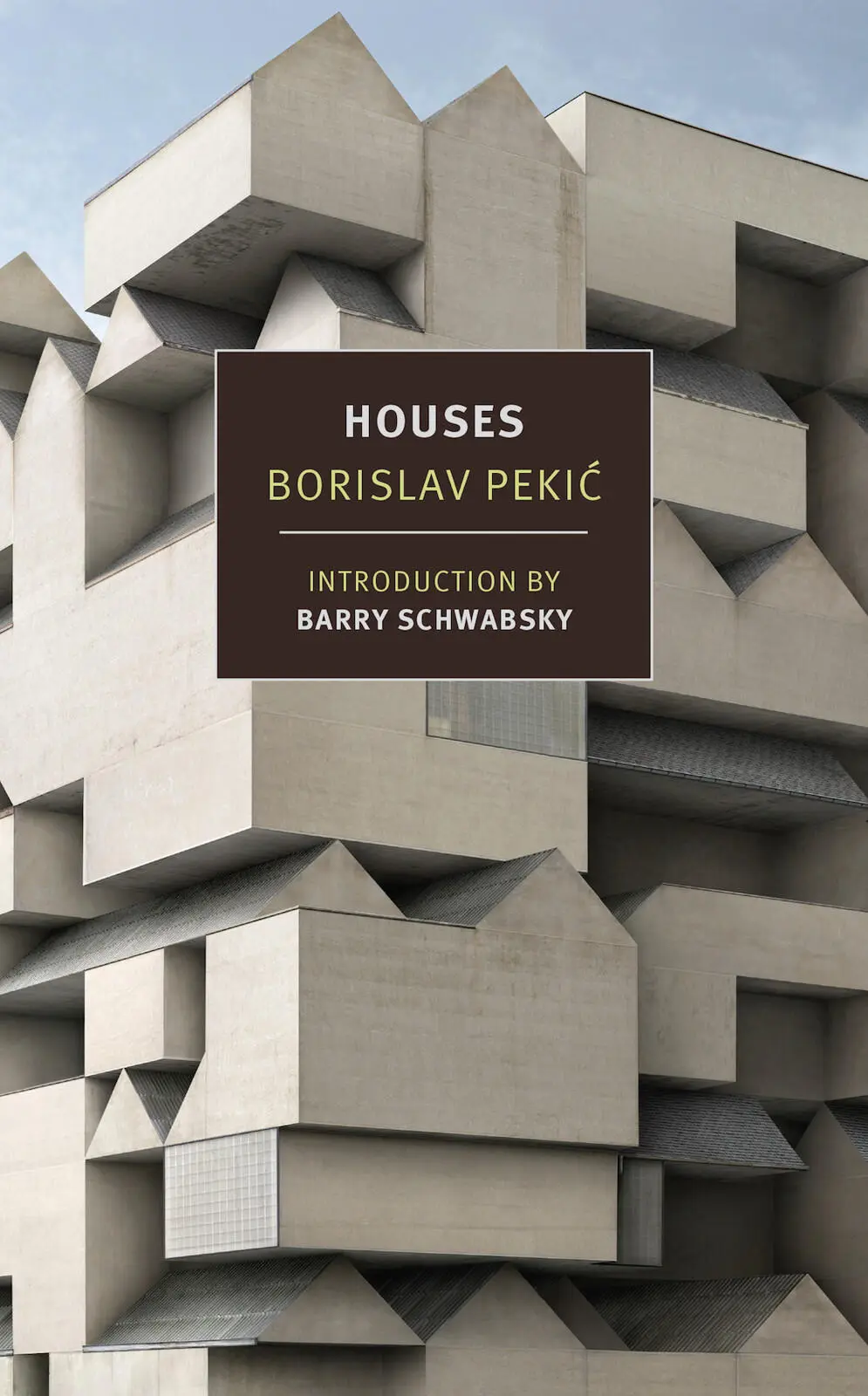
- Название:Houses
- Автор:
- Издательство:NYRB Classics
- Жанр:
- Год:2016
- ISBN:нет данных
- Рейтинг книги:4 / 5. Голосов: 1
-
Избранное:Добавить в избранное
- Отзывы:
-
Ваша оценка:
Houses: краткое содержание, описание и аннотация
Предлагаем к чтению аннотацию, описание, краткое содержание или предисловие (зависит от того, что написал сам автор книги «Houses»). Если вы не нашли необходимую информацию о книге — напишите в комментариях, мы постараемся отыскать её.
Bon vivant, Francophile, visionary, Negoyan spent the first half of his life building houses he loved and even gave names to — Juliana, Christina, Agatha — making his hometown of Belgrade into a modern city to be proud of. The second half of his life, after World War II and the Nazi occupation, he has spent in one of those houses, being looked after by his wife and a nurse, in hiding. Now, on the last day of his life, Negoyan has decided to go out at last to see what he has wrought.
Negoyan is one of the great characters in modern fiction, a charming monster of selfishness and self-delusion. And for all his failings, his life poses a question for the rest of us: Where in the modern world is there a home except in illusion?
Houses — читать онлайн бесплатно полную книгу (весь текст) целиком
Ниже представлен текст книги, разбитый по страницам. Система сохранения места последней прочитанной страницы, позволяет с удобством читать онлайн бесплатно книгу «Houses», без необходимости каждый раз заново искать на чём Вы остановились. Поставьте закладку, и сможете в любой момент перейти на страницу, на которой закончили чтение.
Интервал:
Закладка:
•
Article 4 . I wish to be buried according to the rites of the Serbian Orthodox Church, on the plot of land at the New Cemetery which I bought for that purpose and paid for in a proper and legitimate manner, so that no one else may have the right to be buried in that place, either by right of marriage or any other kinship.
•
Article 5 . I wish that above my grave there be placed a stone of similar proportions to the size of the mound, and that it be constructed by taking from each of my forty-nine houses (including even the one on Gračanička Street), but in no way to the detriment of their appearance, a cornerstone, and that all be harmoniously incorporated into my gravestone so that its composite pieces freely form a pattern, and that on the mosaic thus formed be placed in Cyrillic letters the inscription THE LAST HOUSE OF ARSÉNIE NEGOVAN, PROPERTY OWNER, and beneath the name, engraved in gold, the year of my birth, 1891, and the year of my death, whenever that may be.
•
Article 6 . I further declare that, apart from the ones enumerated above, I have no other needs in death, but desire these my wishes to be carried out just as I have stated and in no other way.
•
And now to describe my unannounced meeting with Simonida. Except for Niké’s absence from Kosmajska Street and what was awaiting me on the other side of the river, it was the misunderstanding with Simonida that caused me the greatest distress. It was for Simonida’s good that I had ignored my heart condition and concealed my going out from Katarina, exposing myself to the mortal danger of illness. In the expectation that the sight of the favorite among my houses would trouble me, I had protected myself with my pills; but it wasn’t like that, far from it. When we actually met, I didn’t feel even the slightest hint of the sudden and overwhelming elation of ownership anticipated. I don’t say, of course, that I looked at her indifferently, as if at someone else’s house, but I didn’t feel her to be my Simonida, I simply didn’t recognize her as the Simonida of my dreams and memories. A huge crane in the garden pointed to the forthcoming destruction. The house itself was not in the best possible condition: Simonida’s façade was crumbling a little, flaking away; the pointing was losing its sharpness, and the rustic brickwork its healthy color of noble stone, the wreath beneath the eaves above the gate had cracked in the center, and its garland had withered and faded, as had the bouquet of stone lilies over the doorway; the iron blooms masking the cellar windows had rusted; and the plaster cast of Saint George, who on the medallion was transfixing a plaster dragon with a plaster lance, had completely lost its detailed relief and its vital strength of the Champion of the Lord.
But all my bitter sadness over Simonida’s deterioration was nothing before the astonishing evidence of my eyes that, entirely without my approval, a square hole had been cut in the fence around the garden and blocked off with a three-paneled iron shutter across which, in black tarred letters and split into syllables, was written GA RA GE. Needless to say, I went over to remove that vile scrawl. Apart from my fragile gloves, I had nothing with which to erase it. Soon I began to pant so hard that I had to go back across the street to a park and find a bench on which to sit and calm myself, and then decide — while never taking my binoculars off of her — what to do for her good.
Only there on the bench, under the blue, reposing shade of the trees — positioned just as if, armed with my binoculars and curiosity beside the west window, I hadn’t left my armchair, I realized that this house was no longer the house which, held in the spell of my uncertain memory and my lawyer’s false photographs, I had imagined her to be. Despite the identical likeness of the exterior, she was not my Simonida, but another building, perhaps another Simonida, perhaps even a building which merited a completely new name. Because of my failure to recognize her, I had a premonition of futility — one that would grow from then on and become even stronger, so that these farewell lines are poisoned with foreboding — a feeling that I shall have explained fully by the end of my testament.
I must also mention that a similar feeling of powerlessness had seized me when faced with the plans of my first house. From a freehand and for my taste slovenly sketch, fingermarked and smudged with erasures, I could hardly get a conception of any house, never mind recognize the one which its overenthusiastic creator warmly commended as mine. But it was my first investment, my baptism as a builder, so I didn’t utter a single one of those harsh observations which later would undermine so cunningly the inventive élan of those experts I hired subsequently. So the house was still a secret for me, carefully concealed under a veil of incomprehensible graphic figures. What she was really going to be like I found out only after her cross sections, basic plans, and frontal views, as well as her estimated costs, had been submitted for my approval, and I had put them together into a single three-dimensional view.
I judged houses as I judge a picture. I sincerely doubt that the whole turned out even as its own creator had imagined it, although on several occasions he tried to assure me that it had. In fact, he could only have surmised what the future house would be like. When the house appeared, it was nothing like the house I had visualized. It was a ponderous sculpture painted in the Greek fashion, before which I stood as before any other finished object, strictly excluded from its being, powerless to pierce the impenetrable surfaces with which it was hermetically sealed off on all sides. Only when I went into the house and wandered among perspectives permeated with the smells of paint and varnish, could I feel her inside me and see her. What I recognized from my first experience was that architecture is a sculpture that is hollowed out , so that man in movement can be situated in the empty space, that immediately afterward this sculpture becomes architecture by virtue of this hollowing out. This is what made of me the property owner that I am.
From then on I was remarkably mistrustful of those elegantly colored graphic representations, those unreal projections of future houses. A plan can never convey the true charm, but only hint at one of the possible realities of a building, while perspectives, despite Brunelleschi, can only timidly indicate an intangible internal territory, but cannot authentically reproduce it as an ordinary human step does, or can only reproduce it wrongly. So even the best drawings say less about a house than a web of transparent human bones from an X-ray image say about a man. Models too express an unreal volume; they could perhaps be successful if their dwarf-sized dimensions weren’t incapable of depicting a building’s spatial reality, which corresponds exclusively to the dimensions of a man.
Perhaps made drowsy by the sultry June air, I fell asleep for a short while. Suddenly I was awakened by the excited shout of a man who after a brief moment of puzzlement I recognized as Tomaž Šomodjija, Simonida’s concierge.
“In God’s name, esteemed Mr. Arsen, what are you doing here?”
If in Simonida’s deterioration I hadn’t detected Šomodjija’s sabotage, and if it hadn’t been my intention to resume control of my affairs, I might have shown a warmer welcome (in any case familiarity was not characteristic of my relations with inferiors) — all the more since this Tomaž or Toma, known as “maestro,” had been one of my first Hausmeisters . But all extenuating considerations had to be set aside, so as to reassert Arsénie Negovan’s authority as an employer. So I overlooked the elation with which Maestro Toma ran up to me, and said with some anger:
Читать дальшеИнтервал:
Закладка:
Похожие книги на «Houses»
Представляем Вашему вниманию похожие книги на «Houses» списком для выбора. Мы отобрали схожую по названию и смыслу литературу в надежде предоставить читателям больше вариантов отыскать новые, интересные, ещё непрочитанные произведения.






Обсуждение, отзывы о книге «Houses» и просто собственные мнения читателей. Оставьте ваши комментарии, напишите, что Вы думаете о произведении, его смысле или главных героях. Укажите что конкретно понравилось, а что нет, и почему Вы так считаете.