Borislav Pekic - Houses
Здесь есть возможность читать онлайн «Borislav Pekic - Houses» весь текст электронной книги совершенно бесплатно (целиком полную версию без сокращений). В некоторых случаях можно слушать аудио, скачать через торрент в формате fb2 и присутствует краткое содержание. Год выпуска: 2016, Издательство: NYRB Classics, Жанр: Современная проза, на английском языке. Описание произведения, (предисловие) а так же отзывы посетителей доступны на портале библиотеки ЛибКат.
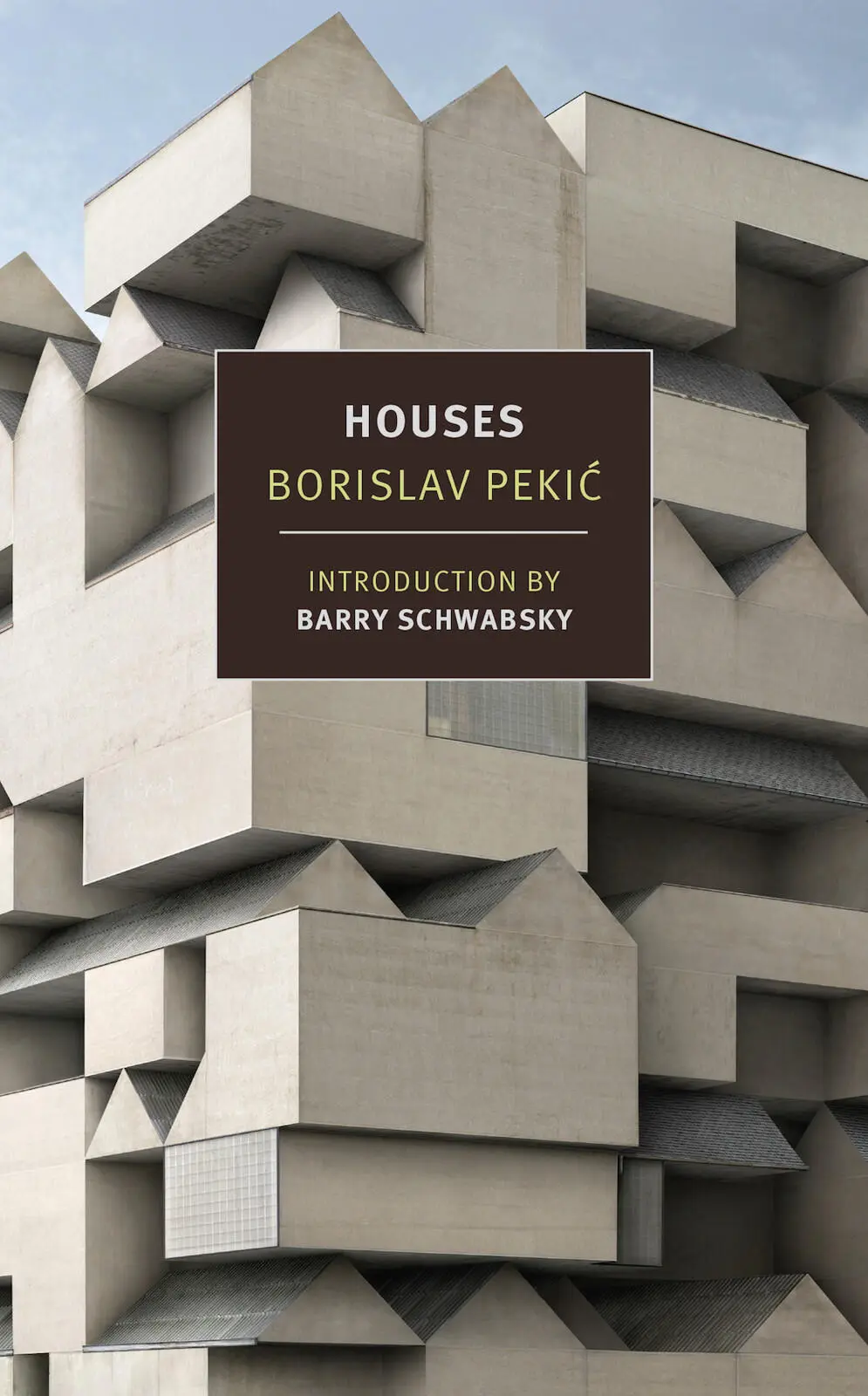
- Название:Houses
- Автор:
- Издательство:NYRB Classics
- Жанр:
- Год:2016
- ISBN:нет данных
- Рейтинг книги:4 / 5. Голосов: 1
-
Избранное:Добавить в избранное
- Отзывы:
-
Ваша оценка:
Houses: краткое содержание, описание и аннотация
Предлагаем к чтению аннотацию, описание, краткое содержание или предисловие (зависит от того, что написал сам автор книги «Houses»). Если вы не нашли необходимую информацию о книге — напишите в комментариях, мы постараемся отыскать её.
Bon vivant, Francophile, visionary, Negoyan spent the first half of his life building houses he loved and even gave names to — Juliana, Christina, Agatha — making his hometown of Belgrade into a modern city to be proud of. The second half of his life, after World War II and the Nazi occupation, he has spent in one of those houses, being looked after by his wife and a nurse, in hiding. Now, on the last day of his life, Negoyan has decided to go out at last to see what he has wrought.
Negoyan is one of the great characters in modern fiction, a charming monster of selfishness and self-delusion. And for all his failings, his life poses a question for the rest of us: Where in the modern world is there a home except in illusion?
Houses — читать онлайн бесплатно полную книгу (весь текст) целиком
Ниже представлен текст книги, разбитый по страницам. Система сохранения места последней прочитанной страницы, позволяет с удобством читать онлайн бесплатно книгу «Houses», без необходимости каждый раз заново искать на чём Вы остановились. Поставьте закладку, и сможете в любой момент перейти на страницу, на которой закончили чтение.
Интервал:
Закладка:
•
We must approach the feud between Emilian Josimović and my grandfather from a somewhat earlier time.
(It’s to him that I address myself, although it had never occurred to me before to write this in the form of a letter. Originally I hadn’t even intended to set down these notes about my sortie into town. I sat down at my desk to write my will. I was incapable of writing it all in one go. I began to make a draft on the backs of old bills and rent receipts, with the intention of writing it out later, sealing it with wax, and stamping the initials of “A.N.” with my signet ring. I shall use this pause to make a change in the legacy for the foundation of the trust fund: I think that the revenue from a single house will be adequate to show my gratitude — most probably, the house on Sveti Sava Street.)
At that time, then, the Turkish quarter still sprawled around the Kalemegdan fortress, which was bordered by the Moat stretching like a Tartar’s bow from the Varoš-Kapija to the Danube. The Serbs built their homes below the Moat; the majority were houses of timber and unbaked bricks or, less often, plastered and whitewashed huts of woven branches with posts supporting roofs of straw or rushes. Then with youthful vigor they began to push their way uphill from the Sava embankment to the Terazije grazing land where, becoming arrogant, they built houses that rose up another story and were roofed with tiles, and that descended underground into largers, storerooms, and cellars: houses built in stone and walled around, and adorned with balconies and belvederes. Among them were the homes of the Negovans. These Negovans stood out, distinguished by a concept of European orderliness; they built up Gospodska and Pop-Pantina Streets (now Brankova and Marshal Biryuzov Streets), letting nothing fall from their grasp. Yet toward the mosques, fountains, bridges, and tumble-down alleyways and passages of the Turkish quarter, where the buildings of the old Austrian district lay in ruins, they displayed an Oriental impassivity. So it was hardly possible to think of an organized town — a Budapest-like way of life and means of communication — while in the upper and lower towns Asiatic chaos still reigned; each house was put up where and how the owner pleased, obstructing street vistas, cramping façades, and improving heights.
In 1864, with the financial support of Simeon Negovan, and probably at his suggestion, Emilian Josimović, a teacher at the lyceum and the high school, set about drawing up the first regulatory plan for Belgrade, which he published under the title An Elucidation of the Proposal for the Regularization of the Area of the Town of Belgrade Situated along the Moat. With a Lithograph Plan to Scale 1/3000 . Bearing in mind the lack of technical means with which it was prepared, this work deserved respect, but found none among the population of the town or with the Administration. Josimović proposed that the abandoned Turkish Moat be filled in and the ground rearranged into esplanades and public gardens in seven crescents.
Old man Simeon, my grandfather, supported Emilian Josimović with both his reputation and his purse against the Administration, and against the landowners who feared losses in the proposed indemnification for property lying within the area encompassed by the “regularization.” Of course Emilian didn’t keep secret from Simeon his sketch for the reconstruction of the street network along the Moat, and certainly entrusted to his benefactor, before they were made public, all the changes which he had thought of in the composition of the town. But as early as the geodetic survey stage, Josimović took the opportunity to give a double warning of the danger of speculation in land, whose value would rise or fall for the most part in accordance with the location of the plots vis-à-vis the sketch. The government had bought up scarcely a third of the land from the Turkish expropriates, so that two-thirds were still for sale. Josimović wanted the state to take it all. In this he had Simeon’s support, or so it seemed.
Nevertheless, as is often the case when commerce and science come together in a development project, interests were common but not identical. Quickly it became known that Simeon Negovan, personally or through intermediaries, had bought up the major part of the land along the projected park, exactly that area which Josimović had categorized as of prime value. Simeon had paid a hundred ducats, whereas the valeur en recouvrement of the land was almost a thousand, and a year later the market price rose to three thousand. Breaking off family relations and repudiating his role as godfather (to which their friendship had brought him in the meantime), the now furious architect showered my grandfather with imprecations whose bitter traces, barely hidden by the academic vocabulary, can be recognized even in the Introduction to his An Elucidation of the Proposal for the Regularization of the Area of the Town of Belgrade Situated along the Moat . I consider the reproaches exaggerated, since without Simeon’s support Josimović’s work would certainly not have existed at all. There was much lack of understanding among the townspeople, particularly the landowners, and much indifference in the Administration. Furthermore, an architect’s greatest work must be exclusively in his mind and his heart: Josimović was entirely obsessed with the new Belgrade, and had no wish for anyone to make anything out of it along the way. Given all this, his complaint that he had “suffered so many unfavorable circumstances from all sides ,” which surely refers to Simeon Negovan, is in no way justified, for he didn’t grasp all the favorable circumstances from which he profited, thanks indeed only to Simeon Negovan.
To somehow stop Simeon — not at all out of malice or to serve some higher principle, but to eliminate doubts about secret collusion between them, and therefore to make it impossible for Simeon to profit from this purchase of land — Josimović proposed a law to the government by which the resale of plots of land along the Moat would be forbidden, except to the State and the Municipality, and at the original sale price. To make sure that this law would destroy Simeon’s speculations, Josimović also demanded that the owners of plots of land be obliged to put up buildings on them within a certain time limit, “according to the regulations affecting the place in question.” He calculated that even Simeon didn’t have sufficient resources to build on all the plots simultaneously. However, before it was entirely certain that this regulation would become law, Simeon had erected, practically overnight and as if by magic, a row of shacks and hovels of any material at hand. In the absence of building regulations they could indeed be considered houses, since they had a certain modest resemblance to them. Just how modest that resemblance was can be seen from a description Josimović gave after his final defeat: “The hulk of an old boat, dragged up from the Danube by mules and plastered with clay and caulked with tin plate, was set up like an unsightly pediment in the middle of a plot of land, beneath which, in my lunacy, I had imagined a French park with a patriotic monument, and an ornate pool with graceful water fountains.”
And now of course, although I don’t have the courage to justify my ancestor, I ask myself: if Simeon Negovan hadn’t acted as he did, could Arsénie Negovan, disdaining profit, enjoy today only the beauty of what he possesses? Like it or not, in commercial affairs it often happens that you have to proceed by roundabout routes, defiles, and shortcuts, and resort to measures a more idealistic man would gladly avoid. Commerce is war: merchants must be continually at war in defense of Possession. You are attacked from ambush and you yourself attack from behind; you camouflage your own intentions and spy out those of your enemies; you sound false alarms, sign false truces, and put out false news. In such a commercial war there are no friends; everyone breaks with everyone, everyone plots against everyone, and alliances are unreliable and short-lived.
Читать дальшеИнтервал:
Закладка:
Похожие книги на «Houses»
Представляем Вашему вниманию похожие книги на «Houses» списком для выбора. Мы отобрали схожую по названию и смыслу литературу в надежде предоставить читателям больше вариантов отыскать новые, интересные, ещё непрочитанные произведения.








Обсуждение, отзывы о книге «Houses» и просто собственные мнения читателей. Оставьте ваши комментарии, напишите, что Вы думаете о произведении, его смысле или главных героях. Укажите что конкретно понравилось, а что нет, и почему Вы так считаете.