Borislav Pekic - Houses
Здесь есть возможность читать онлайн «Borislav Pekic - Houses» весь текст электронной книги совершенно бесплатно (целиком полную версию без сокращений). В некоторых случаях можно слушать аудио, скачать через торрент в формате fb2 и присутствует краткое содержание. Год выпуска: 2016, Издательство: NYRB Classics, Жанр: Современная проза, на английском языке. Описание произведения, (предисловие) а так же отзывы посетителей доступны на портале библиотеки ЛибКат.
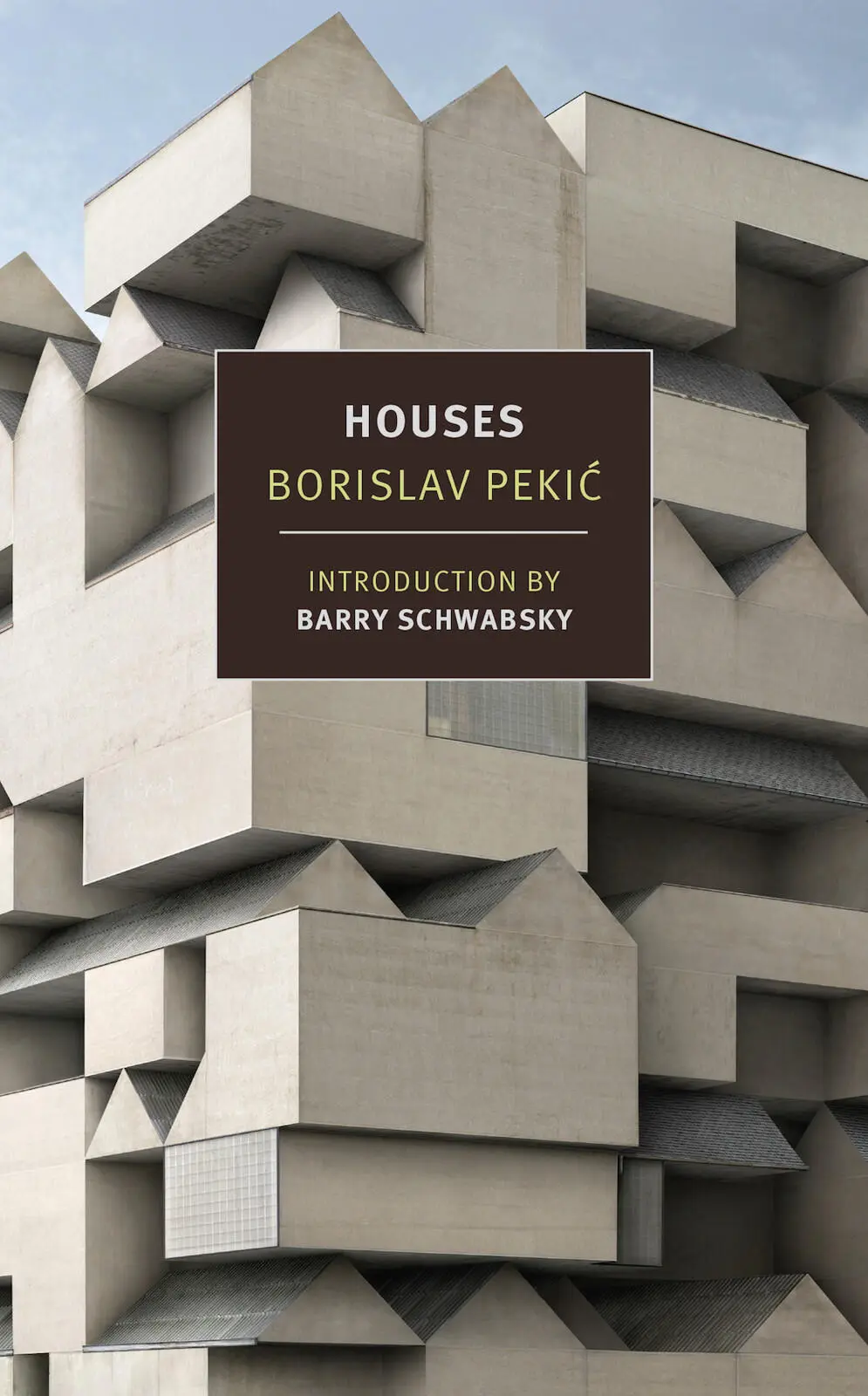
- Название:Houses
- Автор:
- Издательство:NYRB Classics
- Жанр:
- Год:2016
- ISBN:нет данных
- Рейтинг книги:4 / 5. Голосов: 1
-
Избранное:Добавить в избранное
- Отзывы:
-
Ваша оценка:
Houses: краткое содержание, описание и аннотация
Предлагаем к чтению аннотацию, описание, краткое содержание или предисловие (зависит от того, что написал сам автор книги «Houses»). Если вы не нашли необходимую информацию о книге — напишите в комментариях, мы постараемся отыскать её.
Bon vivant, Francophile, visionary, Negoyan spent the first half of his life building houses he loved and even gave names to — Juliana, Christina, Agatha — making his hometown of Belgrade into a modern city to be proud of. The second half of his life, after World War II and the Nazi occupation, he has spent in one of those houses, being looked after by his wife and a nurse, in hiding. Now, on the last day of his life, Negoyan has decided to go out at last to see what he has wrought.
Negoyan is one of the great characters in modern fiction, a charming monster of selfishness and self-delusion. And for all his failings, his life poses a question for the rest of us: Where in the modern world is there a home except in illusion?
Houses — читать онлайн бесплатно полную книгу (весь текст) целиком
Ниже представлен текст книги, разбитый по страницам. Система сохранения места последней прочитанной страницы, позволяет с удобством читать онлайн бесплатно книгу «Houses», без необходимости каждый раз заново искать на чём Вы остановились. Поставьте закладку, и сможете в любой момент перейти на страницу, на которой закончили чтение.
Интервал:
Закладка:
To be honest, all that about the radio and the newspapers was not exactly the truth. For some time we did indeed listen to the radio. Apart from my beloved music, especially if it could be visualized in material terms — I transposed Bach’s fugues into the soaring towers of Gothic cathedrals, Mozart’s concertos into transparent crystal-glass pavilions, and Schubert into family salons looking out onto a garden, but was incapable of making anything of Beethoven (I wasn’t fond of Beethoven, who seemed like a storm, always in unpredictable movement; I couldn’t find a form for him in any building) — apart from my beloved music we listened to the various communiqués from the fronts until, I can’t even remember in what year, the air raids on London began. It was not enough for those monsters to attack houses; now they had started to demolish them as well. I responded by refusing to listen, and then I ordered the radio taken out of the house. As for newspapers, here I was less threatened, for I could pick and choose what I read. They too became preoccupied with the war; when I read of how much damage the Allied bombing had caused to Berlin apartment houses, I gave up all my subscriptions and freed myself of the obligation to suffer because of the insanity in which I had no part.
And so it became the custom not to talk about the war, out of respect for the owner of the house. This deterred George from dropping in, as my brother could think of nothing more useful than battles. Since not even politics, the cause of this destruction, were mentioned, other family friends stayed away who held forth on nothing else.
At first, because of their carelessness, certain events broke through the deadening layer of cork with which I’d lined my study at Kosančićev Venac. Thus I was made aware of food rationing. I learned also about the curfew, though it had little bearing on us except that Katarina had to arrange her Thursday soirée for the early hours of the afternoon. I knew of course that the Croats had proclaimed some sort of independence and liquidated their Serbs, Ličani, and Bosnian Moslems — always unreliable builders, by the way — whose bodies, it was said, were floating down the Sava as far as the piers of the railway bridge. I couldn’t make out a single one with my strongest binoculars, to confirm whether such refugees’ tales were exaggerated. Much was made also of a certain Mihailović (no relation to the gentleman from the basement flat), an infantry officer of the General Staff, who at the head of volunteer peasants was fighting against the Communist rabble which had committed that infamous outrage against me at the junction of Kosmajska and Pop-Lukina Street. By all accounts the Russians had begun to reconquer Russia. And when, on my own misplaced initiative, I learned from Major Helgar that on January 25, 1943, they had entered Voronezh, the vision of merchants thrown on their knees in the mud — the vision which has haunted my footsteps for the last fifty years — was sufficient to confine me to my bed, from where I categorically forbade them to tell me anything more about the war.
This continued right up to the autumn of 1944—with the exception of the comforting news that the Russian onslaught on the Danube had finally been stopped, and the further news that by rapid advances through Italy and Greece the English and Americans were tightening a double pincer around the Balkans. In 1944, with the end drawing near, I couldn’t hold it against Katarina when she informed me that Allied and Yugoslav troops were at the approaches to Belgrade (fortunately nothing more was said of the Bolsheviks); that, judging by the gunfire, their entry into the town could be expected any day, as I observed for myself with my binoculars trained on the street fighting down by the King Alexander Bridge.
It had been said that I had had more good fortune with the Occupation authorities and their civil representatives than other property owners due to my reputation, the name Negovan, and my maintaining relations with them only through my attorney Golovan, who (I must give him his due for that period) had been a forceful representative and faithful interpreter of my owner’s rights. My rigorous retirement, I believe, had saved me from those unpleasantnesses to which even our nearest neighbors on Kosančićev Venac were exposed. Even so, I’m in no way ashamed to declare how elated I was to see the backs of the Germans — and the shuddering rears of their tanks like a praying mantis — crawling over the bridge to the west. My good Katarina was crying — from happiness, of course — and that was the first and last time I ever saw her cry. She was trying hard to get me away from the window, from which, quite forgetting myself, I was loudly encouraging our valiant liberators. Even more, I had completely ignored the danger to which, in the street fighting, they were quite involuntarily subjecting my houses, those same defenseless buildings for which I had so ardently prayed to God during the air raids. And so, close to the window, I wouldn’t give in to Katarina, until I realized that such childish behavior didn’t accord with my dignity, never mind my years, and what’s more could be fatal, because the west window dominated the river, the bridge, and the Sava quays, and could be taken for a command post.
I should make it clear at once that I didn’t follow my father Cyrill or my brother George in their monarchist convictions, even though, of all art forms, architecture had been the most favored by the monarchy. But that day, October 20, whose dawn on the greenish, shaken walls I greeted with all my heart, was not an ordinary one; for me it signified the explosive return to their God-given place of things violently overturned; the restoration of the lawful regime; the re-establishment of security.
With such encouraging prospects in view, I could already begin to think of going out of the house. Not at once, of course. Things had to be given time to settle down. My unhappy experience after the first war prompted me toward caution: for quite a few years after the Armistice conditions had been highly irregular. I remember the efforts I had had to make to obtain even the simplest building material, to achieve priority in litigation over building lots in the center of town, and to get bank credits. But in the Twenties I had been young and in a hurry, whereas now I had time to wait and see how the new turnabout would work. After the Unification I hadn’t possessed a single house except the two I had inherited, and they were shared with my brothers George and Emilian (his religious name); after the Liberation I had forty-nine, not counting building plots already purchased, land under option, and sites where work in various stages had been stopped to await better times. Clearly I had no cause to be rash or overbold in going out into town again.
Katarina agreed to this new postponement, although it continued to place on her shoulders the responsibility which we had originally agreed would be only temporary. But in fact, on her initiative, I now began to think of prolonging the status quo for an indefinite period, especially when she picturesquely described to me the pitiful state of the town: “ You , Arsénie,” she said, “you simply couldn’t bear all those ruined buildings!” Yet eventually I would have gone into town if Katarina hadn’t behaved quite as uncompromisingly as on the occasion of my first decision not to go out. She now deterred me from it with the same Turjaški stubbornness she had once used to urge me to go out, and I was thankful that she had at last understood my decision to retire. The change in Katarina’s attitude was probably influenced by the unexpected visit of Dr. Simeonović, according to whom the condition of my heart had sharply deteriorated, so that any kind of movement was precluded. And so, when I asked for newspapers, I was told that the war was still going on, and when Germany capitulated, that the newspapers were still filled with war news, so that it seemed it had never ended. “You can’t find a single page,” said Katarina, “on which there isn’t a photograph of some ruin.”
Читать дальшеИнтервал:
Закладка:
Похожие книги на «Houses»
Представляем Вашему вниманию похожие книги на «Houses» списком для выбора. Мы отобрали схожую по названию и смыслу литературу в надежде предоставить читателям больше вариантов отыскать новые, интересные, ещё непрочитанные произведения.






Обсуждение, отзывы о книге «Houses» и просто собственные мнения читателей. Оставьте ваши комментарии, напишите, что Вы думаете о произведении, его смысле или главных героях. Укажите что конкретно понравилось, а что нет, и почему Вы так считаете.