Borislav Pekic - Houses
Здесь есть возможность читать онлайн «Borislav Pekic - Houses» весь текст электронной книги совершенно бесплатно (целиком полную версию без сокращений). В некоторых случаях можно слушать аудио, скачать через торрент в формате fb2 и присутствует краткое содержание. Год выпуска: 2016, Издательство: NYRB Classics, Жанр: Современная проза, на английском языке. Описание произведения, (предисловие) а так же отзывы посетителей доступны на портале библиотеки ЛибКат.
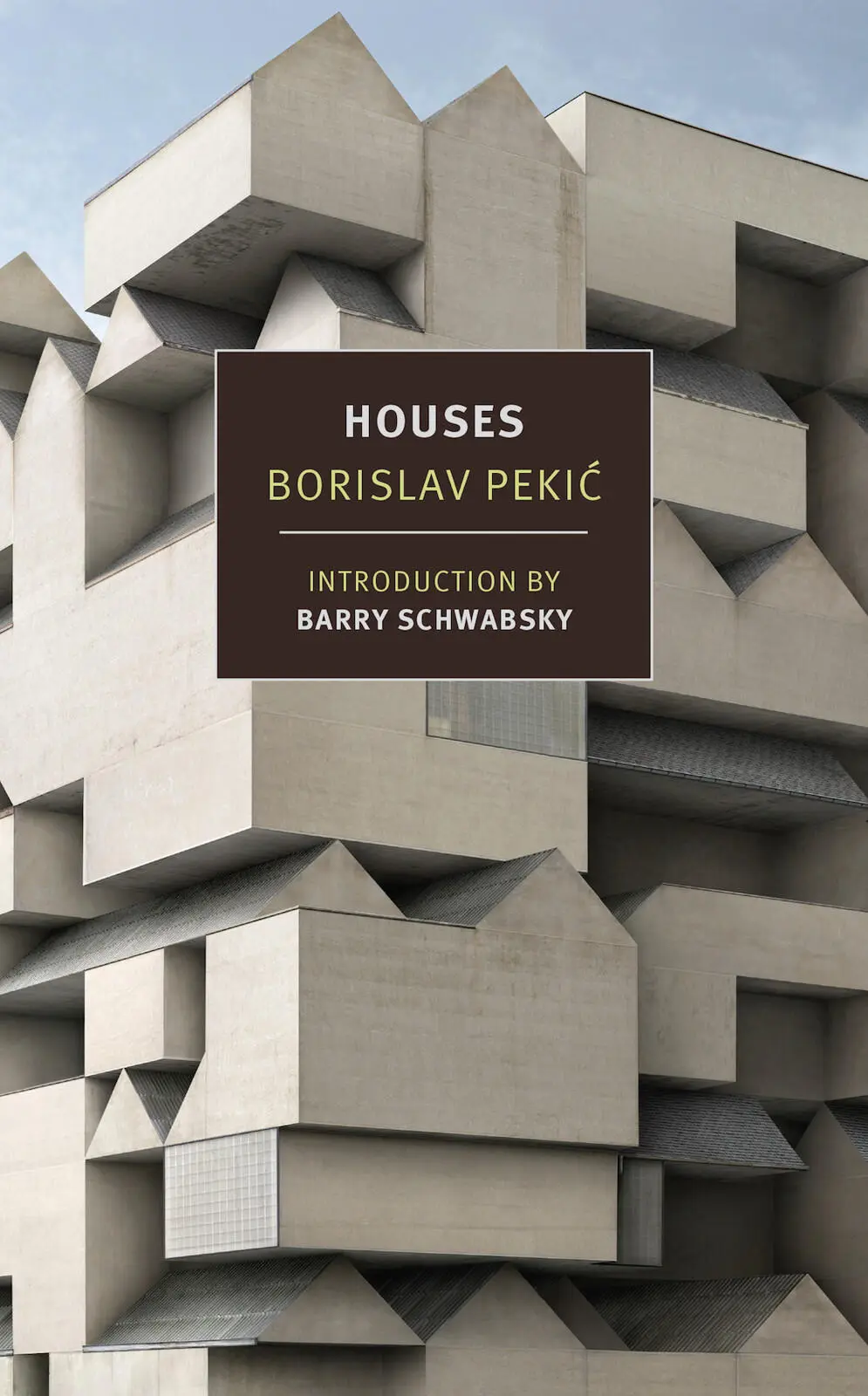
- Название:Houses
- Автор:
- Издательство:NYRB Classics
- Жанр:
- Год:2016
- ISBN:нет данных
- Рейтинг книги:4 / 5. Голосов: 1
-
Избранное:Добавить в избранное
- Отзывы:
-
Ваша оценка:
Houses: краткое содержание, описание и аннотация
Предлагаем к чтению аннотацию, описание, краткое содержание или предисловие (зависит от того, что написал сам автор книги «Houses»). Если вы не нашли необходимую информацию о книге — напишите в комментариях, мы постараемся отыскать её.
Bon vivant, Francophile, visionary, Negoyan spent the first half of his life building houses he loved and even gave names to — Juliana, Christina, Agatha — making his hometown of Belgrade into a modern city to be proud of. The second half of his life, after World War II and the Nazi occupation, he has spent in one of those houses, being looked after by his wife and a nurse, in hiding. Now, on the last day of his life, Negoyan has decided to go out at last to see what he has wrought.
Negoyan is one of the great characters in modern fiction, a charming monster of selfishness and self-delusion. And for all his failings, his life poses a question for the rest of us: Where in the modern world is there a home except in illusion?
Houses — читать онлайн бесплатно полную книгу (весь текст) целиком
Ниже представлен текст книги, разбитый по страницам. Система сохранения места последней прочитанной страницы, позволяет с удобством читать онлайн бесплатно книгу «Houses», без необходимости каждый раз заново искать на чём Вы остановились. Поставьте закладку, и сможете в любой момент перейти на страницу, на которой закончили чтение.
Интервал:
Закладка:
Afterward, when they removed my plaster and replaced it with an elastic lace-up corset such as our mothers used to wear, Katarina told me that for quite some time I had been delirious with a temperature as high as 104 °F., and that in my delirium I had been taking part in an auction of Niké where I was bidding against the strangest rivals: a man called “Hook,” another called “N.N.,” and “Christina.” I easily identified Hook as the war veteran, and N.N. as the speaker who had preceded me at the demonstration; only Christina baffled me. Then it dawned on me that this name stood for the hefty suffragette I was pressed against while we were marching toward Brankova Street.
(Christina, the sister of my architect Jacob Negovan, was a person quite untouched by sanity; although her half-wittedness was known and accepted, it won’t be out of place here for me to note the outward symptoms of her madness. She was a socialist, a left-wing one at that. Furthermore she was a jockey, a suffragette, a bicyclist, a Spanish correspondent in 1937, the first Serbian woman to fly in a balloon, a cellist, and a Trotskyite. She learned Chinese, wore demonstrative black with a red rose on the First of May, and in the fashion of Georges Sand, her spiritual grandmother, smoked with a spindle-shaped ivory cigarette holder like a Turkish pipe. Since I was of course a “reactionary,” she had long ago broken off with me, and had resigned herself to awaiting the World Revolution, a revolution which never came.)
This whole experience — the lynch mob, my injuries, and the misunderstanding over Niké—wouldn’t have been so important, if during my convalescence which went on for, well, almost six months, I hadn’t become preoccupied with refashioning both my business and private life in some new and as yet unconsidered way. There was nothing else for it, Arsénie, you had to adapt yourself to time — I’m not saying submit to it, but come to terms with it. Avoid struggling against its headstrong changes like a mule against the driving harness. All in all, set about something fundamental, one of those lifesaving turnarounds which, according to some higher motivation, had dispersed the sons of the Moskopolje potter, Simeon Nago, to the four corners of the earth, and had subsequently kept their descendants on the sunny surface of life.
The feeling of insecurity was accentuated by the German invaders who during my recovery had stormed the redoubts of our old-fashioned life. Personally, I had nothing against the Germans: given my strained resources, the cessation of building activity came at just the right time. The Germans, it’s true, requisitioned some of my houses, but they kept excellent accounts and paid adequate compensation for what they destroyed. As far as the bombing was concerned, I ascribe all that to their debit, for the first raids were theirs and the subsequent ones were provoked by their presence; but as my lodger, Major Helgar, said: “ Das ist ein Krieg, Herr Negovan! ” Yes, it was war, something subnatural, elemental, which opened up like a crater beneath certain of my houses, to swallow them up and return them to the earth whence they had come.
The Germans too brought changes whose essential nature I strove to fathom, lying in my plaster trough which stank of sweat-soaked, powdered chalk. I strove to fathom all these changes, and Major Bruno Helgar, and Cousin Stefan, and the green man with an iron hook instead of a fist; and N.N., the speaker who proclaimed the Revolution; and the Russian merchants in their overcoats, on their knees; the Solovkino wire with its fivefold noose; Fractura tibiae et fibulae dextre; George’s unwarlike end; Fedor G. Negovan, who used to come see us lowered into our graves; the attempt to demolish my Katarina on Lamartine Street; Agatha’s undermined health; the reason why I wasn’t allowed to give my lecture to the Sisters of Serbia; and Isidor, my Isidor.
And a lot of other things, Isidor, when you look at them soberly were all trifles and nonsense; but every one of those trifles and nonsense was a fresh smear on the lens through which I looked at my town and my fellow citizens, and sometimes even at you, my boy. Filth and dirt had piled up in the space between us, some vile kind of filth. But you mustn’t think that my invalid reflections gave birth to my decision immediately — I was too experienced to give way to those early impulses. Initially they simply nourished my inclination toward the later decision of whose nature, dimension, and scope I had no notion.
And yet, retroactively, the future decision was already in force. My convalescence was progressing, the traces of violence had long disappeared, and my bones had mended, so that I had to think seriously about leaving my bed. The doctors confirmed that any further confinement could lead to dire consequences for my faculty of movement; to restore flexibility to my left leg and suppleness to my body, they prescribed exercises in my room and quiet walks in the fresh air. However, by cunning excuses I postponed getting up, while in the meantime receiving regular reports about my houses from my lawyer Golovan, who had temporarily taken over my office. Thus I delayed getting up until an immediate danger of pneumonia was foreseen if I remained physically inert any longer.
Well and good: I got up and performed the prescribed exercises, but didn’t go out at all — apart, of course, from going to the window, from where I had an excellent view over the delta at the mouth of the Sava, that gray, watery loop in the middle of the Pannonian plain. I supervised Golovan’s activities, but the sad fact is he did not love houses (nor they him); he was merely the representative of my will and passion. Very soon, because of the multiplicity of my affairs, Katarina was obliged to associate herself with him, even though until that time I had always spared her my business worries.
I wouldn’t be telling the whole story if I didn’t report here how much I was tormented by the fear of disrupting that personal relationship, of transforming it into abstract, anonymous figures with which I should have contact only through accounts, receipts, and Golovan’s and Katarina’s reports. Would that not have been similar to banking or, God forbid, stock-exchange transactions, in which numbers — phantom symbols — took the place of houses?
In order that this should not happen, Isidor, I ordered a photographer to prepare enlarged photographs of my houses from various angles — I kept a complete file of the plans, designs, and investment proposals — and I ordered models constructed according to the very best patterns out of ebony and jacaranda. (Use was made, over Katarina’s objections, of some elegant furniture which had belonged to her grandmother Turjaški.)
In this way I perpetuated the appearance of my houses at the very moment I left them. Seemingly left them, of course. In fact, from up there at Kosančićev Venac, as from an observation tower, I continued to watch over them tenderly. I also used photographs to note at quarterly intervals all the changes resulting from external action: atmospheric causes (sunshine, precipitation, frost), and movement or settling of foundations. If the climate caused deterioration, I recognized it in the cracking of the rendering like peeling skin; in the ricketlike appearance of the dried-up woodwork; in the faded pallor of the paint, which withered on the walls like the color of a person gnawed away by a malicious internal disease; in the damp streaks which lined the ceiling like a feverish brow.
At this point I can’t resist the temptation — after all, I’m writing my will — to make note of my personal contribution to building experiments, a contribution which under the name of “Arsénie’s glass” or “Arsénie’s glass leaf” was put into general use. My experts were continually complaining that they had no reliable means of establishing whether a crack was “dead” or “live,” “active” or “inactive”—an important matter, as its origin and therefore its treatment depend upon this: an “active” crack — one that’s getting wider — is caused by constant activity of the ground, which has to be guarded against, whereas an “inactive” crack remains as the result of some past movement, and can simply be filled in and left. But apart from close examination, there was no practical way of determining a crack’s behavior; they simply didn’t know how. Of course I knew even less: I was a property owner, not a builder. But here fortune smiled upon me. Nota bene , something like Isaac Newton and his apple. On several occasions my property owner’s map fell off the wall, for which I could blame neither its modest weight or the tape with which it was fixed. The only thing I noticed was a minute crack which ran crookedly across the paint like a fine wick. The next time, when I threw away the sticky tape and again tried to fasten the map to the wall, I realized that the crack had widened. I concluded that the plaster, paint, and my map were behaving toward the wall very much like skin over flesh, and were being affected by all the changes to which the layer beneath was subjected, just as our skin shrivels and cracks when the muscle beneath it is diseased. It became clear to me at once that quite by chance I had discovered a means of observing the behavior of a crack. The first trial experiment gave excellent results: a thin leaf of glass stuck slantwise across the crevice fell off after only the first week, showing that the crack was getting wider, was active. Despite the expense to which this discovery committed me — the wall had to be reinforced because of the unsound terrain — I was pleased: “Arsénie’s glass” became part of the history of building. But I’m digressing.
Читать дальшеИнтервал:
Закладка:
Похожие книги на «Houses»
Представляем Вашему вниманию похожие книги на «Houses» списком для выбора. Мы отобрали схожую по названию и смыслу литературу в надежде предоставить читателям больше вариантов отыскать новые, интересные, ещё непрочитанные произведения.







Обсуждение, отзывы о книге «Houses» и просто собственные мнения читателей. Оставьте ваши комментарии, напишите, что Вы думаете о произведении, его смысле или главных героях. Укажите что конкретно понравилось, а что нет, и почему Вы так считаете.