Borislav Pekic - Houses
Здесь есть возможность читать онлайн «Borislav Pekic - Houses» весь текст электронной книги совершенно бесплатно (целиком полную версию без сокращений). В некоторых случаях можно слушать аудио, скачать через торрент в формате fb2 и присутствует краткое содержание. Год выпуска: 2016, Издательство: NYRB Classics, Жанр: Современная проза, на английском языке. Описание произведения, (предисловие) а так же отзывы посетителей доступны на портале библиотеки ЛибКат.
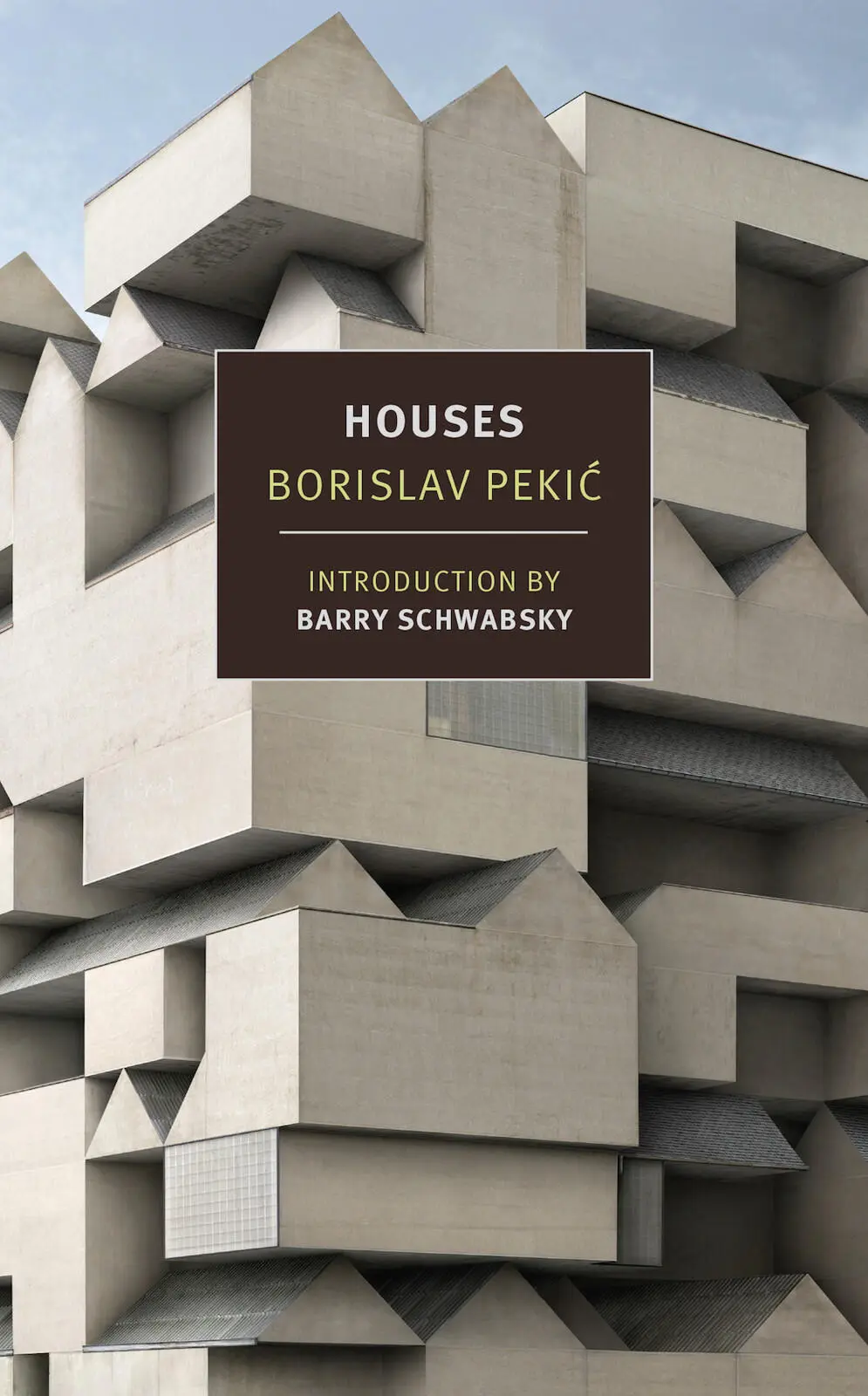
- Название:Houses
- Автор:
- Издательство:NYRB Classics
- Жанр:
- Год:2016
- ISBN:нет данных
- Рейтинг книги:4 / 5. Голосов: 1
-
Избранное:Добавить в избранное
- Отзывы:
-
Ваша оценка:
Houses: краткое содержание, описание и аннотация
Предлагаем к чтению аннотацию, описание, краткое содержание или предисловие (зависит от того, что написал сам автор книги «Houses»). Если вы не нашли необходимую информацию о книге — напишите в комментариях, мы постараемся отыскать её.
Bon vivant, Francophile, visionary, Negoyan spent the first half of his life building houses he loved and even gave names to — Juliana, Christina, Agatha — making his hometown of Belgrade into a modern city to be proud of. The second half of his life, after World War II and the Nazi occupation, he has spent in one of those houses, being looked after by his wife and a nurse, in hiding. Now, on the last day of his life, Negoyan has decided to go out at last to see what he has wrought.
Negoyan is one of the great characters in modern fiction, a charming monster of selfishness and self-delusion. And for all his failings, his life poses a question for the rest of us: Where in the modern world is there a home except in illusion?
Houses — читать онлайн бесплатно полную книгу (весь текст) целиком
Ниже представлен текст книги, разбитый по страницам. Система сохранения места последней прочитанной страницы, позволяет с удобством читать онлайн бесплатно книгу «Houses», без необходимости каждый раз заново искать на чём Вы остановились. Поставьте закладку, и сможете в любой момент перейти на страницу, на которой закончили чтение.
Интервал:
Закладка:
The Martinovići lived in Topličin Venac, and it wasn’t difficult to find them: my memory for houses was infallible. There was no building which I couldn’t describe in detail, especially if it had attracted my attention because of some unusual feature. I could hardly remember Martinović himself, but recalled his house distinctly — most probably because of its color, since it had no other striking feature. It looked in fact as if it had been rubbed with wet ash. And if the house lacked character, this was entirely in keeping with the reputation Martinović enjoyed as a grain dealer in the market place. Now the house was hardly upright on its foundations, it was so run-down. Its paint — still cadaverous but visible — had peeled, as if the walls had been afflicted by some skin disease. The window panes were cracked; the wood was moldering like that of old sea chests. The crooked and rusty drainpipe came down, like a tin intestine, only as far as the ground floor, and ended in a broken stump.
Although Jovan Martinović had never been a house-proud owner in the professional sense of the word — my judgment of him was for that reason more tolerant than otherwise — he was not, even so, capable of such shameful neglect. Its desolate state could only mean that he had moved on, God forbid, gone bankrupt, which would not have entirely surprised me, since against all my warnings he had foolishly involved himself in speculation on the stock exchange. Unfortunately, my worst supposition was confirmed. As soon as the door of the mezzanine floor was opened, and the warm, dark, fishy smell of the entrance hall mingled with the semi-darkness of the stairway which smelled of a cold, unwashed marble ash tray, it became quite apparent that Mr. Martinović had indeed experienced the catastrophe I had foreseen.
Anyway, in the doorway, distorted on the smoky porch, as if from the depths of a dream brought on by an upset stomach, there appeared a strange being, an undulating form swathed in a shaggy bathrobe. Controlling my uneasiness at not knowing who it was I had in front of me, I said that I should like, if possible, to speak with Mr. Jovan Martinović.
“Are you blind or something? It says there clearly: Martinović, two short rings and one long.”
Indeed, on a slip of paper pinned to the doorpost it was written: two short and one long.
“Forgive me. I don’t see too well.”
“Go ahead, Grandpa, you don’t have to explain!”
With these words, the carnival-like being moved aside and banged its fist on the board which had replaced the glass in the inside door.
“Martinović, someone to see you!”
My reception was preceded by a scurrying from the other side of the board-backed door, a hurried scraping as if furniture was being moved. As I waited, it occurred to me that I should have written or at least telephoned before barging in on them. The door at last opened and in its narrow frame appeared a dried-up woman in a dressing gown of loose violet cotton. I recognized her, I admit unashamedly, more from the location than from memory.
Of course I could see it all. I take in everything with a lightninglike glance, whose efficacy comes from communication with houses and was perfected at auctions. The room looked like a refuge in which the Martinovići, burnt-out survivors, had hidden the remains of their devastated possessions: canvas shades through which a greenish dusty light barely settled on the faded, threadbare surface of an office sofa; a table covered with a worn oilcloth; a triple Altdeutsch dresser, which creaked at every step; battered walls from which ribs of wallpaper hung down like dried tobacco leaves; and finally — there in the corner of the room, probably once the kitchen — a Moorish folding screen which in the pale glimmer from the window looked like ice overgrown with wild flowers and briars. I sensed too the bitter smell of stale medicines, musty leather, unaired eiderdowns, decaying clothes, parchmentized documents, and other petty reminders of decay: in a word, the intangible scent of misfortune. My professional experience helped me identify in it that element by which ruin , that final death throe of wasted riches, is distinguished from the smell of innate, inherited poverty — a smell which I had met long ago in the houses I rented out to people in the suburbs until, out of shame and loyalty to my theory of mutual possession, I sold them all without excessive loss and some even at a profit. I was at the very center of the devastation which Speculation had left behind; I was standing on the cold ashes of Possession, which had burned down in the fire of a gambler’s mad rush for easy profits, made on the bitter green baize of the roulette wheel of the stock exchange, in the lackeylike service of the god Mammon. And I felt unspeakably sorry that I had come here at all.
“How could I not remember? You’re Colonel Negovan!”
“You’re thinking of my brother, General Negovan. I concern myself mainly with houses, my dear lady.”
“Oh?” she said suspiciously. “Then you’re not from the Secret Police?”
“I don’t belong to any firm or company, madam. I concern myself with houses, if I may say so, in a special way, on my own account, for the love of it so to speak.”
“We don’t own houses any more.”
“Of course, I understand. Speculation. Gambling on a rise during a fall, a fall before a rise.”
At this Mrs. Martinović, with dismay out of all proportion to the sympathy I expressed, declared that she hadn’t understood a thing about all those speculations; in fact she said her husband hadn’t involved her in his shitty business affairs, in fact she hadn’t found out about them until the trial, and she had nothing more to add to what she’d said earlier under oath.
“I told him to leave all that alone!”
“I told him that too, madam. In any case,” I added cautiously, “I’m certainly far from disagreeing with you. But with your permission I’d still like to discuss this matter with your esteemed husband. If he’s at home, of course.”
Without turning around she pointed over her shoulder at the Moorish screen.
“Where else would he be? Of course he’s at home. He’s over there.”
She then explained that Mr. Martinović had been ill for a long time, was in fact paralyzed and barely alive.
“But he is alive?”
“Barely. His whole left side is gone.”
“I’m sorry to hear that. Truly sorry. With me it was my right side. Does that mean, my dear lady, that there is no way of communicating with him?”
“It depends. I’ll go see.”
She disappeared behind the screen; the cretonne flowers visibly darkened; I heard a scraping noise and saw a metal bedpan disappearing below the bottom edge of the partition like a tortoise beneath its white enamel shell. Then there was the creaking of the bed and mattress, and a hissing sound like escaping gas, followed at intervals by that bubbling, gurgling whistle with which sewage bursts through blocked drainpipes. Finally I could hear Mrs. Martinović:
“That Negovan is here. Do you remember him?”
I couldn’t hear the sick man’s answer so I thought it useful to add: “Arsénie K. Negovan from Kosančićev Venac!”
“Arsénie K. Negovan from Kosančićev Venac!” repeated the woman clearly. It was apparently difficult for the paralyzed man to give any sign of having understood. “He’s here, behind the screen. He says he wants to ask you something.”
When the woman reappeared from behind the screen she was holding the goosenecked bedpan in her hand.
“Try for yourself,” she said sharply, “only don’t move the screen. Bring your chair up. That’s right. He can hear quite well, but it’s difficult for him to speak. Especially when he gets excited.”
Читать дальшеИнтервал:
Закладка:
Похожие книги на «Houses»
Представляем Вашему вниманию похожие книги на «Houses» списком для выбора. Мы отобрали схожую по названию и смыслу литературу в надежде предоставить читателям больше вариантов отыскать новые, интересные, ещё непрочитанные произведения.








Обсуждение, отзывы о книге «Houses» и просто собственные мнения читателей. Оставьте ваши комментарии, напишите, что Вы думаете о произведении, его смысле или главных героях. Укажите что конкретно понравилось, а что нет, и почему Вы так считаете.