Borislav Pekic - Houses
Здесь есть возможность читать онлайн «Borislav Pekic - Houses» весь текст электронной книги совершенно бесплатно (целиком полную версию без сокращений). В некоторых случаях можно слушать аудио, скачать через торрент в формате fb2 и присутствует краткое содержание. Год выпуска: 2016, Издательство: NYRB Classics, Жанр: Современная проза, на английском языке. Описание произведения, (предисловие) а так же отзывы посетителей доступны на портале библиотеки ЛибКат.
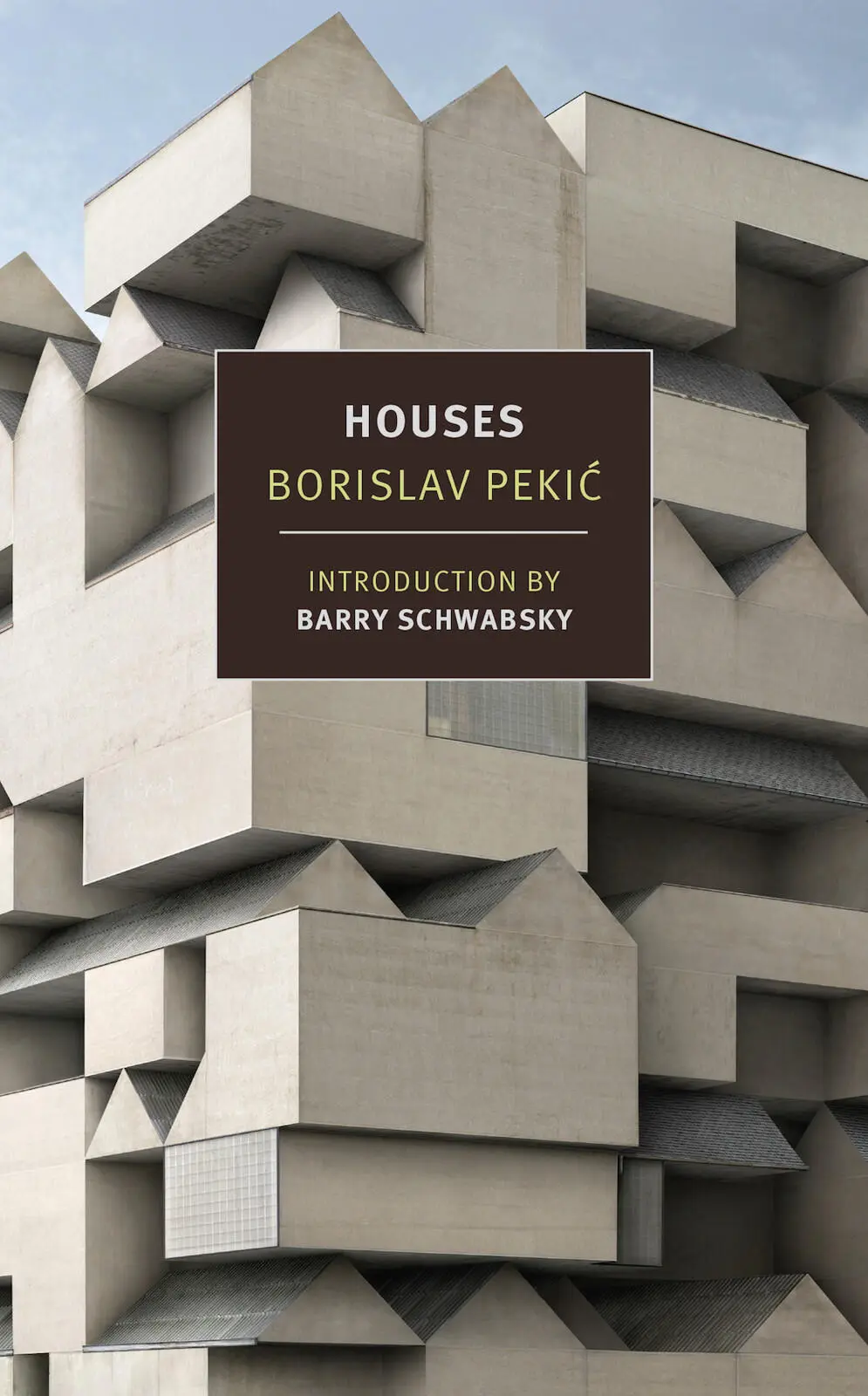
- Название:Houses
- Автор:
- Издательство:NYRB Classics
- Жанр:
- Год:2016
- ISBN:нет данных
- Рейтинг книги:4 / 5. Голосов: 1
-
Избранное:Добавить в избранное
- Отзывы:
-
Ваша оценка:
Houses: краткое содержание, описание и аннотация
Предлагаем к чтению аннотацию, описание, краткое содержание или предисловие (зависит от того, что написал сам автор книги «Houses»). Если вы не нашли необходимую информацию о книге — напишите в комментариях, мы постараемся отыскать её.
Bon vivant, Francophile, visionary, Negoyan spent the first half of his life building houses he loved and even gave names to — Juliana, Christina, Agatha — making his hometown of Belgrade into a modern city to be proud of. The second half of his life, after World War II and the Nazi occupation, he has spent in one of those houses, being looked after by his wife and a nurse, in hiding. Now, on the last day of his life, Negoyan has decided to go out at last to see what he has wrought.
Negoyan is one of the great characters in modern fiction, a charming monster of selfishness and self-delusion. And for all his failings, his life poses a question for the rest of us: Where in the modern world is there a home except in illusion?
Houses — читать онлайн бесплатно полную книгу (весь текст) целиком
Ниже представлен текст книги, разбитый по страницам. Система сохранения места последней прочитанной страницы, позволяет с удобством читать онлайн бесплатно книгу «Houses», без необходимости каждый раз заново искать на чём Вы остановились. Поставьте закладку, и сможете в любой момент перейти на страницу, на которой закончили чтение.
Интервал:
Закладка:
“Shit on your gentlemen!”
“… that the direct system of ownership is being replaced by the indirect…”
“Get rid of that idiot.”
“This is freedom! Anyone can talk!”
“What freedom? It’s a circus!”
“Listen to him!”
The crowd was exhilarated and I had to keep going at all costs. “Whereas once possession was a means of setting up a mutually corrective relationship between material and its produced forms, in the sense that work on material was carried out by the mind” (laughter), “even so it used to be balanced by the reciprocal work which material carried out on the mind” (laughter), “so that we continually had the identification of roles between mind and matter” (loud laughter). “But today the dividing lines have disappeared” (wild laughter, applause), “so that all relationship between owner and what is owned has been lost, and there are people — tycoons who call themselves owners, but don’t in fact know what they own! Bremmer, Brevit, Brickhouse, British Aluminum, British Cotton, British Termo, Broom, Wade, Cable Covers, Allied Brick, Allied Insulators, Allied Textile — what can their owners know of their possessions from the interest rates and fractions which the stock exchange index shows them, or from the mathematical symbols in which the banks have drowned our assets?”
To your horror, the painted idol beneath the red sky is leaning forward as if he wants to crawl over the heads toward you. He’s shouting:
“Get rid of that madman!”
You are offended. You protest in the name of ordinary decency. You resist.
“Get rid of him — get him down!”
In such a situation the best thing is to act as if that shameless interruption in no way concerned you, to remain aloof.
“Gentlemen! If the French client could have seen with his own eyes…”
“Aaaahh, down with the speaker!”
“… I repeat, if he could have seen that Louisiana on the basis of whose fatal natural riches Mr. Low from Highland Scotland” (laughter, applause, whistles) “issued his assignats , would any one of them have been deceived or gone bankrupt?”
“He doesn’t even know how to speak Serbian!”
“Down with the imperialist agents!”
“I will pass over the unworthy invective from the gentlemen over there, and as a proof of good faith I will give as a personal example the property owner in personam . I don’t know my Christina or Stephanie through brokers’ valuations, I know them in my heart. And Niké…” (Indignation, acclamation, laughter, whistling.) “I withdraw, I demonstratively withdraw from the platform, I request to be put down!”
“Knock him down!”
“I’ve lost my Borsalino with the black ribbon — first give me back my hat!”
“Fuck your burzalino, fuck your whore of a mother, and fuck you, too!”
That is the last observation which I am reasonably certain was directed at me. Controlling myself, I ask with whom I have the honor, then everything becomes mixed up, troubled, disintegrating in a seething emulsion of colors, movement, and shouting.
“Long live the Communist Party! Down with the Bolsheviks! Slavs, unite! Moscow-Belgrade! God and Justice! Citizens! Comrades! Cattle! Long live the young King! Down with Hitler! Down with Stalin! What a crock of shit! Kill the traitors! Wretched of the world, arise! Moscow ass lickers! Get him! Police, police! Here comes the cavalry!”
Twenty-seven years later, here I am on that same corner, but not flat on the ground. I am standing, as if I had just got up, as if I had spent that unknown time — time deep as a well — in the shallow dusty gutter. I suddenly felt a jerking of my facial muscle, I was seized by Pareze facialis dextri (whenever I woke up that muscle began to quiver), so that at the threshold of Kosmajska Street I had to turn my back on the road and, facing the shining window of the clinic, take the muscle between the thumb and forefinger of my right hand and gently but firmly massage its pliable rubber mass until it calmed down. Only after that internal shuddering had subsided did I venture to look about.
On a dark blue plaque fixed to the lined façade of the clinic, just above eye level, there was written in large white enameled letters: MARSHAL BIRYUZOV STREET.
So they had renamed Kosmajska Street. But who was this Biryuzov? A Russian Czarist officer had once been commander in chief of the Serbian Army, but that was during the reign of Prince Milan Obrenović, and his name was Chernyaev, not Biryuzov; Mikhail Grigoryevich Chernyaev. Moreover, he hadn’t been a marshal but a general, like George. I could recall only one other general. (Budyonny too, of course, came to mind, although it was inconceivable that a royal street could bear the name of that regicide.) That general who had defended Port Arthur against the Japanese — his name was Kuroglatkin — or was it Kurosatkin?
Standing underneath the plaque which shone slantwise in the sun, I tried to think who that marshal could be. Finally I concluded that most probably he was one of those military brains whose operations George considered “infantile” maneuvers based on still more infantile premises, George being convinced that the front lines on both sides were commanded by complete idiots. There was a certain injustice in the fact that all sorts of Biryuzovs were honored in the names of the most eminent streets in the capital, whereas the man who had criticized them could only achieve a gilt inscription on a cemetery cross. And there were the most serious reasons for upbraiding the Town Council in that, on renaming the street, they hadn’t consulted the citizens of the town, not to mention its home owners. On my way to Niké, I concluded that the restoration of the street’s old name was one of the questions I would take up as soon as I had begun to sort out my business affairs.
As I approached No. 41, which was still hidden by the projecting fronts of the houses this side of it, my excitement grew. My reflections on Kleont and his house avec le caractère de Cléont , were only, of course, an excuse for keeping my thoughts away from the forthcoming meeting with Niké, a meeting which without doubt would resemble the sobering encounter of two lovers who, after years without contact, approach each other apprehensively, wondering whether their former passion — which they wish to make eternal — will have withstood the changes both have suffered. Thus I was approaching Niké with a gnawing pain inside me. It wasn’t my fault I hadn’t arrived at the auction, but then again it was, since I’d made that unfortunate speech.
I was so agitated that I again had to stop to calm my facial muscle, that wound-up monster beneath my right cheek whose hot and cold quiverings announced that it was again about to be seized by a convulsive spasm. When I had managed to massage it back into its den, and my lips were no longer jerking as if tied to my forehead with strings, I took the last step. I crossed over the street toward Kleont’s house — to the spot where I would be able to take in Niké at a single glance.
It is impossible for me to describe at one and the same time what I saw and felt at that moment. It seemed to me that in reality I could see nothing at all, that I was inventing everything, so that I should see my Niké just as I had left her, leaning out over her conservatories and balconies, following me with her eyes filled with the violet glow of the sun. But now I couldn’t see her — probably the effect of my self-inflicted punishment was still at work — for over her leveled foundations as over an abandoned grave overgrown with brambles, weeds, and briars, stretched a rectangular square with three internal walls built of stone anthills like the walls of a casemate, a square with paved paths crossing in the form of an X. Nearby were placed groups of two red and two green freshly painted benches. The houses at the rear of the square were blurred, as if, in the same band of colorless horizon, an unsteady camera had taken several pictures of buildings, one on top of the other.
Читать дальшеИнтервал:
Закладка:
Похожие книги на «Houses»
Представляем Вашему вниманию похожие книги на «Houses» списком для выбора. Мы отобрали схожую по названию и смыслу литературу в надежде предоставить читателям больше вариантов отыскать новые, интересные, ещё непрочитанные произведения.





Обсуждение, отзывы о книге «Houses» и просто собственные мнения читателей. Оставьте ваши комментарии, напишите, что Вы думаете о произведении, его смысле или главных героях. Укажите что конкретно понравилось, а что нет, и почему Вы так считаете.