Borislav Pekic - Houses
Здесь есть возможность читать онлайн «Borislav Pekic - Houses» весь текст электронной книги совершенно бесплатно (целиком полную версию без сокращений). В некоторых случаях можно слушать аудио, скачать через торрент в формате fb2 и присутствует краткое содержание. Год выпуска: 2016, Издательство: NYRB Classics, Жанр: Современная проза, на английском языке. Описание произведения, (предисловие) а так же отзывы посетителей доступны на портале библиотеки ЛибКат.
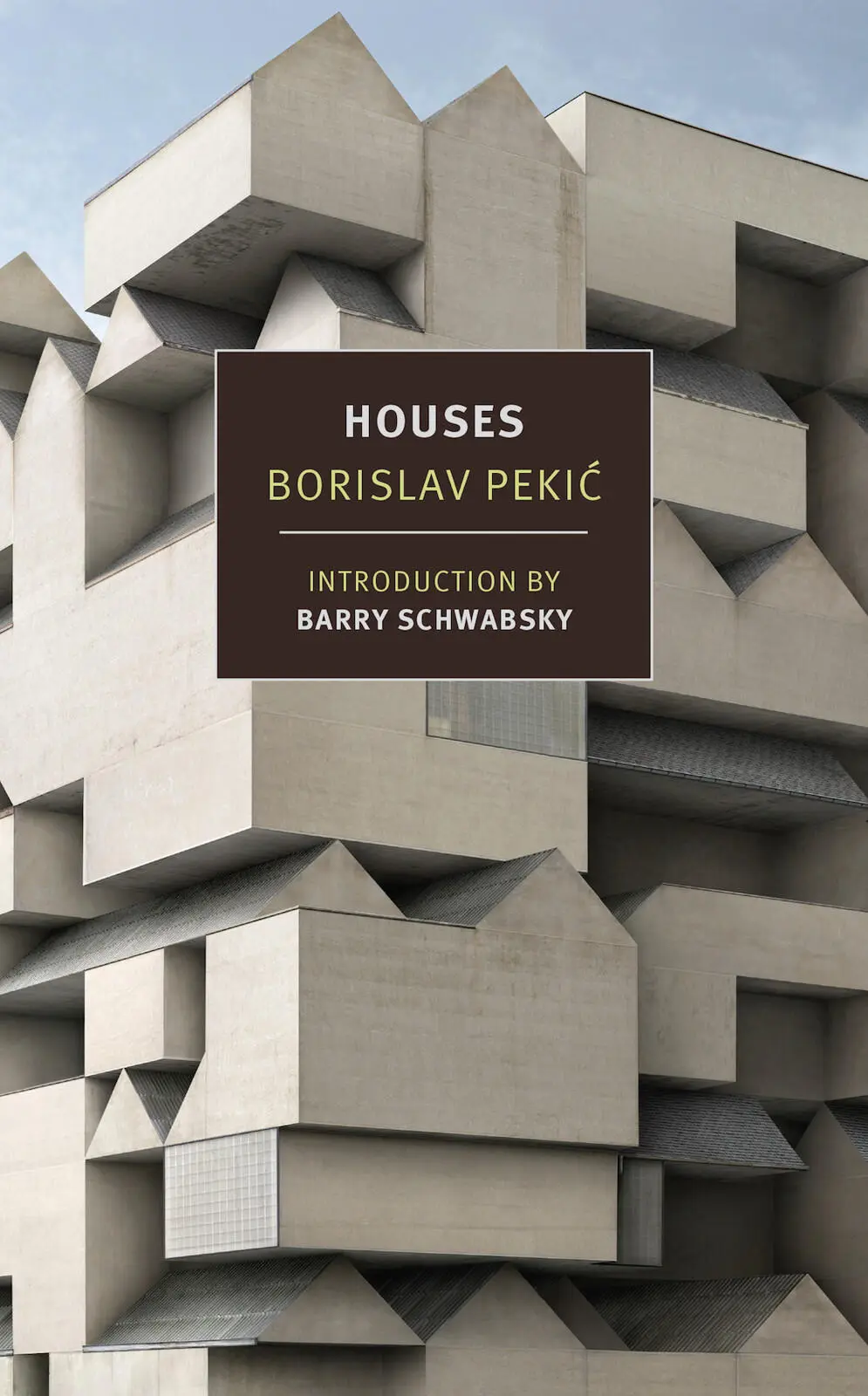
- Название:Houses
- Автор:
- Издательство:NYRB Classics
- Жанр:
- Год:2016
- ISBN:нет данных
- Рейтинг книги:4 / 5. Голосов: 1
-
Избранное:Добавить в избранное
- Отзывы:
-
Ваша оценка:
Houses: краткое содержание, описание и аннотация
Предлагаем к чтению аннотацию, описание, краткое содержание или предисловие (зависит от того, что написал сам автор книги «Houses»). Если вы не нашли необходимую информацию о книге — напишите в комментариях, мы постараемся отыскать её.
Bon vivant, Francophile, visionary, Negoyan spent the first half of his life building houses he loved and even gave names to — Juliana, Christina, Agatha — making his hometown of Belgrade into a modern city to be proud of. The second half of his life, after World War II and the Nazi occupation, he has spent in one of those houses, being looked after by his wife and a nurse, in hiding. Now, on the last day of his life, Negoyan has decided to go out at last to see what he has wrought.
Negoyan is one of the great characters in modern fiction, a charming monster of selfishness and self-delusion. And for all his failings, his life poses a question for the rest of us: Where in the modern world is there a home except in illusion?
Houses — читать онлайн бесплатно полную книгу (весь текст) целиком
Ниже представлен текст книги, разбитый по страницам. Система сохранения места последней прочитанной страницы, позволяет с удобством читать онлайн бесплатно книгу «Houses», без необходимости каждый раз заново искать на чём Вы остановились. Поставьте закладку, и сможете в любой момент перейти на страницу, на которой закончили чтение.
Интервал:
Закладка:
Yes, it was incompatible with that entrenched world between the fortress walls of No. 17 Kosančićev Venac, where everything from the furniture to the people, their thoughts and feelings, their actions and conversations moved, glided noiselessly, like railway cars over permanent, well-oiled rails laid down long ago.
But here in the street everything was unnatural, so that from the beginning I was unaware of what was happening to me and to my attention — if one can term “attention” that blind absorption with extraneous details of the situation: details such as my hat with the fold down the middle of its gray crown, its stiff, upturned brim, and its five centimeters of black silk band; or the semitransparent back of the placard carried in front of me, on which, since I could only read the inscription from behind, I persistently and foolishly scanned the same words: “retteB raw naht eht tcaP, retteb eht evarg naht eb a evals.” My attention was disoriented, not fixed; it seized on every detail that rushed into my nightmarish field of vision, yet I could make no sober assessment of the situation. Furthermore, I had forgotten why I was there, what I was looking for, and why I was tumbling down the street like a stone.
Even so, you mustn’t forget that this experience lasted only a short time.
I don’t know how long it lasted.
It can’t have lasted long because you yourself observed that your rank was moving in a line parallel with the left corner of Kosmajska Street.
Perhaps it was the sight of that corner which brought me to my senses. Arsénie, what are you doing, I thought, they’re waiting for you at Stefan’s. You’re going to an auction! They’re selling Niké. What’s happening to you, for Christ’s sake?
You’d been caught up in a howling dance, that’s what. And as they carried you along arm in arm, they were chanting: “Better war than the Pact, better a grave than be a slave!” And your feet in your lacquered shoes were dangling in the air, hardly touching the ground. You were held by two fat women in suffragette’s black whose biceps, wound around your arms, looked like a crab’s shiny claws tearing their prey apart. The two women were breathing like two balloons overfilled with explosive gas, forcing air out of their lungs and showering you with saliva like frothy gruel.
“Better war than the Pact, better a grave than be a slave!”
I was hatless, and my light summer coat was almost torn off my back. I had to do something.
“My good ladies—”
“War grave, war grave!”
“I beg you—”
“War grave war grave!”
“I believe that all this is quite—”
“Wargravewargravewargravewargrave!”
An extremely undignified situation — I would even say comical — if at the same time it hadn’t all been so pitiful, if I hadn’t been violently pushed, jostled, banged, scratched, pulled, tugged in that wave from whose foaming crest I was dangling like an eggshell battered against a cliff.
I think you said something else to the woman on your left?
The lady had a brigand’s mustache and a voice like a stonecrusher at full blast. She wasn’t a woman! She was a loading crane!
What did you say to her?
That I was sorry but we had to part now, that I was glad to have met her, and that my name was Arsénie Negovan.
I don’t think she was listening.
I told her that it was our last chance to say good-by.
You said that to the one on your right.
It was no longer a woman lurching about there, but a war veteran who had pushed his hook under my elbow so skillfully that my arm felt like a telegraph pole, a pygmy-size telegraph pole along whose miniature iron crosspieces a tiny leather creature was climbing.
“What time is it?”
Yes, I actually asked him what time it was because I couldn’t get my hand down to my vest. He said he didn’t know, but thought Comrade N.N. would start the meeting at any moment.
Meeting! We thought with alarm of Stefan, of Niké, and the auction. And we made one more heroic effort to break out of the onrushing mass, this time without saying anything to anyone.
Meanwhile the ranks of the demonstrators had begun to shudder as if with the sharp jolt of a tender and a railway car connecting, so that my nose was brutally thrust down between someone’s shoulders, while behind me some ponderous being rose up and wrapped its wet, shaggy sleeves around my head. This was the limit: to be kept forcibly in that unruly mass in the street, like a tramp, hatless, with one sleeve half torn and the buttons dangling, my nose buried in a moist, crumpled bit of cloth reeking of tobacco! The very thought of appearing at Stefan’s, in front of Niké, dirty, crumpled, as if I had just crawled out of a heap of rubble — infuriated me.
Suddenly something went wrong. We had stopped on a slope, deprived of that common motion which had allowed some freedom of movement. The concentrated pressure became more unbearable, and the prospects of getting out more remote. It was as if an invisible circular press was working from the walled-in edges of the procession to compact us slowly together, so as to grind us into mincemeat, then squeeze us out into Brankova Street.
The placards had again turned their ashen, daubed faces toward me, and the blood-red banner was again toiling uphill until it stopped high above me and was spread out, its poles rattling, like the purple sky of Theophany, like an open wound in the dark, chilling air. (Made of worn crèpe de chine, it was stiff as a board buffeted by the wind.) Meanwhile the howling had diminished to a dull decrescendo in which, here and there, angry words arose rapidly and subsided into the tired strain of a rumbling chorus melody in which the themes and the instruments that bore them mingled as in some fantastic Concerto Grosso.
And then that head emerged.
Yes, perhaps ten meters from where I was standing, an egg-shaped head, fleshy and purple with cold, extricated itself from the mass. Slowly the man rose like a bather from the sea, with his arms on high, calling for silence.
“Comrades and citizens!”
He took his time to settle his thickset body firmly on the shoulders of his bearers. The war veteran whose hook was tucked under my elbow cried out, “Silence, let’s hear him!” The speaker stood on high above the procession, like a statue at a religious festival, his clenched fists raised toward the sky.
“Down with the butcher Hitler!” “Down with him!” “Long live the Army!” “The Army!” The singing and responses sounded like an open-air church service with several different denominations holding forth at the same time.
“Comrades and citizens, today the peoples of Yugoslavia have washed away a shameful stain from their pure body. The overthrow of the traitorous Prince Paul and his blood-thirsty collaborators is the result of the popular struggle for peace and independence our country has been waging in recent days, days of such crucial importance for the world.”
“Down with the government of traitors!”
“Down with the German hirelings!”
I pulled my watch out of my vest pocket: it was a quarter to seven. The auction had been announced for seven. I hoped that the gathering would spend at least a half hour looking over Niké’s plans and financial records.
“Organized resistance began as far back as 1935…”
In 1935 I bought Agatha and Christina and I was negotiating for Stephanie, but I didn’t finally acquire her until 1940.
“Remember, comrades, our demonstrations for the elections of May 5, for the Civil War in Spain!”
Although my late cousin Constantine, the builder — the only person with whom I could discuss houses properly without being laughed at — was of a different opinion, I myself liked Spanish architecture, especially their plateresque. (I prefer Enrique Egas to the more famous Juan de Herrera anytime, for without that cladding which is considered artificial, these buildings would be indecently bare and ugly.)
Читать дальшеИнтервал:
Закладка:
Похожие книги на «Houses»
Представляем Вашему вниманию похожие книги на «Houses» списком для выбора. Мы отобрали схожую по названию и смыслу литературу в надежде предоставить читателям больше вариантов отыскать новые, интересные, ещё непрочитанные произведения.






Обсуждение, отзывы о книге «Houses» и просто собственные мнения читателей. Оставьте ваши комментарии, напишите, что Вы думаете о произведении, его смысле или главных героях. Укажите что конкретно понравилось, а что нет, и почему Вы так считаете.