Borislav Pekic - Houses
Здесь есть возможность читать онлайн «Borislav Pekic - Houses» весь текст электронной книги совершенно бесплатно (целиком полную версию без сокращений). В некоторых случаях можно слушать аудио, скачать через торрент в формате fb2 и присутствует краткое содержание. Год выпуска: 2016, Издательство: NYRB Classics, Жанр: Современная проза, на английском языке. Описание произведения, (предисловие) а так же отзывы посетителей доступны на портале библиотеки ЛибКат.
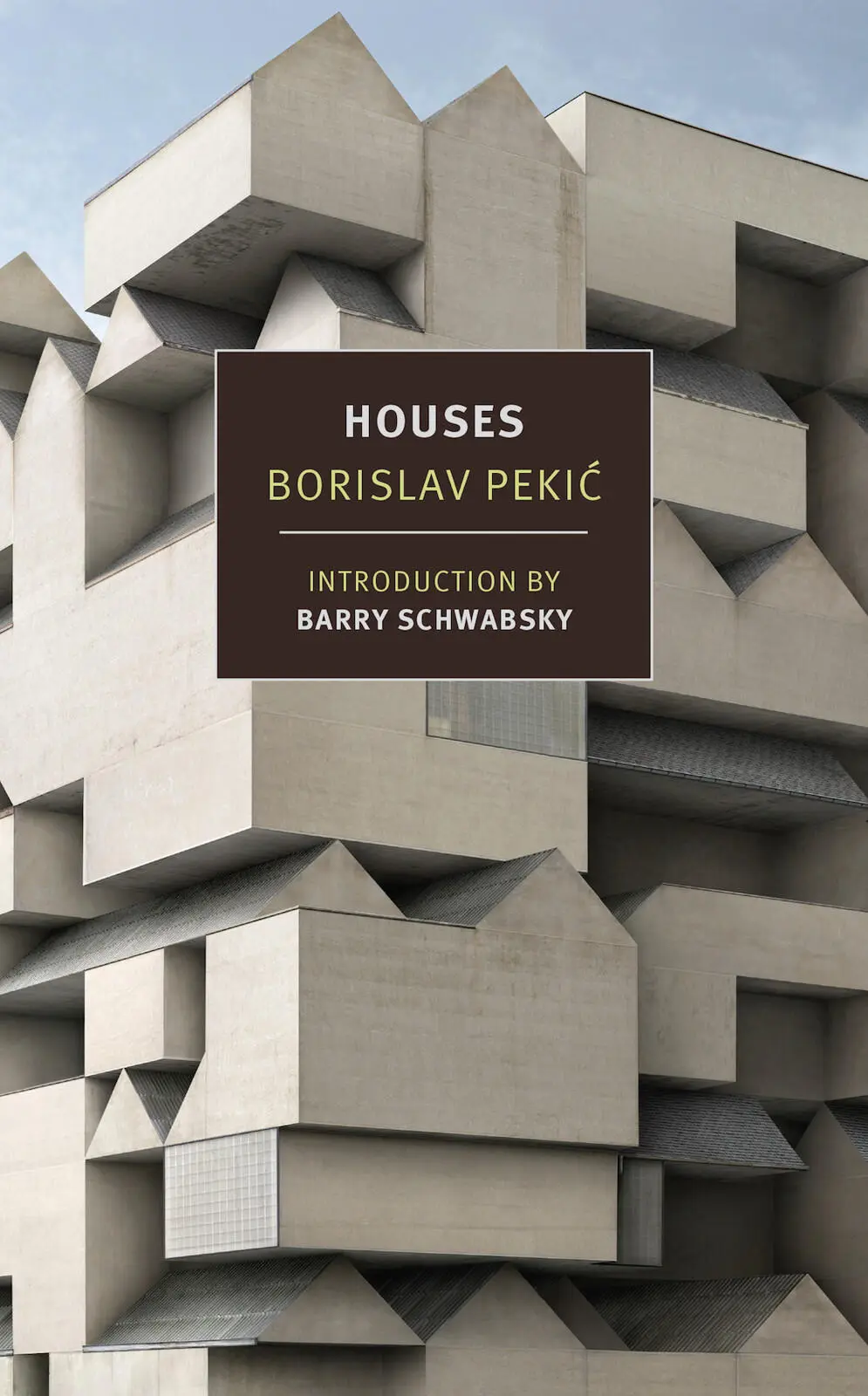
- Название:Houses
- Автор:
- Издательство:NYRB Classics
- Жанр:
- Год:2016
- ISBN:нет данных
- Рейтинг книги:4 / 5. Голосов: 1
-
Избранное:Добавить в избранное
- Отзывы:
-
Ваша оценка:
Houses: краткое содержание, описание и аннотация
Предлагаем к чтению аннотацию, описание, краткое содержание или предисловие (зависит от того, что написал сам автор книги «Houses»). Если вы не нашли необходимую информацию о книге — напишите в комментариях, мы постараемся отыскать её.
Bon vivant, Francophile, visionary, Negoyan spent the first half of his life building houses he loved and even gave names to — Juliana, Christina, Agatha — making his hometown of Belgrade into a modern city to be proud of. The second half of his life, after World War II and the Nazi occupation, he has spent in one of those houses, being looked after by his wife and a nurse, in hiding. Now, on the last day of his life, Negoyan has decided to go out at last to see what he has wrought.
Negoyan is one of the great characters in modern fiction, a charming monster of selfishness and self-delusion. And for all his failings, his life poses a question for the rest of us: Where in the modern world is there a home except in illusion?
Houses — читать онлайн бесплатно полную книгу (весь текст) целиком
Ниже представлен текст книги, разбитый по страницам. Система сохранения места последней прочитанной страницы, позволяет с удобством читать онлайн бесплатно книгу «Houses», без необходимости каждый раз заново искать на чём Вы остановились. Поставьте закладку, и сможете в любой момент перейти на страницу, на которой закончили чтение.
Интервал:
Закладка:
At first it seemed impossible to get through — those creatures were stuck together thick as dough. I reckoned that with luck and a good deal of effort — I was really in good physical condition then — I would need at least two hundred meters of street length to get across by working my way diagonally to the opposite pavement; that meant coming right up against the cordon of police who were closing off Pop-Lukina Street from the Sava side.
But wouldn’t that have been the answer? The police would have let you through: you were a well-known figure, Vice-President of the Chamber of Commerce, the spokesman of our Trade Association. But most of all you were a Negovan, a name which had figured in every cabinet since Unification. They would surely have let you through and given you an armed escort.
There wasn’t any time for explanations.
Is that why you tried to work your way around the procession?
Yes.
But you weren’t successful?
No.
So you went back to the corner of Pop-Lukina and Zadar Streets. What next?
Next? Well, I stepped into the crowd, intending to get across the street.
Into that mob? Surrounded by frenzied people?
What is the point of these superfluous and unseemly details?
Are we carrying out an inquiry or not? Haven’t we decided to discover what kept us locked up there in Kosančićev Venac for so many years with that ivy-framed window facing west? With all those binoculars which could bring the world, defined by the parapet and the oak window frame, so near to us? With Katarina and her sobriety worthy of respect? With the property owner’s map — that work of St. J. Sušić from which the pinheads burgeoned like yellow pollen and sky-blue fruit, alongside the registers and leather folders with the carefully folded cartes d’identité of our houses? With the sided 30 × 30 photographic enlargements and several portraits in oils of the most outstanding of them? How can we find out the truth, if we conceal everything that was unpleasant or humiliating?
Perhaps after this pilgrimage you won’t go back like a disappointed fugitive to Kosančićev Venac and your imprisoning attic. Perhaps you will again conduct your business affairs without an intermediary. Simonida would not be in despair at the threat of pickax and crowbar if you hadn’t retreated — deserted, so to speak. And weren’t you not an hour ago sitting by the west window holding the Mayer to your tired eyes, dreaming of how you would extend your ownership to the other side of the Sava — if you took a liking to it, of course — when you had looked at it from close up?
At the very beginning, after I had cast myself into the mob, nothing particular happened. I stood there, at the spot where the ragged line of the asphalt joins the macadam, while in front of me pressed the galvanized throng. I could hear it breathing like an antediluvian monster flopping over a marsh on its belly, across its tertiary homeland. Most of the placards had been carried past. Now, above the tumult, the demonstrators turned their white, ragged backs toward me; the red banner was bleeding down there like a wound, a purple slash on the clear stone of Brankova Street. I still hesitated, though I knew I’d have to make up my mind quickly. Then suddenly I was sucked into the mass. A dozen or so demonstrators had been forced out by the pressure of the oncoming waves, and had swirled into Zadarska Street, like a crackling stream forced out of some giant tube, and when this group had hurled themselves back, they carried me along with them.
And you — did you hold back, did you resist?
Resist? Why should I have resisted? I wanted to get across.
That way?
Why not? I can’t honestly say that I was altogether passive in giving way to the pressure which was carrying me toward the center. Somehow, I held myself up. Instinctively I must have pushed with my back, on which I felt more weight with each linked step. I let my legs drag along the ground like two crooked black brakes, while my hands in their light-blue suede gloves pushed against someone in an overcoat of rough cloth from which one epaulet had been torn, its ribbon with a brass button dangling like a piece of torn yellow skin stuck on with a yellow Band-Aid. He was not in fact a soldier; inside the ragged collar I could see the bluish-white folds of a scarf, like a bandage flecked with dark blue iodine, and a web of gray, greasy hair with a cap pulled down over it. While I was being crushed like grain by these two millstones — the invisible body from behind and that foul-smelling one in front — at that fraction of a second which divided me from the rushing torrent of the procession (with greater presence of mind, a single bold step to one side might have saved me), I felt panic swift as a shot, powerful as a heart seizure, and so unbearable in its sudden acceleration that I began to scream for help.
Doesn’t it seem improbable that the imperturbable Arsénie Negovan should have given way to panic simply because he got caught up in a riot, which even so was no more unbearable than the rush hour on the Paris Métro?
In that crisis, no jovial comparisons with Paris came to mind. The thing I was absolutely certain of was that I was screaming for help as if someone were about to cut my throat. The sounds that came from my throat weren’t words. Probably that’s why I can’t remember them. We were all behaving like wild animals.
The Honorary Vice-President of the Chamber of Commerce, a Negovan, behaving like one of a pack of wolves!
At Solovkino Station, in 1919…
Unconventional behavior, to say the least.
And then my hat fell off.
How did that happen?
Those hooligans knocked it off my head. For a few seconds it bounced against my shoulders like a frightened gray bird against a wall (a rather stiff Borsalino with a curled brim, and a wide black band around its crown) — bounced like a gray bird with black feathers around its throat, then disappeared.
A hat! They’re trampling you underfoot like so much dog shit, and you’re carrying on about your hat!
A gray Borsalino with a stiff crown, a deep fold at its crown, an upturned brim, and a black silk band around it. Constantine gave it to me for my birthday.
Anyway, the people, caught up in a national dance, accepted you as one of them: you were striking out with your fists just as they were, and you were shouting just as they were. Deceived by your eagerness for battle, they grabbed you under the arms and took you along with the main stream?
Carried.
All right, carried — carried you off like a sack from the market, carried you off like a cripple, like a helpless paralytic.
True. At that moment I was a kind of paralytic. And not just in the physical sense. Everything had happened so quickly. It was all so incompatible with my tranquil, cork-paneled, lavender-sprinkled study where, behind the cotton curtains which tempered the harsh March daylight, I had leafed through my saffian notebook, glancing at Niké’s carte d’identité for the last time before the auction. So incompatible with the Regency drawing room where I had said good-by to Katarina and her guests for afternoon tea. God, how sincere I had been, how approachable, even exhilarated, if such expressions weren’t out of character with my normal habit: “They say it’s us they’re auctioning.” “It’s my Niké they’re selling, madame, but we’re up for auction too.” “They say that the only thing we have is the Army.” “I don’t know, madame, I’m not a recruiting officer.” “They say that if there’s a war, we’ll be in Vienna in three days.” “Perhaps, madame, but with our hands tied behind our backs.” “My husband says that the English will land.” “Well, madame, the English are always landing somewhere.” “He says that it’s not a Putsch but a national revolution.” “It’s an officers’ game, madame.” “What does General Negovan say about it?” “Madame, General Negovan is a complete idiot!”
Читать дальшеИнтервал:
Закладка:
Похожие книги на «Houses»
Представляем Вашему вниманию похожие книги на «Houses» списком для выбора. Мы отобрали схожую по названию и смыслу литературу в надежде предоставить читателям больше вариантов отыскать новые, интересные, ещё непрочитанные произведения.






Обсуждение, отзывы о книге «Houses» и просто собственные мнения читателей. Оставьте ваши комментарии, напишите, что Вы думаете о произведении, его смысле или главных героях. Укажите что конкретно понравилось, а что нет, и почему Вы так считаете.