Borislav Pekic - Houses
Здесь есть возможность читать онлайн «Borislav Pekic - Houses» весь текст электронной книги совершенно бесплатно (целиком полную версию без сокращений). В некоторых случаях можно слушать аудио, скачать через торрент в формате fb2 и присутствует краткое содержание. Год выпуска: 2016, Издательство: NYRB Classics, Жанр: Современная проза, на английском языке. Описание произведения, (предисловие) а так же отзывы посетителей доступны на портале библиотеки ЛибКат.
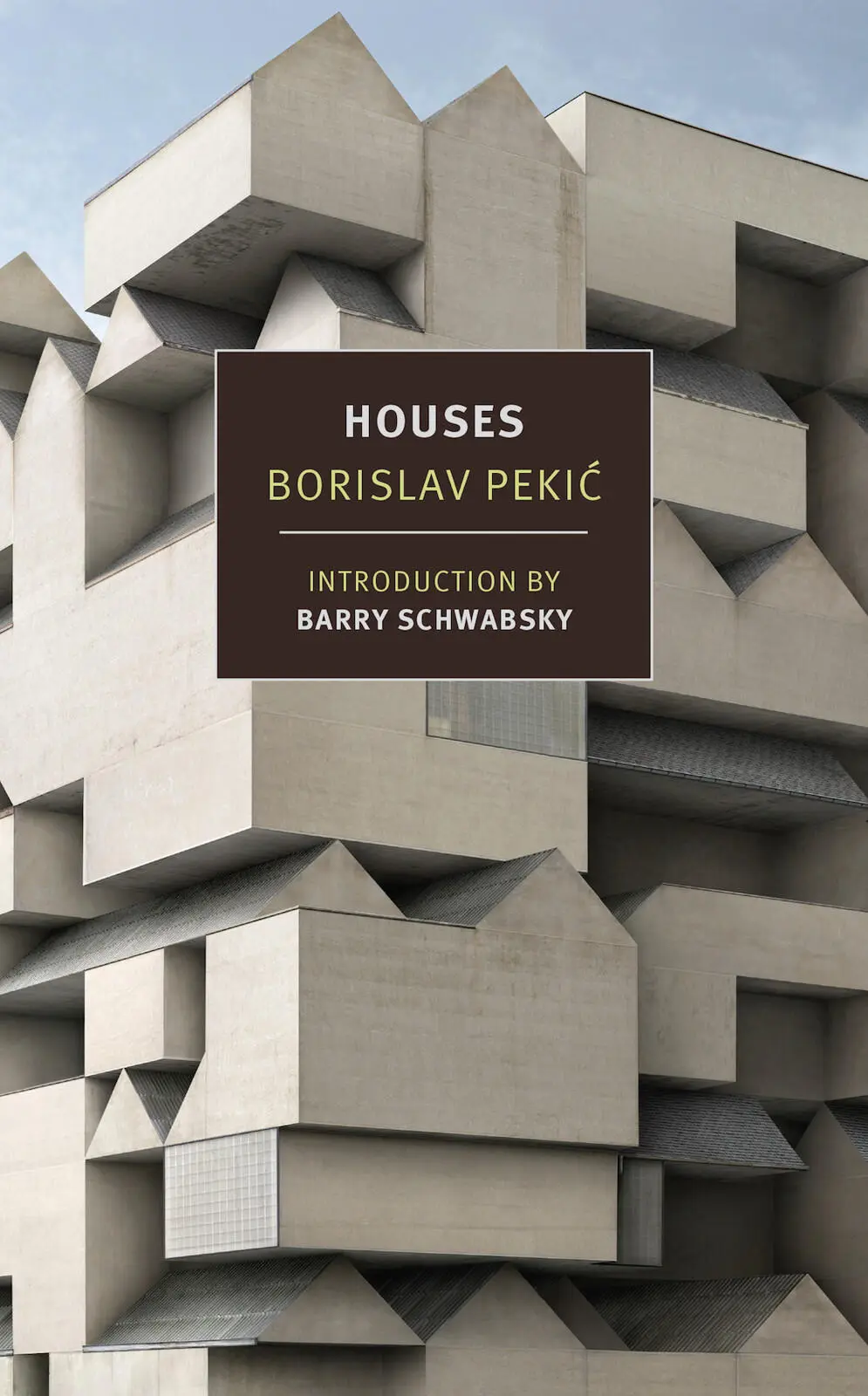
- Название:Houses
- Автор:
- Издательство:NYRB Classics
- Жанр:
- Год:2016
- ISBN:нет данных
- Рейтинг книги:4 / 5. Голосов: 1
-
Избранное:Добавить в избранное
- Отзывы:
-
Ваша оценка:
Houses: краткое содержание, описание и аннотация
Предлагаем к чтению аннотацию, описание, краткое содержание или предисловие (зависит от того, что написал сам автор книги «Houses»). Если вы не нашли необходимую информацию о книге — напишите в комментариях, мы постараемся отыскать её.
Bon vivant, Francophile, visionary, Negoyan spent the first half of his life building houses he loved and even gave names to — Juliana, Christina, Agatha — making his hometown of Belgrade into a modern city to be proud of. The second half of his life, after World War II and the Nazi occupation, he has spent in one of those houses, being looked after by his wife and a nurse, in hiding. Now, on the last day of his life, Negoyan has decided to go out at last to see what he has wrought.
Negoyan is one of the great characters in modern fiction, a charming monster of selfishness and self-delusion. And for all his failings, his life poses a question for the rest of us: Where in the modern world is there a home except in illusion?
Houses — читать онлайн бесплатно полную книгу (весь текст) целиком
Ниже представлен текст книги, разбитый по страницам. Система сохранения места последней прочитанной страницы, позволяет с удобством читать онлайн бесплатно книгу «Houses», без необходимости каждый раз заново искать на чём Вы остановились. Поставьте закладку, и сможете в любой момент перейти на страницу, на которой закончили чтение.
Интервал:
Закладка:
My preparation—“the artillery barrage preceding a frontal attack,” as my brother George would have said — lasted for some time, about a year in fact, until, through the Town Hall, I had managed to obstruct the administration of his property. (In a typically Balkan manner no one could care less about the capital, and Stefan, out of spite and by means of unofficial interventions, had by now disfigured Niké with new but fortunately removable extensions.) By that time I had also managed to surround his wife with barbed insinuations, so that she completely lost her head and at last confided in me, seeking my advice as a relative and expert.
I took care to give wings to her doubts as to the taste with which the house was designed, particularly with respect to its location. It would have been well suited to Dedinje, I said, but in the middle of the commercial center, next to wholesale dealers and department stores, it gave the impression of an artificial Siamese pavilion which, I added to heighten the effect, had been built by craftsmen from every continent and from all the differing architectural traditions. I said that the house from a utilitarian point of view was a complete failure; that it was more like a riding stable with a great marble manège than the house of an industrialist. Finally, I brought her some building-industry magazines, and by showing her a number of advertised designs, pleasantly induced her to want each of them in turn instead of the house she already had; yet I took care that she didn’t decide on a design to which Niké could be adapted by inexpensive modifications.
And when the former minister Mr. K.L., my secret agent, made public his offer for the house, he was not turned down. Without this mental preparation of Mrs. Negovan-Georgijević, he undoubtedly would have been, but after some short time taken for reflection, and thanks to my anonymous influence, the formal agreement of purchase and sale was forthcoming. From then on, everything went smoothly. Even the negotiations concerning the purchase price turned out favorably for me. Through Mr. K.L. I kept putting the price down on various pretexts, while at the same time through other indirect accomplices — without their conscious collaboration, of course — I heightened my relations’ fear that by living in such a house, a house with a bad reputation, their social standing in the town was continuously declining — declining so much, in fact, that the foolish, unsuspecting Stefan began to imagine that his work was suffering because of that house, and not because of his own ineptitude.
And then Mr. K.L. — a minister without portfolio, and a fully equipped jackass in the bargain — Mr. K.L., at the party Stefan gave to celebrate the imminent conclusion of the sale, being probably drunk, telephoned Arsénie Negovan to tell him that he had become the owner of the palace at No. 41 Kosmajska Street. Obviously, he was unaware that the time he had spent in the Ministry of Internal Affairs had been completely wasted, since Stefan was listening in on another extension.
What more can I say? I had to come into the open as the purchaser. At once, of course, all Niké’s unpleasant and intolerable defects were transformed into virtues which Stefan couldn’t bring himself to renounce at any price.
(At the first cabinet reshuffle Mr. K.L. took over Foreign Affairs, and as far as I could see from my superficial grasp of politics, went on to conduct national affairs with the same flippancy that he had shown in mine.)
However, I didn’t give up. Under the pretext that the more prosperous people had moved out of town and into the hills, I lowered the rents of all the houses in Niké’s vicinity, and reduced Aspasia’s rent to suit even a pauper’s pocket, thus bringing down Niké’s value. While I could somehow cope with the other landlords — who, with justification, accused me of residence “dumping” and even of Bolshevism (here they made capital out of my time spent in Russia) — it was virtually impossible to convince Aspasia’s inhabitants that I wasn’t degrading them by this reduction of my profits, but simply giving my commercial, professional answer to the migration of riches, power, and reputation from one side of town to the other.
In desperation I had the idea of buying up other houses on Kosmajska Street, which were available above the market price, and then settling in them the dirtiest gypsy element I could find, whose proximity would have driven the Devil himself out of hell. But I gave up the notion: I couldn’t subject houses to such an onslaught, not even for the love of Niké.
Finally I was so overcome by fury, never mind the cost, that I bought a plot of land adjacent to Niké. I brought in quantities of building material, as if I were going to build nothing less than a skyscraper; I set cranes and bulldozers to work, although no plans were drawn up for any building; I sent trucks up and down the street, and generally started building operations of a kind that would convince even a deaf man that the days ahead would not be easy. Then one night, thinking over the amount that my passion, my craving, was costing me, I decided that it would be better to satisfy it in a cheaper way — with patience, cunning, words — instead of throwing away the money saved up for my grandiose plans, my architect’s vision of a future Belgrade. So I stopped the construction work, sold the plot of land at a profit, and once again fell into a state of depression.
The war crisis was already upon us when I decided to clear the matter up one way or another. I asked my cousin to surrender the house to me for an amount which he himself should determine. For the first time in my commercial career I compromised myself in a business transaction: I placed in his hands my admission that the object of the transaction pleased me so much that I renounced the right to help determine its price. Bearing in mind the condition, the patently unreasoning condition (for if my interest hadn’t been at the very limits of good commercial practice, I would certainly not have approached him so directly, from a commercial point of view so indecently, so childishly) — bearing in mind the condition that I had to buy the house at any price , I said that, given my obsessive feeling toward her, I had no choice but to go to the owner with an appeal to our family ties, however much they had degenerated. He could name any figure he chose, he could himself write it on the check, here was my check book, I wouldn’t even look at it, I didn’t even intend to make use of that final limit on which purchases customarily depended: the hope that the sum in question would remain within the bounds of logic or of my financial possibilities. If it were nevertheless outside such possibilities or logic, even this wouldn’t matter as I would sell some other houses; in any case it was Niké that at all costs I had to have.
Stefan’s first reaction was one of such complete surprise that he gave no answer to my offer, but only mulishly asked what had got into me all of a sudden, after two whole seasons had passed since the house had been built, especially since it was a well-known fact that I’d never had a high opinion of it, and that at one time I had actually called the house a monstrosity, an abomination which ought to be destroyed. Given all this, he said, he decidedly couldn’t grasp what I really wanted after having exhausted all those villainous, cannibalistic, and yes, even criminal means of driving him from his own house!
“Anyway, I don’t know where you find the nerve to suggest something so vile, as if I didn’t exist, as if I were going to sit back and watch you hurl yourself at my property. And all this because of the obsessed principles of your somnambulist taste, in a town which, I hope, despite all the houses that you already possess, isn’t yet yours and never will be. I’ve been patient only for the sake of peace in the family. Until this meeting I kept receiving you into my house with esteem, even though I never had any particular liking for you — nor you for me, no doubt, that’s something we both agree on.”
Читать дальшеИнтервал:
Закладка:
Похожие книги на «Houses»
Представляем Вашему вниманию похожие книги на «Houses» списком для выбора. Мы отобрали схожую по названию и смыслу литературу в надежде предоставить читателям больше вариантов отыскать новые, интересные, ещё непрочитанные произведения.






Обсуждение, отзывы о книге «Houses» и просто собственные мнения читателей. Оставьте ваши комментарии, напишите, что Вы думаете о произведении, его смысле или главных героях. Укажите что конкретно понравилось, а что нет, и почему Вы так считаете.