Borislav Pekic - Houses
Здесь есть возможность читать онлайн «Borislav Pekic - Houses» весь текст электронной книги совершенно бесплатно (целиком полную версию без сокращений). В некоторых случаях можно слушать аудио, скачать через торрент в формате fb2 и присутствует краткое содержание. Год выпуска: 2016, Издательство: NYRB Classics, Жанр: Современная проза, на английском языке. Описание произведения, (предисловие) а так же отзывы посетителей доступны на портале библиотеки ЛибКат.
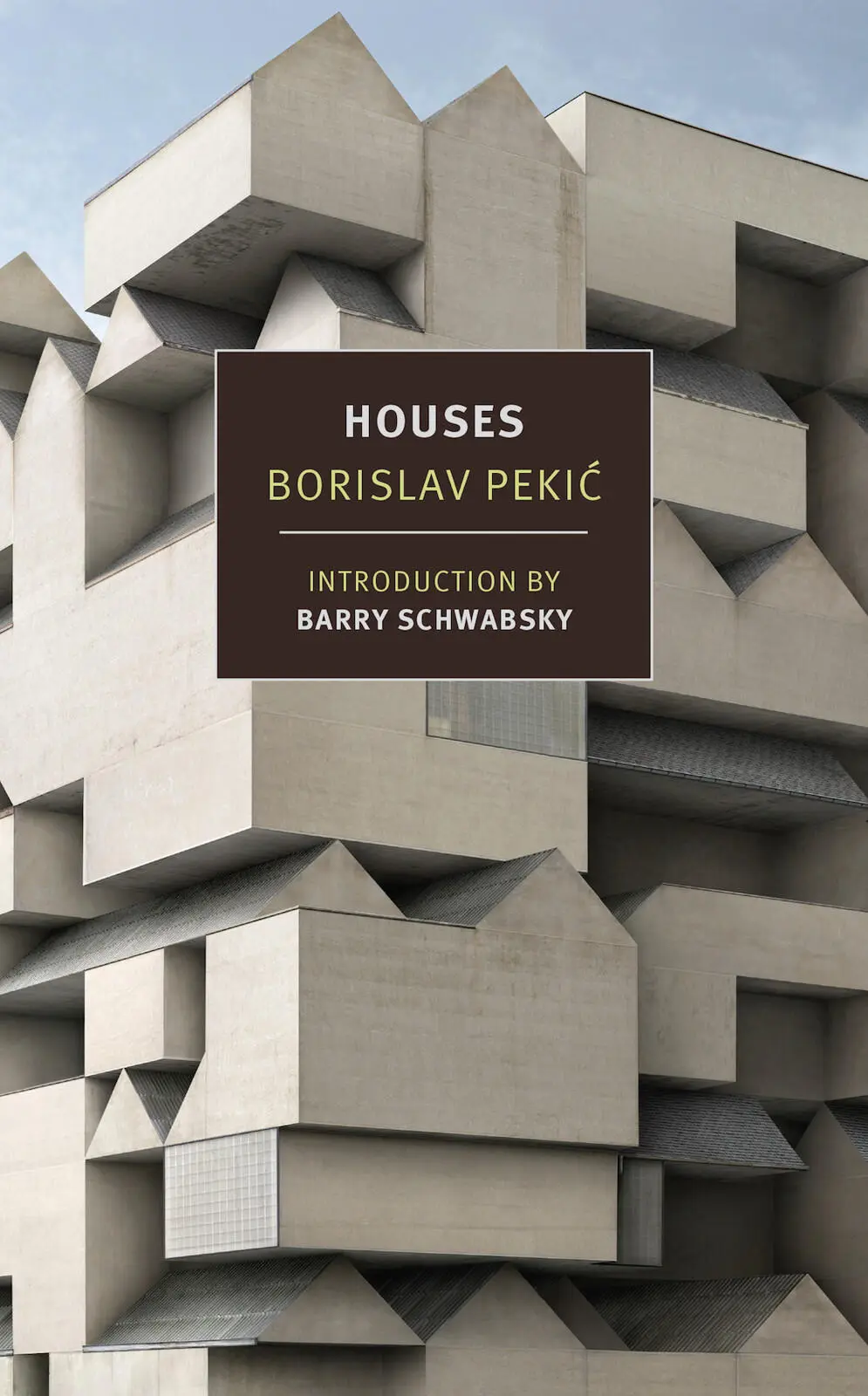
- Название:Houses
- Автор:
- Издательство:NYRB Classics
- Жанр:
- Год:2016
- ISBN:нет данных
- Рейтинг книги:4 / 5. Голосов: 1
-
Избранное:Добавить в избранное
- Отзывы:
-
Ваша оценка:
Houses: краткое содержание, описание и аннотация
Предлагаем к чтению аннотацию, описание, краткое содержание или предисловие (зависит от того, что написал сам автор книги «Houses»). Если вы не нашли необходимую информацию о книге — напишите в комментариях, мы постараемся отыскать её.
Bon vivant, Francophile, visionary, Negoyan spent the first half of his life building houses he loved and even gave names to — Juliana, Christina, Agatha — making his hometown of Belgrade into a modern city to be proud of. The second half of his life, after World War II and the Nazi occupation, he has spent in one of those houses, being looked after by his wife and a nurse, in hiding. Now, on the last day of his life, Negoyan has decided to go out at last to see what he has wrought.
Negoyan is one of the great characters in modern fiction, a charming monster of selfishness and self-delusion. And for all his failings, his life poses a question for the rest of us: Where in the modern world is there a home except in illusion?
Houses — читать онлайн бесплатно полную книгу (весь текст) целиком
Ниже представлен текст книги, разбитый по страницам. Система сохранения места последней прочитанной страницы, позволяет с удобством читать онлайн бесплатно книгу «Houses», без необходимости каждый раз заново искать на чём Вы остановились. Поставьте закладку, и сможете в любой момент перейти на страницу, на которой закончили чтение.
Интервал:
Закладка:
Unfortunately, that evening my reflections found no support in Katarina; on other evenings she was generally less vague, more receptive. She had been asleep, I suspect, for quite some time. She was sleeping soundly as if nothing at all unpleasant had happened, and attentive as I am, I didn’t have the heart to wake her and go over my decision with her. But later, whenever mention was made of Stefan’s house, Katarina expressed a harsh, irrational hostility toward it for which I was never able to find a sound basis.
A day after I had ceremoniously pronounced that I was going to ignore the monstrosity, I stood before it again. Every day, Sundays and holidays excepted, according to an established schedule, I paid a visit to one of the rented houses, and on the following day I went to see Aspasia. Once en route, I was ashamedly aware of where I was really going. Stephanie of Vračar was on the list, and there was no legitimate reason for me to change the route of my inspection. And of course, when I found myself there, I couldn’t, and most probably didn’t want to, overcome the temptation. And so, furious at my own irresolution, I walked a few paces farther and once again found myself in front of Stefan’s house.
Hardened by the first appalling impression, I was now able to look at the house in its own light, resisting the temptation to pass judgment on it because of the imagined unpleasantness it would cause Aspasia. I could cope with the unpleasantness later; for the moment, it was the house itself that troubled me. With quiet deliberation I plunged into her luxuriant forms, her butterfly-shaped roof with the upturned edges beneath which tin was curved up into the gutterings. The copper dome for some strange reason no longer reminded me of a boil but rather of a full breast straining skyward. As for that tympanum, supported on columns of Corinthian slimness, it would indeed have looked much worse if the designer had filled the simple field between the architrave and the main arch with figures of famous warriors or gods, half-gods, and quarter-gods in some farcical action such as the slaying of bulls.
Then the portal, a special feature of that deranged house which seemed to lead not into an ordinary lay dwelling but into a shrine: a shrine to Money, perhaps, and in which I failed to recognize, until I got up close to it, a wild variation of the triple-nave porch of King Milutin in the cathedral church of the Sacred Presentation of the Virgin at Hilendar. Its various divergences from the original were the obvious contribution of Madame Jelena Negovan-Georgijević to that weird house: the surround was like Hilendar, of white marble, perhaps slightly more grained, grayer, but it was outlined by the Tree of Good and Evil. The vault, also like Hilendar, was supported by three consoles; three Doric caraway trees in the form of a half-rolled leaf with protruding veins, which would suggest to the uninitiated a family crest, although no Negovan ever bore such a thing. On the plaque behind the caraways it looked as if someone in righteous anger had smashed a beer bottle against the door jamb — which, all things considered, would not have been surprising. Finally, the door itself was quite independent of its Mount Athos original: it was oak, cruciform, double-paneled, and from it, as from a gloomy face, emerged the thick yellow tongue of an engraved doorknob.
And so, when I saw her for the second time, I mollified my judgment of Stefan’s house; I went on calling her a monstrosity, but there was no further mention of avoiding her at all costs, and what’s more, I singled out the gutter as a successful combination of the useful and aesthetic. Leaving aside the details, the portal was the only feature which I could in no way swallow, but this apart, the house was to the highest degree an individual expression. In principle, of course, I liked such powerful and imposing houses, and in actual fact, they were the only ones I liked. Among my own houses not one could want for praise, not only for some particular feature, but for the special impression which the house made as a whole. Now, one way or another, I began to go around more often; pretexts about Aspasia were no longer necessary. With every meeting the dome, that hidden boil on her tin crown, became not a breast but a bud which oxidization had successfully changed into spring greenery; the four petrified tears which slid down the tympanum now excellently matched her troubled face (later I came to believe that they were tears of longing for me); while only the portal of the house stubbornly maintained its sobering role and had the effect of a single startling feature in an attractive face, a feature which, by some inverted logic, charms us more than all the other features which truly attract us.
I did not recognize my true feelings for the house, however, until the day Stefan moved into it. As I was passing along Kosmajska Street from Topličin Venac, I came upon several moving vans in front of Stefan’s house. The movers were carrying in the furniture under the nervous and petulant supervision of Helena, Madame Georgijević herself. The movers were going in with the pieces of furniture and coming out empty-handed, so that they formed a kind of elliptical chain like a bicycle’s, whose far end revolved around the orange, sunlike, red-lead perspective of the portico while the other end, closer to me, rubbed against the hampers of the moving vans, whose gray-green sides looked as if they’d been painted with the cadmium used for bridges. Along the diameter of that circle Mrs. Georgijević moved like some tireless pedal, scattering to left and right her hysterical and contradictory directions.
I have remembered every detail concerning what I could call a revolutionary upheaval in my relations with Stefan’s house, as if my brain had been a molten copper alloy on which the mold of that moving day had stamped a lasting copper-plate impression; the cirrus clouds hung in white hempen and woolen strands against the sky, barely touched with shadows from the east; in the air was a promise of rain for whose freshness the overheated stone, asphalt, glass, and tile gasped and thirsted; and the bells of the cathedral were ringing — it was the hour for vespers, that mournful moment when color, outline, and sound merge. I stood there across the way from the newly peopled house like a snail curled up in Kleont’s gate — not to be seen, recognized, or spoken to. I was struck as by a clap of thunder with epiphanic love for that building which only the day before I was calling a monstrosity, and for whose demolition I had even in a certain sense been agitating — a building which had been leading me on very effectively at each meeting, so that I now found myself in the humiliating and comical position of a cuckold who is secretly present at the wedding of his beloved to another man; or, bearing in mind that I was not conscious of my affection until the moment Stefan moved in, in the painful position of the poor fool who discovers he’s in love at the moment the object of his passion is led to the altar. Nota bene , this comparison with all its boldness is perhaps not the happiest one, but if it doesn’t lead to the conclusion that I’m mad (to marry a house is after all not such a widespread desire), it will help me even belatedly to judge the depth and strength of my feelings. For everything — that mastodon-sized entrance, like an altar in whose sacristy candles were burning; the guard of honor that the movers constituted; the mystic twilight of the street, in which I felt as if I were in the nave of a church; the insistent ritual ringing of the bells — everything made me, in the cavern of the gate, feel like a betrayed lover hiding behind a column, as in that well-known poem by Rajić, “On the Day of Her Wedding”:
So all my finest dreams are cast asunder ,
Читать дальшеИнтервал:
Закладка:
Похожие книги на «Houses»
Представляем Вашему вниманию похожие книги на «Houses» списком для выбора. Мы отобрали схожую по названию и смыслу литературу в надежде предоставить читателям больше вариантов отыскать новые, интересные, ещё непрочитанные произведения.






Обсуждение, отзывы о книге «Houses» и просто собственные мнения читателей. Оставьте ваши комментарии, напишите, что Вы думаете о произведении, его смысле или главных героях. Укажите что конкретно понравилось, а что нет, и почему Вы так считаете.