Borislav Pekic - Houses
Здесь есть возможность читать онлайн «Borislav Pekic - Houses» весь текст электронной книги совершенно бесплатно (целиком полную версию без сокращений). В некоторых случаях можно слушать аудио, скачать через торрент в формате fb2 и присутствует краткое содержание. Год выпуска: 2016, Издательство: NYRB Classics, Жанр: Современная проза, на английском языке. Описание произведения, (предисловие) а так же отзывы посетителей доступны на портале библиотеки ЛибКат.
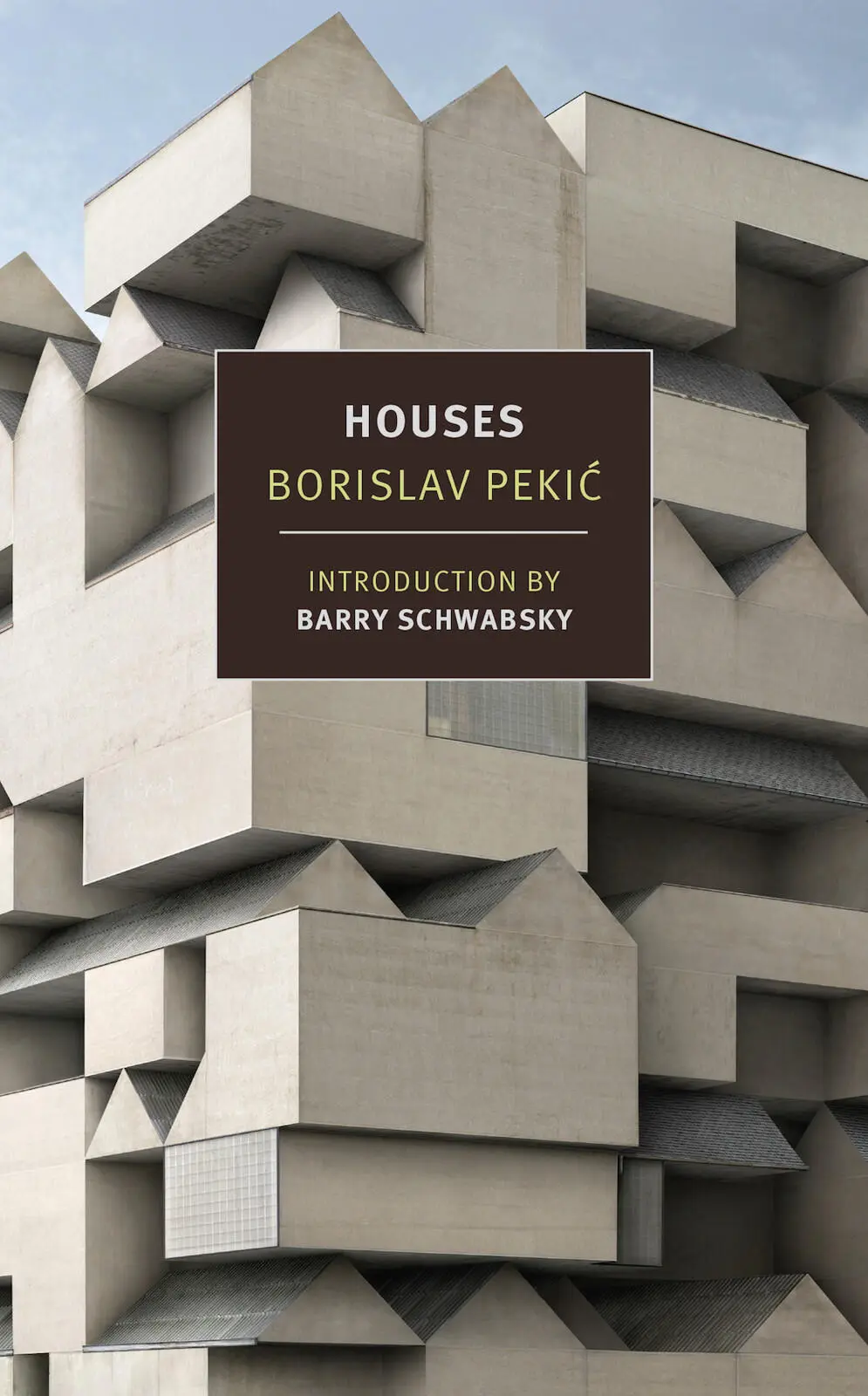
- Название:Houses
- Автор:
- Издательство:NYRB Classics
- Жанр:
- Год:2016
- ISBN:нет данных
- Рейтинг книги:4 / 5. Голосов: 1
-
Избранное:Добавить в избранное
- Отзывы:
-
Ваша оценка:
Houses: краткое содержание, описание и аннотация
Предлагаем к чтению аннотацию, описание, краткое содержание или предисловие (зависит от того, что написал сам автор книги «Houses»). Если вы не нашли необходимую информацию о книге — напишите в комментариях, мы постараемся отыскать её.
Bon vivant, Francophile, visionary, Negoyan spent the first half of his life building houses he loved and even gave names to — Juliana, Christina, Agatha — making his hometown of Belgrade into a modern city to be proud of. The second half of his life, after World War II and the Nazi occupation, he has spent in one of those houses, being looked after by his wife and a nurse, in hiding. Now, on the last day of his life, Negoyan has decided to go out at last to see what he has wrought.
Negoyan is one of the great characters in modern fiction, a charming monster of selfishness and self-delusion. And for all his failings, his life poses a question for the rest of us: Where in the modern world is there a home except in illusion?
Houses — читать онлайн бесплатно полную книгу (весь текст) целиком
Ниже представлен текст книги, разбитый по страницам. Система сохранения места последней прочитанной страницы, позволяет с удобством читать онлайн бесплатно книгу «Houses», без необходимости каждый раз заново искать на чём Вы остановились. Поставьте закладку, и сможете в любой момент перейти на страницу, на которой закончили чтение.
Интервал:
Закладка:
Certainly those other possessors would not be capable of such things. Indeed, can I call them by that honorable name? They have become so alienated from their own possessions that, since no direct or personal link binds them, they no longer possess at all in the popular sense of the word, nor does the possessed have any right over them. These men no longer operate in real objects belonging to them, but in their vague, alien, shadowy affairs, such as acquisitions on the stock market whereby industrial and agricultural products, immovable assets, land, mineral wealth, ores — in a word, all the wealth of this planet — are transformed into paper values, barely perceivable in concepts of rent, dividends, shares, loan extensions, cash and terms of work, or agreed-upon deferred payments (just as nothing at all could be found out about my houses — about their appearance and soul, or our mutual relations — from the concept of rent). Inevitably, that abandoned trace of reality is finally lost by its owner. Yet it’s quite inappropriate to call them owners, for they have acquired only echoes of those shadows — in fact, their formless movements up and down, movements defined by the stock exchange index, by the possessor who, speculating à la hausse , on the rise of shares, or à la baisse , on their fall, in fact possesses only disembodied differences between changeable and similarly disembodied sums, nuances which themselves are exceptionally inconstant and changeable.
In short, between the other owners’ and my own understanding of possessions there had come about — gradually, of course — a complete difference of opinion which could, for the sake of expressiveness, be compared with the essential difference between the theological representation of God as an impersonal concept of omnipotence, and the real, incarnate God which believers experience in their very soul. This opposition had led me to suspect that all my apparent “professional friends,” if by some mischance they had found themselves in my position, would have retreated before that street of rioters, probably because everything which made it necessary to pass through that pandemonium, through that molten hell as over an enemy redoubt, could be postponed to some more favorable occasion; or if it couldn’t — if it really were a question of that unique chance by which it is sometimes possible to surprise the market — they would nevertheless have preferred to renounce the profit involved than to risk their own life.
(My exclusive aim in pausing at this to some extent historic spot was not to reconstruct my feelings at that time , in the context of conditions and their meanings for me then —that would have been a real and useless feeling, like that which against my will had once again drawn me back to the funeral of Constantine Negovan or to the laundry room under the stone trough — but rather to subject them to a critical assessment from the considerably altered present-day viewpoint. To disclose the errors of my behavior which had almost brought about my demise, I had to comment on them, so as to be able to argue with those earlier feelings as if they hadn’t belonged to Arsénie Negovan, but to some other person, quite indifferent to him.)
Although I wasn’t stubborn in the usual sense of the word, I was embellished — if indeed it is an embellishment, and I believe it had to be so, Katarina’s views to the contrary — I was embellished, I repeat, by that conqueror’s nomad’s, and traveling merchant’s constancy of purpose which brought my ancestors, still bearing the Graeco-Tsintsarski name of Nago, from the backwoods of Aegean Macedonia, out of dreary anonymity, to attain first of all a separate identity, and later our enviable present-day power in society.
I would never have written all this down, of course — I was already making spontaneous use of it, living it in fact — had I not been asked to give a lecture at the Jubilee of the Circle of the Sisters of Serbia. The ladies of the organizing committee intended this to be a series of lectures about the multiple aspects of urban life under the general title “The Different Faces of Belgrade,” which was to take place once a week in the large hall of the Kolarac Institute. B.P., Professor of Comparative Literature at the University of Belgrade, was enlisted to say a few words to those eminent ladies, so desirous of knowledge, about the artistic realities of the capital. (To this day I’m not clear why he thought it appropriate to deliver, in his otherwise incomparable manner, something on “The Eighteenth-Century Frenchwoman.”) N.N., an experienced Treasury architect, was to summarize the architectural content of the general theme, following which the biggest names were engaged according to their own special interests. And so, as secretary of the Chamber of Commerce, I was chosen to inform my ambitious listeners about that less romantic aspect of Belgrade life, the mechanism of its economic development; in this way, apparently the part of the general title of the series promising an insight into the unknown side of the town would be fulfilled. So I had to talk about the monetary system, stock exchange speculations, exports and imports, industrial perspectives, trade and the market; about goods, clearing, rent, stocks, shares, bills of exchange, bankruptcy (both real and fictional), imposition of taxes, accumulation, profits, and wages (I remember that under wages it was suggested that in passing, in nuce , I should dispose of the Problem of the Workers). But all this, of course, in a way which would be both entertaining and accessible to the ladies.
I must immediately make it clear that before this offer I had never appeared at public gatherings; with the evident exception of meetings of the Chamber, auctions, and professional conferences, this particular art was for me something completely new. Without any doubt, I would have refused to take part — however flattering it was — had I not had in mind the benefit to my own business affairs which could accrue from this close and essentially intellectual contact with the wives of our most important and influential industrialists, merchants, bankers, capitalists, statesmen, and politicians. Above all, I didn’t have a very able tongue, although — here I’m giving passively the opinion of others — I knew how to rise to heights of poetic inspiration whenever I talked about my own houses or something directly related to them. On this occasion, however, there was to be nothing about houses, or at least about mine, though property ownership did come within the scope of the lecture. I was to talk about such great matters as the mechanism of economic developments which, it was naively believed, would lay the foundations for the prosperity of our flea-ridden, Levantine community. Most lamentably of all, in my statement of the essentials of the banker’s profession, for example, I was expected to praise that very type of possession which is the true antithesis of real possession, and to turn real possession’s living forms into a vampirelike roundabout of soulless and faceless figures on the current stock exchange index!
Arsénie Negovan could not agree to such blasphemy! I decided to make use of the occasion for myself — and, in a somewhat indirect way, for my listeners’ husbands — to outline my own ideas about the subject, mainly my views about the essential difference between the erroneously favored single-phase ownership and the benefits of the equal, reciprocal dual-phase type. This was my own terminology to illustrate the fact that true ownership can only be one in which the subject and the object share possession mutually, in consequence of which all differences between them are erased, so that the Possessor becomes the Possessed without losing any of the traditional function of Possession, and the Possessed becomes the Possessor, without in any way losing its characteristics of the Possessed. In short, I would explain my philosophy of Possession.
Читать дальшеИнтервал:
Закладка:
Похожие книги на «Houses»
Представляем Вашему вниманию похожие книги на «Houses» списком для выбора. Мы отобрали схожую по названию и смыслу литературу в надежде предоставить читателям больше вариантов отыскать новые, интересные, ещё непрочитанные произведения.







Обсуждение, отзывы о книге «Houses» и просто собственные мнения читателей. Оставьте ваши комментарии, напишите, что Вы думаете о произведении, его смысле или главных героях. Укажите что конкретно понравилось, а что нет, и почему Вы так считаете.