Borislav Pekic - Houses
Здесь есть возможность читать онлайн «Borislav Pekic - Houses» весь текст электронной книги совершенно бесплатно (целиком полную версию без сокращений). В некоторых случаях можно слушать аудио, скачать через торрент в формате fb2 и присутствует краткое содержание. Год выпуска: 2016, Издательство: NYRB Classics, Жанр: Современная проза, на английском языке. Описание произведения, (предисловие) а так же отзывы посетителей доступны на портале библиотеки ЛибКат.
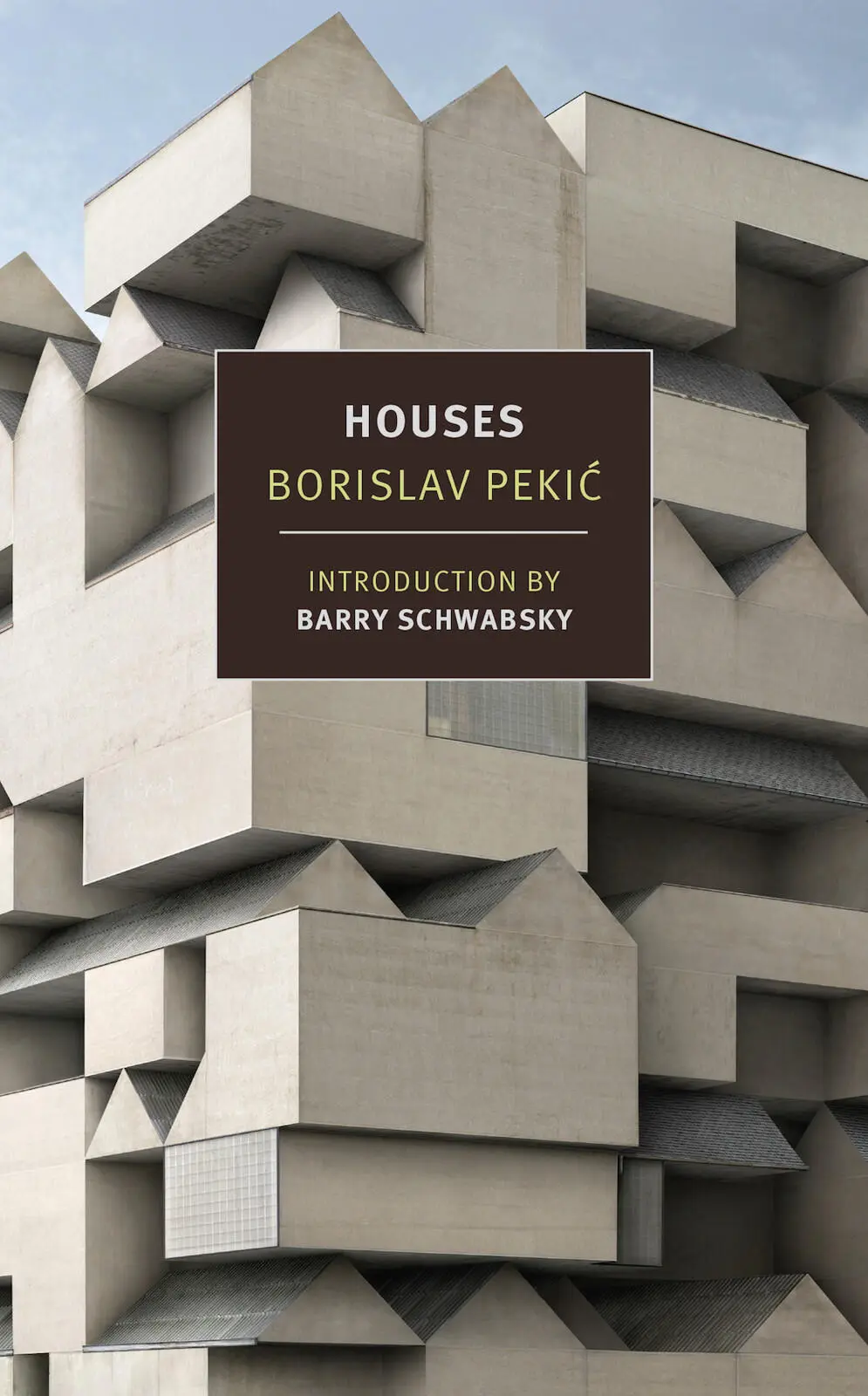
- Название:Houses
- Автор:
- Издательство:NYRB Classics
- Жанр:
- Год:2016
- ISBN:нет данных
- Рейтинг книги:4 / 5. Голосов: 1
-
Избранное:Добавить в избранное
- Отзывы:
-
Ваша оценка:
Houses: краткое содержание, описание и аннотация
Предлагаем к чтению аннотацию, описание, краткое содержание или предисловие (зависит от того, что написал сам автор книги «Houses»). Если вы не нашли необходимую информацию о книге — напишите в комментариях, мы постараемся отыскать её.
Bon vivant, Francophile, visionary, Negoyan spent the first half of his life building houses he loved and even gave names to — Juliana, Christina, Agatha — making his hometown of Belgrade into a modern city to be proud of. The second half of his life, after World War II and the Nazi occupation, he has spent in one of those houses, being looked after by his wife and a nurse, in hiding. Now, on the last day of his life, Negoyan has decided to go out at last to see what he has wrought.
Negoyan is one of the great characters in modern fiction, a charming monster of selfishness and self-delusion. And for all his failings, his life poses a question for the rest of us: Where in the modern world is there a home except in illusion?
Houses — читать онлайн бесплатно полную книгу (весь текст) целиком
Ниже представлен текст книги, разбитый по страницам. Система сохранения места последней прочитанной страницы, позволяет с удобством читать онлайн бесплатно книгу «Houses», без необходимости каждый раз заново искать на чём Вы остановились. Поставьте закладку, и сможете в любой момент перейти на страницу, на которой закончили чтение.
Интервал:
Закладка:
Carried away by this power for enlightenment, I threw myself into the work and quickly prepared an outline of my lecture. Bearing in mind my inexperience as an orator, I thought it best to test my impact on some more experienced speaker. Not wanting to give my casual, so to speak, amateur soliloquy any prior publicity — for it was in some way to be a conversation with myself at which, quite fortuitously, the matrons of our town were to be present — I took it in typescript to Mr. Joakim Teodorović, through whom, as the initiator of the function, I normally communicated with the Circle. It would be unjust to complain that Mr. Teodorović didn’t show an immediate interest in my work — perhaps “interest” is too modest a synonym for the tense expression of his face while he literally raced over the text, in which the heavy Remington letters stood out in lines like grains of wheat, like the lead beads on the wires of a child’s abacus — or that he was miserly in his praise, although for my restrained taste they were a little overeffuse.
Despite this promising reception, I never appeared on the rostrum of the Kolarac Institute with my “completely original angle.” To this very day I am unaware as to why this came about, and why in my place Mr. Teodorović himself gave the lecture, meekly and unintelligently retracing all those weary errors by which this vast subject is devastated. In actual fact I presume he retraced them, for it goes without saying that I didn’t have the honor of being present at the lecture. But this was not important for me now, invidia virtutis (or as is said nowadays, comes — invidia virtutis comes; envy is the companion of virtue), as the Romans would have exclaimed; all this was but a pretext for me to recall something quite different. Actually, in putting together the sketch of the lecture that was not to be, I had noted down in the margin, just as they came to me, several concise definitions, paradigmatic notes which were really too exclusive to be included in the framework itself. These notes should have been read by that idiot Joakim Teodorović, for him to see what a “completely original angle” really meant, but they were indeed the barest essentials of what, in a more subtle version, I intended to elucidate for my Serbian Sisters of the Circle. As far as I remember, these notes could be reduced to a number of axioms:
1. I do not own houses, we, I and my houses, own each other mutually.
2. Other houses do not exist for me; they begin to exist for me when they become mine.
3. I take houses only when they take me; I appropriate them only when I am appropriated; I possess them only when I am possessed by them.
4. Between me and my possessions a relationship of reciprocal ownership operates; we are two sides of one being, the being of possession .
There were several others — probably they began to develop the above principles in individual areas of ownership — but, hesitating on the asphalt threshold of Pop-Lukina Street, looking at the pale-colored, unequally hewn-out gashes of the streets on the other side of the imaginary procession, I wasn’t capable of recalling them. It was, indeed, superfluous to try. The ones I could remember were sufficient to restore my faltering conviction about the decision which I had then taken. I had to get across. Such decisiveness, whatever may be said, came straight from my possessor’s heart and was therefore legitimate.
Here, of course, that ill-considered step which for many years shut me in my house cannot be hidden. Perhaps the mistake was made later. I don’t deny the possibility that I even foresaw something of the sort, that I got something confused while forcing my way through the mass, or even during the subsequent incident. I can allow this — I’m only at the beginning of my reconstruction — but without any doubt, at the intersection of Zadarska and Pop-Lukina Streets I couldn’t have acted in any other way than the way I did.
At that time my heart, my possessor’s heart, was worrying about the house which my cousin on my father’s side, Stefan Negovan, had built on Kosmajska Street, No. 41: “Stefan’s Folly” as the neighbors called the free, and certainly lighter and more intelligent, copy of Dietrich and Eizenhofer’s Academy of Sciences in Vienna. Its appearance, taken from a baroque, aristocratic hôtel particulier , with some of the aspects and forlorn contours of a Chinese pagoda, gave the impression of a dwarf-size castle in the middle of the town, with tin, butterflylike wings as roofs from whose arch a mildewed copper dome burgeoned like a festering boil, like a breast with a circular lantern around it, with a tympanum in the middle of the façade, a blind, three-cornered Cyclop’s eye from whose edge hung two pairs of (four in all) Corinthian columns like stalactite tears, with the three-sided hollow of a balcony between them and loggias to the left and right, with French windows and an ornately worked portal instead of an entrance door. Nor did the interior lag behind the façade: It was hung with expensive wall lamps, and the ceilings were of alabaster and the floors of lacquered oak, with spiral staircases and raised marble daises. Even discounting the unique furniture — in which, en route to a bearable compromise, the haphazard taste of Stefan’s wife Jelena had clashed with the patriarchal heritage of her hated mother-in-law — the house recalled a padded chest where precious souvenirs were collected. And now it had come about that Stefan’s Folly had cast its Cyclop’s eye on me.
Not at once, of course, not the very moment it was built. When I first caught sight of it — I’d been abroad at the time it was completed — I was amazed, and that’s no exaggeration; I was in fact appalled. In the humble, simple, architecturally modest surroundings of Kosmajska Street of that time — where two plots away, at No. 45, stood my Aspasia, up to then the bravest of houses, and across the way, Kleont Negovan’s bungalow, the somber face of which was smooth as a serpent — in these surroundings, Stefan’s palace produced a truly disturbing effect, irritatingly perverse and pretentious, like an erratum, a coarse printing error in the elegant context of the street; or, to keep closer to its essential character, like a fit of madness which had suddenly taken hold of deranged, frustrated stone and which, with hysterical joy produced its own malignant currents like cancer, its swellings, lumps, tumors, lesions, humps, ganglions, haemotomes, and all that metastasis of distorted stone forms. I could go on listing comparisons indefinitely, and still only begin to give the displeasing impression which Stefan’s new house left on me at first sight.
Right from the beginning, at the moment of my first astounded repulsion, the seed of my later admiration was sown. I and Stefan’s house — I’m now loath to consider it Stefan’s — were like two beings at first sight divided by antipathy, but who began secretly to draw closer long before that antipathy was overcome and repudiated; moreover, quite unquestionably the initiative belonged to the house, or rather to its irresistibly extraordinary quality. I remember that, on returning to Kosančićev Venac a second time — Stefan hadn’t moved in yet — I was furious. (Why that anger, when the house wasn’t mine and had no reason to concern me? That a Negovan should make himself ridiculous before everyone could affect me personally only insofar as the uninformed might confuse the two of us.)
I shouted at Katarina that that irresponsible Stefan had built himself a monstrosity cheek by jowl with Aspasia — an unseemly stone aberration, une sépulture presumptueuse des pharaons, nécropole dans la petite version primitive balkanique , never mind what his original intentions had been; for certain, that gilded Georgian pumpkin had stuck her poisonous oar in; certainly it was far from responsible or considerate, not to mention cousinly, to contaminate the street with such a house and spoil — what am I saying, completely desolate — a whole area as if Belgrade were his patrimony, dowry, feudal domain, and not a public treasure subject to recognized laws, not to mention urban principles. “What’s more,” I said, “he must have greased someone’s palm generously to have been allowed to indulge in such madness, with no concern at all that there are still houses being rented on Kosmajska Street. Now, of course, with Stefan’s scarecrow alongside them, the question is whether they can be rented at all, never mind if there’ll be any rent out of them!”
Читать дальшеИнтервал:
Закладка:
Похожие книги на «Houses»
Представляем Вашему вниманию похожие книги на «Houses» списком для выбора. Мы отобрали схожую по названию и смыслу литературу в надежде предоставить читателям больше вариантов отыскать новые, интересные, ещё непрочитанные произведения.






Обсуждение, отзывы о книге «Houses» и просто собственные мнения читателей. Оставьте ваши комментарии, напишите, что Вы думаете о произведении, его смысле или главных героях. Укажите что конкретно понравилось, а что нет, и почему Вы так считаете.