Borislav Pekic - Houses
Здесь есть возможность читать онлайн «Borislav Pekic - Houses» весь текст электронной книги совершенно бесплатно (целиком полную версию без сокращений). В некоторых случаях можно слушать аудио, скачать через торрент в формате fb2 и присутствует краткое содержание. Год выпуска: 2016, Издательство: NYRB Classics, Жанр: Современная проза, на английском языке. Описание произведения, (предисловие) а так же отзывы посетителей доступны на портале библиотеки ЛибКат.
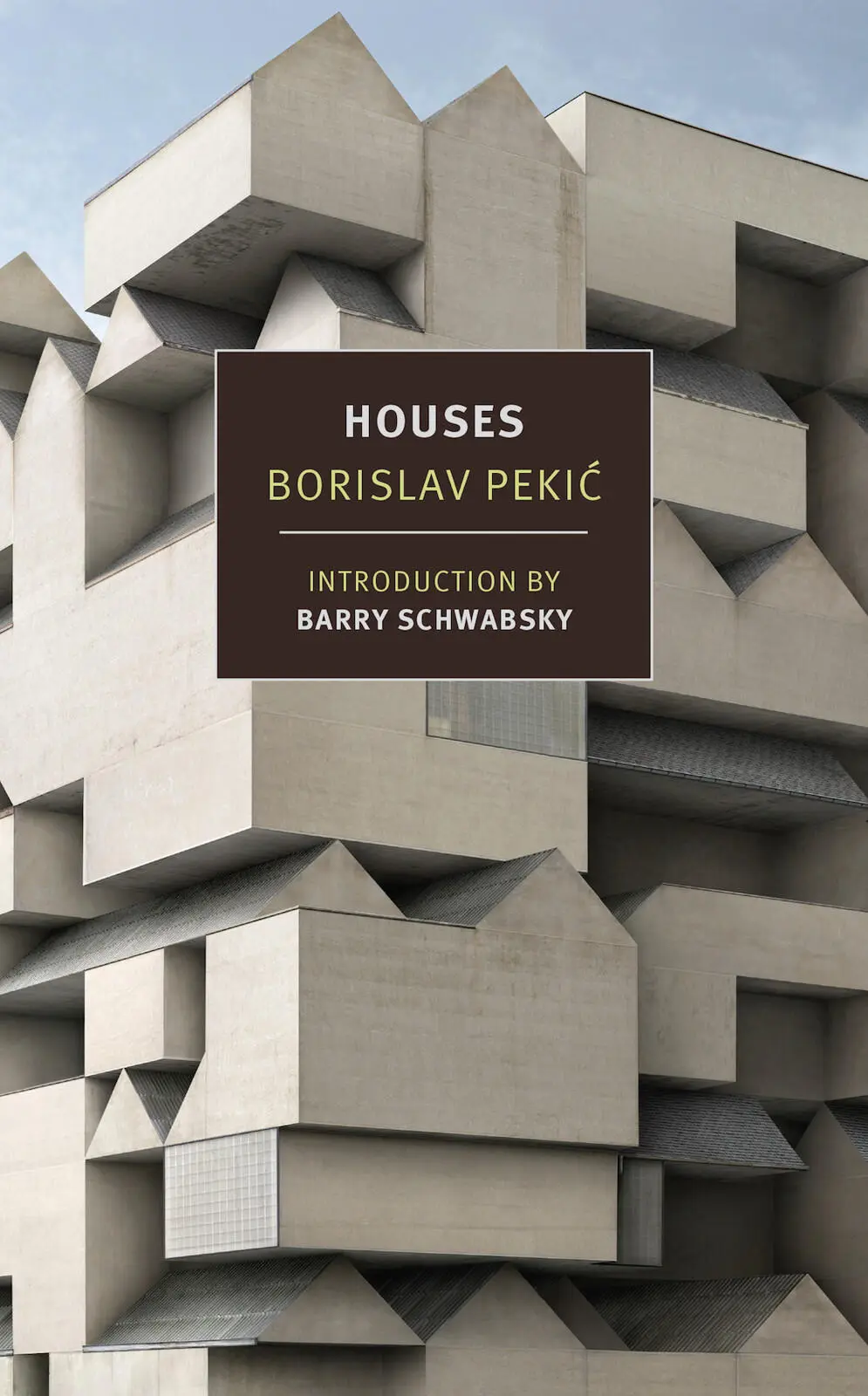
- Название:Houses
- Автор:
- Издательство:NYRB Classics
- Жанр:
- Год:2016
- ISBN:нет данных
- Рейтинг книги:4 / 5. Голосов: 1
-
Избранное:Добавить в избранное
- Отзывы:
-
Ваша оценка:
Houses: краткое содержание, описание и аннотация
Предлагаем к чтению аннотацию, описание, краткое содержание или предисловие (зависит от того, что написал сам автор книги «Houses»). Если вы не нашли необходимую информацию о книге — напишите в комментариях, мы постараемся отыскать её.
Bon vivant, Francophile, visionary, Negoyan spent the first half of his life building houses he loved and even gave names to — Juliana, Christina, Agatha — making his hometown of Belgrade into a modern city to be proud of. The second half of his life, after World War II and the Nazi occupation, he has spent in one of those houses, being looked after by his wife and a nurse, in hiding. Now, on the last day of his life, Negoyan has decided to go out at last to see what he has wrought.
Negoyan is one of the great characters in modern fiction, a charming monster of selfishness and self-delusion. And for all his failings, his life poses a question for the rest of us: Where in the modern world is there a home except in illusion?
Houses — читать онлайн бесплатно полную книгу (весь текст) целиком
Ниже представлен текст книги, разбитый по страницам. Система сохранения места последней прочитанной страницы, позволяет с удобством читать онлайн бесплатно книгу «Houses», без необходимости каждый раз заново искать на чём Вы остановились. Поставьте закладку, и сможете в любой момент перейти на страницу, на которой закончили чтение.
Интервал:
Закладка:
Loyally subordinating themselves to this unifying force, they linked arms in a solid trellis of fists and pushed forward as if boiling over from a white-hot cauldron of discontent and despair. The participants in these demoniacal rounds were constantly replaced by others; sidelong tremors broke apart their single-line chains, tore at their links, replaced them with more resistant, firmer ones. Those who were pushed aside, after having been battered for a time by the oncoming ranks, would grab on to other lines, for which it appeared a lesser strength was sufficient, for they were out of direct range of the constraining blockage, lower down at the approaches to the bridge.
Stretched up over the mob were poles bearing the Yugoslav and Serbian flags. (One of them was red, yes, completely red like newly shed blood.) They were carried between two masts and looked like a bloodied bandage which had just been unwound from a giant’s forehead. I felt myself once again in the outskirts of Voronezh, in the midst of an evil mob of rioters, their ranks like rows of coal-black, sodden hovels. It was 1919, the White General Marmontov had already retreated across the Don, and under the protection of the riflemen of Budyony’s Sixth Cavalry — who, clustered together into smallish, perhaps even fortuitous groups, looked down from their horses with soldierlike indifference, half-dozing — the mob was dragging frightened, stunned people out of porchways: people in dressing gowns, kaftans, fur coats, cloth cloaks, field overcoats, waterproof capes, and coats with sable collars — from their appearance, respectable middle-class folk and even, I fear, property owners who, as was later explained to me, were counterrevolutionaries, Denikinites, Black Hundreds, and black marketeers. They were beating them with staves and forcing them to crawl in the gutter before their own houses, which they did quite earnestly, even so to speak committedly, while they were battered in the clinging autumn mud with the same staves, pickaxes and hammers. Then the crowd moved toward other houses where the wailing, like that of a forlorn and abandoned dog, awaited them.
Now, today, I beheld placards of brown paper, cardboard, and cloth on which slogans were inscribed in black and red oil:
DOWN WITH THE ANTIPEOPLE PACT!
LONG LIVE THE ARMY!
DOWN WITH THE GOVERNMENT OF TRAITORS!
DOWN WITH FASCISM!
DEATH TO THE GERMAN HIRELINGS!
BETTER THE GRAVE THAN BE A SLAVE!
BETTER WAR THAN THE PACT!
All this I could understand (though not of course approve), since in those conceited sentiments there was much more of a national, Slav, Kosovo, Salonika-front spirit than of revolutionary intent. But among the protests, and especially among the demands, were some which by their radical Bolshevik line took me back to Voronezh and that macabre railway halt of Solovkino. The troublemakers — undoubtedly Moscow stooges — were brandishing placards on which I made out with amazement:
DOWN WITH THE CORRUPT BOURGEOISIE!
WE DEMAND A POPULAR FRONT!
DEMOCRATIC FREEDOM FOR THE MASSES!
LONG LIVE OUR RUSSIAN BRETHREN!
WORKERS, UNITE SOLIDLY IN THE STRUGGLE FOR OUR COMMON CAUSE!
UNION WITH THE USSR!
ALL POWER TO THE PEOPLE!
Which was only a more cunning way of saying: all power to the Soviets, all possessions to the nonworker rabble!
One might think that for my own peace of mind I would have chosen a roundabout route for my visit to Simonida, a detour which would lead me away from that howling procession of hysterical fiends gathered from all sides on the afternoon of March 27, 1941, on Pop-Lukina Street, and still surging down it right up to the present day as if awaiting me, as if again blocking the road in front of me. I had been afraid only of that single corner in my dream, yet here I was now stopped by a familiar stone angle with a passageway, into which I had retreated to avoid being trampled down. Could I have reached Simonida by the more accessible Paris Street? I must say at once that it would have been impossible, just as it had been impossible at that first, real encounter. I had done all I could do to get away from them! I had gone around the corners on the vertical line which joined Kalemegdan Park to Nemanja Prospect. Yet each time I came up against the procession I tried to outflank it, keeping to streets which were parallel. No good! It flowed along densely in an all-blanketing layer which settled upon pavements and houses, just like vacuoles and minute bubbles of protoplasm which feed through their skin, consuming open space. And every minute I was in danger from that jellylike, voracious mass, one of whose extruded sleeves, having penetrated into the sidestreets, might suck me in like a stream of gelatine that in sliding down a glass absorbs sprinkled droplets from all sides.
That, then, was the reason why even now it made no sense to look for another route to Simonida. Between me and my threatened house serried ranks of riffraff, whom nothing could disperse, were still passing; in fact they were there only in my irritating memory, and their phantom procession was no longer under the control of the real laws of pressure and compression, but of some kind of laissez faire, protected by memory, over which only I had a certain influence. Only I, therefore, could eliminate them, although the term “eliminate” could in no way be taken literally, for it was not my aim to erase my events from my memory; I could have done that only by eliminating their living results! Rather I desired to reconstruct them in the transforming light of new consciousness, bearing in mind the forthcoming meeting with Simonida, over whose uncertain position they perhaps had a fateful power — to reconstruct them unhurriedly, objectively, as it were outside my own self , and to show myself that my decision to withdraw from society had been at the very least premature, irrational, unfounded, in short mistaken, and that but for that decision I would today have been free of the need to defend my embattled domain.
I believe, however, that it would be useful to look back a little and explain why I hadn’t returned home immediately on coming face to face with the demonstration. I can safely assert that among the property owners there was not one (and I knew them all well, and had maintained professional relations with the most eminent of them) for whom the safety of his own skin wouldn’t have been more vital than his work — work in that higher sense which doesn’t depend on the size of income or the index of growth, but on the character, capacity, and depth of feeling which together are put into it.
Such men increased their possessions either through inertia, to be secure in old age, or simply to strengthen and solidify their personal or social integrity. They didn’t do it to augment their property as such, or in any way to become identified with the things which belonged to them, so that they should merge with these objects of commercial control into an indivisible whole, be absorbed into a mutual lymphatic system for the flow and flood of capital, feeling, will, rent, ideas, instinct, profit, hope, beauty, revenue, passion, and the remaining forms of living — a unity of two otherwise opposite beings in which, as in ideal love, it would no longer be possible to distinguish possessor and possessed, owner and owned, and where the very act of possession would be so completely reciprocal that sometime, perhaps in some perfect world, it would become one with the act of self-perception.
It goes without saying that my professional friends were far from the ideal concept of property ownership. The exception, although in a completely different sphere, was perhaps Theodore, the deceased Theodore X., Negovan’s adopted son, the one who had studied at the Jewelers’ School in Amsterdam. Every diadem, necklace, bracelet, stud, earring — each individual piece of jewelry in his shop possessed him to the same degree as he, Theodore, was its possessor. Even more so, for Theodore was capable, in his otherwise voluntarily subordinate position, of manifesting scrupulous effort, fatherlike care, tender love, and even adoration of the particular article of adornment he owned (compare this with my attitude toward my houses), while the jewels (again akin to my houses) could only return all this devotion with an unimpassioned shine which sparkled, in all its colors, from behind the thick crystal pane of a display cabinet, with its comfortable bed of purple and dark blue satin.
Читать дальшеИнтервал:
Закладка:
Похожие книги на «Houses»
Представляем Вашему вниманию похожие книги на «Houses» списком для выбора. Мы отобрали схожую по названию и смыслу литературу в надежде предоставить читателям больше вариантов отыскать новые, интересные, ещё непрочитанные произведения.






Обсуждение, отзывы о книге «Houses» и просто собственные мнения читателей. Оставьте ваши комментарии, напишите, что Вы думаете о произведении, его смысле или главных героях. Укажите что конкретно понравилось, а что нет, и почему Вы так считаете.