Borislav Pekic - Houses
Здесь есть возможность читать онлайн «Borislav Pekic - Houses» весь текст электронной книги совершенно бесплатно (целиком полную версию без сокращений). В некоторых случаях можно слушать аудио, скачать через торрент в формате fb2 и присутствует краткое содержание. Год выпуска: 2016, Издательство: NYRB Classics, Жанр: Современная проза, на английском языке. Описание произведения, (предисловие) а так же отзывы посетителей доступны на портале библиотеки ЛибКат.
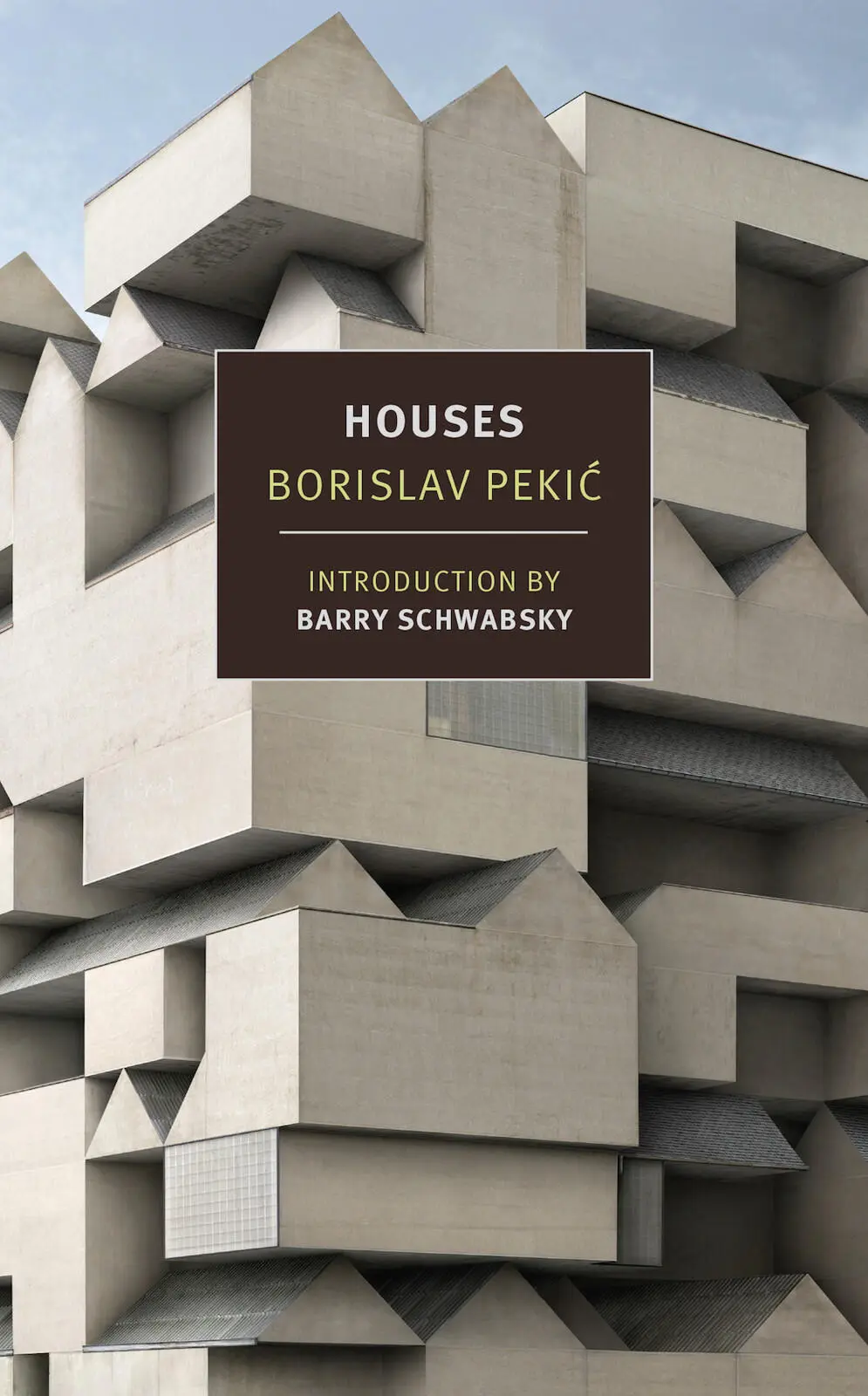
- Название:Houses
- Автор:
- Издательство:NYRB Classics
- Жанр:
- Год:2016
- ISBN:нет данных
- Рейтинг книги:4 / 5. Голосов: 1
-
Избранное:Добавить в избранное
- Отзывы:
-
Ваша оценка:
Houses: краткое содержание, описание и аннотация
Предлагаем к чтению аннотацию, описание, краткое содержание или предисловие (зависит от того, что написал сам автор книги «Houses»). Если вы не нашли необходимую информацию о книге — напишите в комментариях, мы постараемся отыскать её.
Bon vivant, Francophile, visionary, Negoyan spent the first half of his life building houses he loved and even gave names to — Juliana, Christina, Agatha — making his hometown of Belgrade into a modern city to be proud of. The second half of his life, after World War II and the Nazi occupation, he has spent in one of those houses, being looked after by his wife and a nurse, in hiding. Now, on the last day of his life, Negoyan has decided to go out at last to see what he has wrought.
Negoyan is one of the great characters in modern fiction, a charming monster of selfishness and self-delusion. And for all his failings, his life poses a question for the rest of us: Where in the modern world is there a home except in illusion?
Houses — читать онлайн бесплатно полную книгу (весь текст) целиком
Ниже представлен текст книги, разбитый по страницам. Система сохранения места последней прочитанной страницы, позволяет с удобством читать онлайн бесплатно книгу «Houses», без необходимости каждый раз заново искать на чём Вы остановились. Поставьте закладку, и сможете в любой момент перейти на страницу, на которой закончили чтение.
Интервал:
Закладка:
And suddenly everything had become possible. Since Katarina and Golovan — albeit for my own good — had tried to hide from me the fate which now threatened Simonida, why wouldn’t they with still greater reason have kept me in the dark for years regarding her true condition? And also of the condition of others about which, in that fateful sense, nothing had been said? Why had the money from the houses dried up all at once? It’s because of the crisis, Arsénie, I was told. Crises never affect everyone, Katarina. Outlay for repairs, Arsénie. Repairs are never carried out all at once, Katarina.
Once I had lost confidence in Katarina, I could no longer remain calm regarding other information offered me about my houses, my beloved houses.
I went up anxiously to the property owner’s map. This was a blown-up plan of Belgrade, drawn in India ink on a background of snow-white draftsman’s paper, on which the names of streets, squares, districts, and suburbs were marked in red, other geographical features in green, and the heading typed and stuck across the upper left-hand corner where the map ended toward Umka. As a basis I had used An Alphabetical Index, Compiled from Official Data from the Municipal Land Register, T. D. No. 25728/33 , which had been edited and published in 1934 by St. J. Sušić, and Belgrade Street by Street, A Guide and a Plan , 1933, by the same compiler. Changes in street names, at the time when I still took an active interest in my affairs, were written in ordinary pencil, but clearly. At each spot where I owned a house there was a tiny cardboard flag, lemon-yellow or sky-blue depending on whether the house was bought or built under my direction. Each little flag had on it information about the name of the house, the district and street where it was situated, its number, the year in which it was built, the names of its designer and builder, the size of the plot of land, the number of stories and the style of the building, its investment value, its living area, the number and category of its apartments, and last but not least its rent.
I hesitated before the pictorial map like a worried general before a plan of his positions under attack, before the map which resembled my brother George’s headquarters sections, those useless copies of wars. Only on this map it was not phantom tank columns which were moving forward, nor phantom companies which joined battle, nor phantom bombers which razed towns to the ground. There was no record of ruin and destruction on this map, but only of building and preservation of what was already built. It was a picture of creation and not of destruction, and I stood before this model of my threatened possessions gripped by the fear that I might arrive too late, that during the time I had spent as a hermit, isolated from evil, irremediable misfortune had already befallen Sophia, Eugénie, Christina, Emilia, Serafina, Katarina, Natalia, Agatha, Barbara, Daphne, Anastasia, Juliana, Theodora, Irina, Xenia, Eudoxia, Angelina, and on their whole breed, as had now happened to the most beautiful of them all, my good Simonida.
Here in front of an ordinary drawing, a street plan in a bamboo frame, as if in front of some family altar, I felt remorse that I had abandoned everything I’d lived for to the care of others — even though at that time there had been strong reasons for my decision: the riots which had almost cost me my life. I felt remorse that in a cowardly way I had believed that I could keep myself from danger by cunningly dropping out of sight as if dead, instead of taking the bull by the horns as all true, stubborn Negovans would have done, resisting, fighting, retreating in order to advance again, until victorious or slain in battle.
Fortunately, I now again felt young and determined, just as when I had gone out into the town to contract the work for my first house with the builders. I turned back the page on the church calendar — it was June 1968—and without bestowing a further glance upon the room in which the open shoe boxes lay stranded like stricken ships, I went out.
•
And once again, by the gong at the front door of the house, I found myself in one of those distressing moments of my past.
Here come the first bombs. They’re falling slantwise. They seem to come from nowhere, swarming down magically out of the white honeycomb of the sky. Black holes open in the cloudless air. The aircraft can’t be seen. Not even their silver trails, ribbons of silver paper like the tail of a kite floating behind. They must be hidden by the upper arch of the east window, through which I’m leaning. The explosions are soundless. I pay no attention to them. I leave them to George. I’m certain that, shielded by the eaves above the balcony in Lamartine Street as by some stone umbrella, my brother, with the same binoculars — provided, of course, that Mlle. Foucault hasn’t yet dragged him away to the shelter — is watching the Allied squadrons and subjecting to withering criticism their frivolous formations, their badly chosen bombing runs, their ineffectiveness.
I myself, on the other hand, am attracted by the bombs. The round, moving, shaking azure veil in the binoculars is crisscrossed with projectiles like flying dots, like the wayward petals of a giant iron flower which has fallen apart high above the roofs, and is now scattering itself over the earth in slow, hesitant fragmentation, casting its seeds over the thick, powder-dry, smoke-filled furrows. Katarina pulls me away from the window—“You must go down into the cellar, Arsénie”—but I won’t give in, I cannot leave my houses. I go on trying to guess in what area the bombs will fall, which of my houses is in danger. This is difficult, all the more so because my wife is at me to come away from the window. At first I think that the raid is over the Third and Fourth Wards, above the heads of Agatha, Juliana, and Barbara; then, carried by the wind, it’s all falling on Sophia, Christina, and Simonida; then from the right, from the direction of the railway station, comes a crash like the tearing of gigantic dry tree trunks, which I can hardly make out. Now, with Katarina trying to get me to go down into the cellar, I’m leaning across the sill of the west window, from which I can catch a glimpse of the balustrade railings on Angelina’s roof. Luckily, Angelina is unscathed, wreathed in a fiery mist but apparently undamaged. Unfortunately, from this distance one can’t tell if she’s been hit in the back. Behind her the detonations move on, lightninglike, downriver; it’s as if along the shore, between the blades of the railway line, some invisible beast whose red paws are raising clouds of soot-colored dust is moving forward in convulsive bounds. The giant grows weak before reaching the top of Senjak hill. Calmer now, I have time to explain to Katarina why I can’t go down into the shelter while my houses are in danger, why I have to stay where I can give them courage even if I can no longer save them, but that I have no objection to her going down, and promise that I’ll follow immediately. In the meantime a second invisible giant with a roar follows in the smoke-filled track of the first, directly onto Senjak ridge, where Eugénie stands alone and unprotected. A third rumbles away to the right, its heavy footsteps stamping across the river, and buries itself in the Sava embankment.
Beside me stands Major Helgar, Bruno Helgar from the ground floor. “ Um Gottes Willen, Herr Negovan, das ist ein Wahnsinn! Hören Sie nicht den Luftalarm? Man muss in den Keller hinabsteigen!” “It’s very easy to go down into the cellar, but why don’t you stop them?” I shout. “They’ll destroy my houses! Haven’t you got some way of making them stop this bloodletting?” “Our antiaircraft defenses are in action, Herr Negovan. We are doing everything we can.”
Читать дальшеИнтервал:
Закладка:
Похожие книги на «Houses»
Представляем Вашему вниманию похожие книги на «Houses» списком для выбора. Мы отобрали схожую по названию и смыслу литературу в надежде предоставить читателям больше вариантов отыскать новые, интересные, ещё непрочитанные произведения.







Обсуждение, отзывы о книге «Houses» и просто собственные мнения читателей. Оставьте ваши комментарии, напишите, что Вы думаете о произведении, его смысле или главных героях. Укажите что конкретно понравилось, а что нет, и почему Вы так считаете.