Borislav Pekic - Houses
Здесь есть возможность читать онлайн «Borislav Pekic - Houses» весь текст электронной книги совершенно бесплатно (целиком полную версию без сокращений). В некоторых случаях можно слушать аудио, скачать через торрент в формате fb2 и присутствует краткое содержание. Год выпуска: 2016, Издательство: NYRB Classics, Жанр: Современная проза, на английском языке. Описание произведения, (предисловие) а так же отзывы посетителей доступны на портале библиотеки ЛибКат.
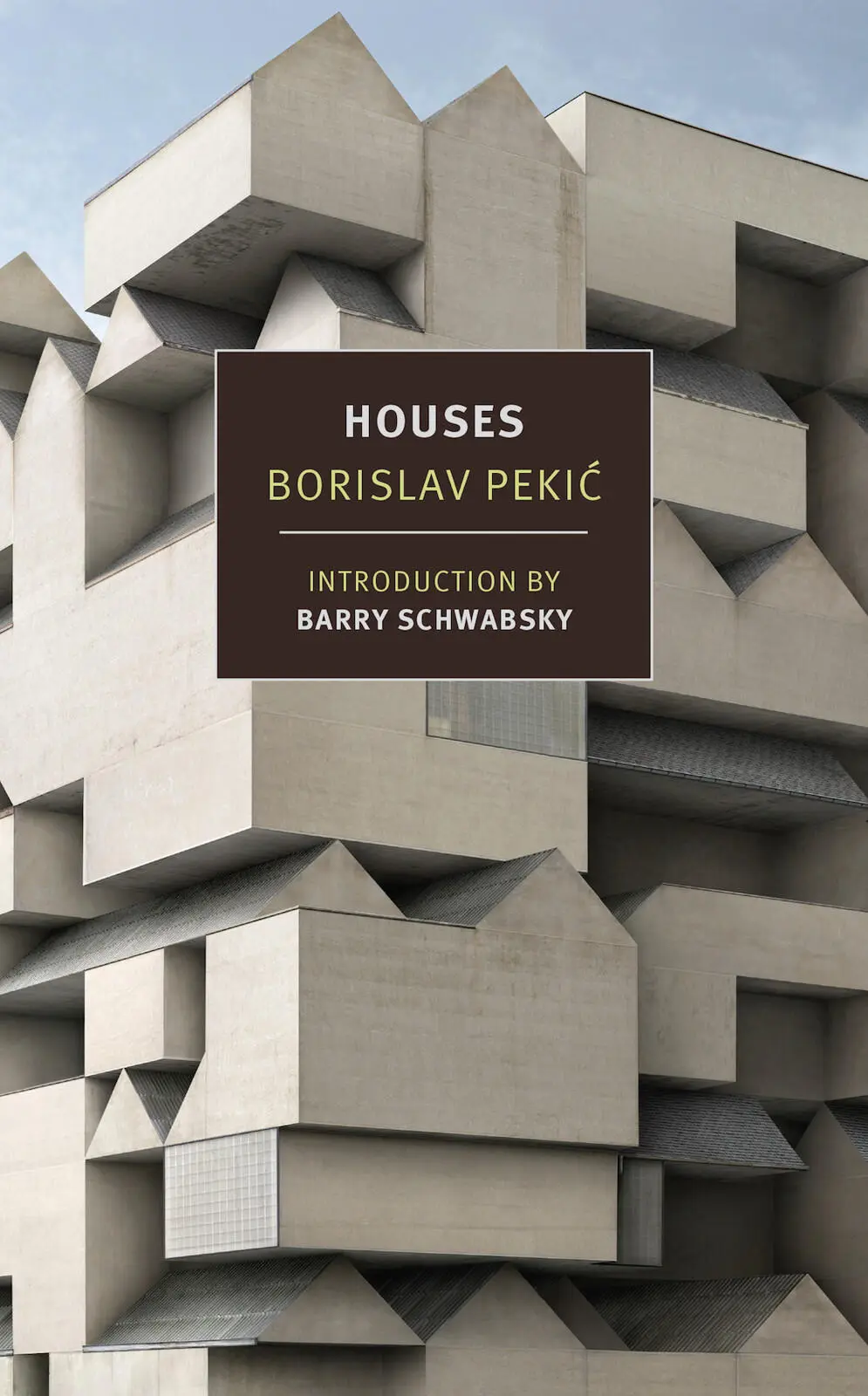
- Название:Houses
- Автор:
- Издательство:NYRB Classics
- Жанр:
- Год:2016
- ISBN:нет данных
- Рейтинг книги:4 / 5. Голосов: 1
-
Избранное:Добавить в избранное
- Отзывы:
-
Ваша оценка:
Houses: краткое содержание, описание и аннотация
Предлагаем к чтению аннотацию, описание, краткое содержание или предисловие (зависит от того, что написал сам автор книги «Houses»). Если вы не нашли необходимую информацию о книге — напишите в комментариях, мы постараемся отыскать её.
Bon vivant, Francophile, visionary, Negoyan spent the first half of his life building houses he loved and even gave names to — Juliana, Christina, Agatha — making his hometown of Belgrade into a modern city to be proud of. The second half of his life, after World War II and the Nazi occupation, he has spent in one of those houses, being looked after by his wife and a nurse, in hiding. Now, on the last day of his life, Negoyan has decided to go out at last to see what he has wrought.
Negoyan is one of the great characters in modern fiction, a charming monster of selfishness and self-delusion. And for all his failings, his life poses a question for the rest of us: Where in the modern world is there a home except in illusion?
Houses — читать онлайн бесплатно полную книгу (весь текст) целиком
Ниже представлен текст книги, разбитый по страницам. Система сохранения места последней прочитанной страницы, позволяет с удобством читать онлайн бесплатно книгу «Houses», без необходимости каждый раз заново искать на чём Вы остановились. Поставьте закладку, и сможете в любой момент перейти на страницу, на которой закончили чтение.
Интервал:
Закладка:
From the drawer I took a white poplin shirt with mauve stripes, and a hard shiny rubber collar and cuffs. Then I expertly knotted an ash-gray silk tie and attached it to my shirt with a gold pin, its head dark as night with a precious alexandrite diamond. From Katarina’s jewel case I took a pair of hollow gold cuff links like filigree tennis balls. Several more of my valuables were scattered about the box, but there were none of Katarina’s jewels. Suddenly I was seized with a terrible premonition. Ignoring it, I hoped that for greater safety she had transferred the jewels to the wall safe under the icon of Saint George. But they were not there either. Nor could I find them in her desk. I had nothing more to hope for; quite clearly Katarina had deposited her jewelry in the bank. Despite my resentment toward banks and their thieving activities — and she must have known of my attitude from my open feuds with all the eminent bankers of the kingdom — she had probably, from an irrational female fear of loss, entrusted her jewels, our jewels, our valuable possessions, the possessions of Arsénie Negovan, to people to whom I wouldn’t even have entrusted my excrement! So that’s it, I thought angrily: we’ll have something to talk about when she comes back from town.
I retained the linen I was wearing, but put on black socks, then my pointed black Bally shoes. In order to hide the seams, which were slightly cracked from standing long unused, I pulled on gray spats with a thin, darker edging. To all this I added two handkerchiefs hemmed with lace, arranging the smaller one in my coat pocket; light-blue gloves flecked with green; a light cane with a handle in the form of a silver greyhound’s muzzle; and after short reflection, a Panama hat whose wide Boer brim gave me a bohemian appearance, and which with its air of holiday relaxation compensated for the gloomy significance of my suit.
Bearing in mind an old man’s infirmity and my lack of practice in those slow actions which make up the art of dressing — the tie had to be tied in a pleated knot and pinned to the shirt front as a butterfly is pinned to a cardboard base; the buttons had to be pulled through the holes in the cuffs, which were stiffened from lack of use; the laces had to be threaded into the shoes, and the spats tugged on — and bearing in mind also my fear of being discovered, I, in fact, dressed myself quite quickly and neatly. However, I hadn’t once turned around to look in the mirror, being quite determined to view myself only when everything was in place. So at last I gathered up gloves, stick, and hat and went up to its crookedly hung, framed surface, marred by smoky streaks, to see how I looked in the suit which I had almost certainly worn last at the funeral of Constantine Negovan.
•
Of my eight fellow pallbearers, opposite me is Jacob Negovan, son and heir of the deceased. Behind us, barely keeping his dignity under the weight of the hexagonal oak coffin, wriggles Timon, representing the dead man’s absent brother Kleont, and the contractor’s first-born son, Daniel Negovan. The massive rear of the coffin is being hustled along by two of Constantine’s construction foremen with such unstoppable force that the nailed-down coffin sways as we charge down the steps of the chapel, and threatens to run away with the honorary pallbearers and descend like an avalanche on the hired musicians listlessly playing the Funeral March, and on the silent company gathered around the black and silver coach, to which are harnessed four black horses with the feathered mourning plumes fixed to their leather halters.
I can hear Timon, with the sharp-pointed ornament on the coffin lid painfully scraping his chin, telling the over-zealous bricklayers to slow down: “You’re not carrying a load of bricks on a building site, damn it!” The pressure from behind slackens off. Once again we’re carrying the coffin more slowly, though with every step we still stagger along the black carpet like an eight-masted boat pushed over a black wave by a wind from the stern.
I have no feeling for anything else but the dangerously increasing weight of the coffin; I am conscious of nothing save the orientally ornate chains, glistening in the damp October mist. From the sides of the coffin hang eight bronze handles entwined with thick gilt branches which only make it more difficult to carry the coffin, since my fist is too small to get a firm grip on them. Level with the lid, which is the color of burnt coffee, spread silver roots and palm fronds in riverlike profusion, recalling for Constantine, the architect, our Moskopolje origin; between them, gleaming islands of three-limbed, rhomboid-shaped bronze plaques alternate with silver arabesques, rolls, medallions, and gilt haloes from which the metal faces of angels shine as from a darkened window right up to the clasps, from which clustered silver lace falls motionlessly, caught up in places in loops of bulging yellow grain the size of ripe peas. I cannot see the legs, rolled in the form of scrolls, but one of them, the one beneath my handle, bangs against my bent knee at every step.
We move to one side, turning on the spot like a team of horses stuck in the mud, and place the coffin on the low catafalque, facing the gaping glass innards of the hearse. Then those on the left, headed by Jacob, come around to our side, and we line up along the right edge of the coffin so as to be able to take up the handles again immediately after the funeral oration, and lift the coffin into the coach. With my handkerchief I wipe away the sweat mixed with rain; the rain is no longer falling but is stationary in the murky air, lying on it like a veil of leaden drops. The musicians in their mournful capes press their instruments to their black chests: deadened movements of gold, from which here and there flutter damp, crumpled note sheets hung on wire hooks. In the darkened depths of the chapel somebody’s hand — probably Katarina’s — adjusts the folded-back draperies which cover the empty bier. The greasy dark yellow, brown, and mud-colored candles, cut by the funeral attendants’ scissors, smoke and hiss and choke in their wax.
Out of that murky cavern lit only by the amoebal flames, there moves toward me a wax procession of mauve flowers, oval wreaths with shaking leathery greens around their crowns of blooms, and a huge copper-bound cross on the horizontal member of which is inscribed: Constantine, son of Simeon Negovan, 1867–1936 .
Up into the movable black pulpit climbs the permanent secretary to the Ministry of Housing, G.K. He places a folded sheaf of paper on the reading stand, discreetly changes his glasses, impatiently tugs at the umbrella held over his head, coughs noisily to clear his throat, and begins the funeral speech. I can hardly hear him. Young Fedor Negovan, that irresponsible offspring of George’s, stands behind me whispering: “Make thee an ark of gopher wood; rooms shalt thou make in the ark, and shalt pitch it within and without with pitch.” I ask him to stop, but with redoubled sarcasm he goes on declaiming: “And, behold, I, even I, do bring a flood of waters upon the earth, to destroy all flesh, wherein is the breath of life, from under heaven; and every thing that is in the earth shall die.” I try to get away from his silky, thick, almost feminine alto, but cannot move because of the group of mourners pressing around the bier. “And the Lord said, I will destroy man whom I have created from the face of the earth; both man, and beast, and every creeping thing, and the fowls of the air…” The measured posthumous praises of Mr. G.K. are corrupted at the very moment when they reach my ear by a distorted echo: “… for it repenteth me that I have made them.” I turn toward the brazen culprit as far as the compressed space allows: “Will you shut up at once!” He looks me up and down like some object he has chanced upon, placidly, knowingly. “I can, Uncle Arsénie, but it won’t help. God had the Negovans in mind, too — in fact, I think he had them especially in mind.” “I don’t care what you think.” “I’m sorry about that, Uncle,” he answers mockingly, “but at the moment you’re not in a position to choose who you talk with.” “I’d gladly box your ears!” I’m angry, and this to my discomfort inspires him: “No you wouldn’t, and you can’t even move your hand. Besides, Uncle, you’re not sure how I’d behave: perhaps I’d repay you in kind. Actually, I’ve always wanted to hit a real, authentic Negovan. You’re not the one I had in mind, but you’d do.” “Why did you come to his funeral at all?” “For pleasure.” “To see how we die?” “Yes,” he admits straightforwardly, then coughs: “But even for me, if it makes any difference to you, it’s not very pleasant. Don’t you think that bureaucratic windbag could get on with his farting? Constantine won’t be any better off because we’ve caught a cold.” He is standing on tiptoe to try to stop the wet from seeping through the cracked leather of his shoes. “Where are your galoshes?” I say maliciously. I’m not sorry for him; the voluntary poverty of a Negovan who had, so to speak, totally cut himself off from the family and become an anchorite to humiliate us publicly only makes me angry. But this is not enough for Fedor. He wants to make me worry as well. “I haven’t got them any more. Sophia made them into slippers.” I hear him cough again. “For herself, of course,” he adds. “That’s in keeping with her name.” I’m pleased that he’s given me the chance to insult him. But quietly and with evident enjoyment, he agrees: “Yes, she’s a bitch, a born bitch. That’s what attracts me. With Sophia you feel as if you’re sleeping with a garbage can.”
Читать дальшеИнтервал:
Закладка:
Похожие книги на «Houses»
Представляем Вашему вниманию похожие книги на «Houses» списком для выбора. Мы отобрали схожую по названию и смыслу литературу в надежде предоставить читателям больше вариантов отыскать новые, интересные, ещё непрочитанные произведения.








Обсуждение, отзывы о книге «Houses» и просто собственные мнения читателей. Оставьте ваши комментарии, напишите, что Вы думаете о произведении, его смысле или главных героях. Укажите что конкретно понравилось, а что нет, и почему Вы так считаете.