Borislav Pekic - Houses
Здесь есть возможность читать онлайн «Borislav Pekic - Houses» весь текст электронной книги совершенно бесплатно (целиком полную версию без сокращений). В некоторых случаях можно слушать аудио, скачать через торрент в формате fb2 и присутствует краткое содержание. Год выпуска: 2016, Издательство: NYRB Classics, Жанр: Современная проза, на английском языке. Описание произведения, (предисловие) а так же отзывы посетителей доступны на портале библиотеки ЛибКат.
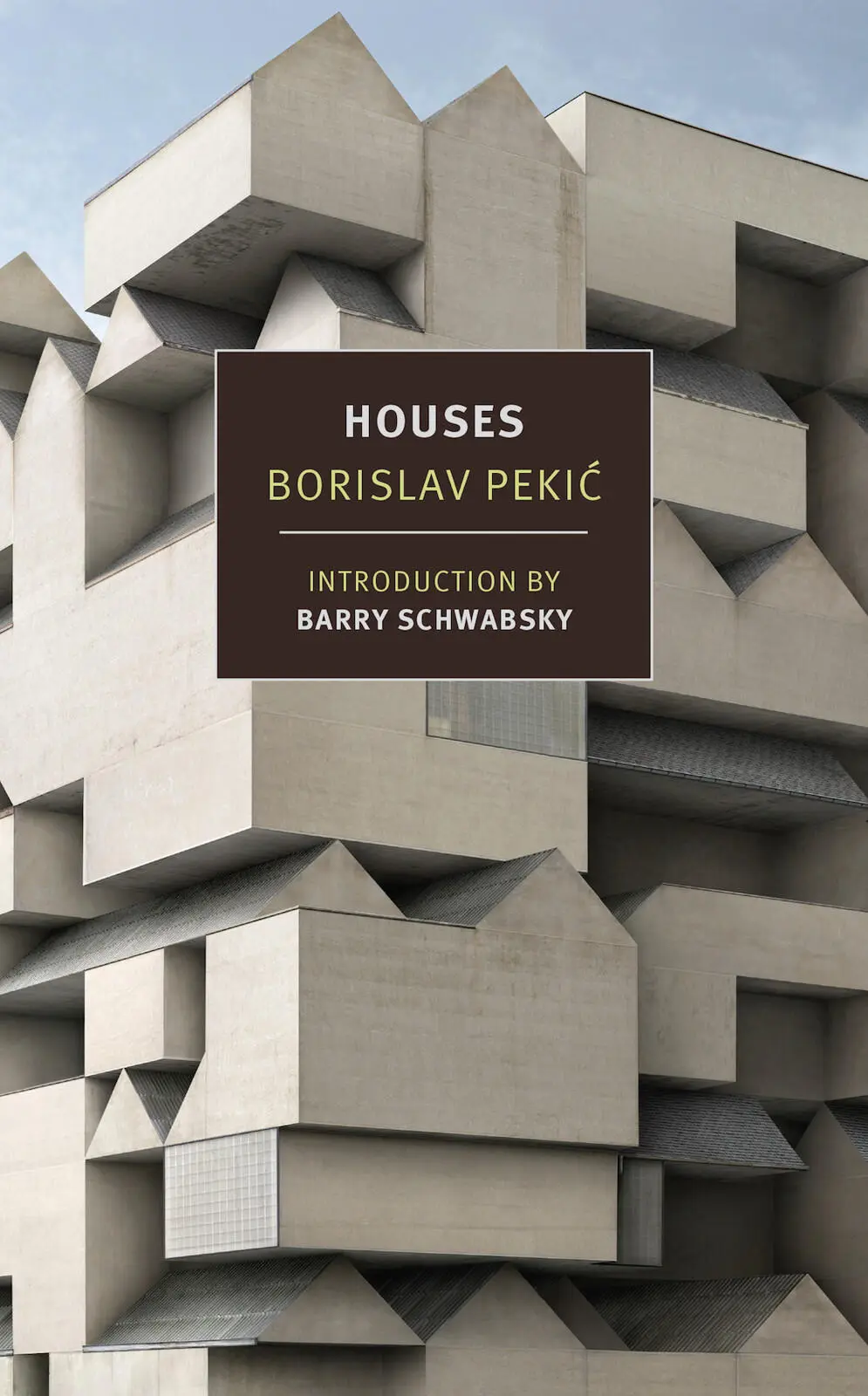
- Название:Houses
- Автор:
- Издательство:NYRB Classics
- Жанр:
- Год:2016
- ISBN:нет данных
- Рейтинг книги:4 / 5. Голосов: 1
-
Избранное:Добавить в избранное
- Отзывы:
-
Ваша оценка:
Houses: краткое содержание, описание и аннотация
Предлагаем к чтению аннотацию, описание, краткое содержание или предисловие (зависит от того, что написал сам автор книги «Houses»). Если вы не нашли необходимую информацию о книге — напишите в комментариях, мы постараемся отыскать её.
Bon vivant, Francophile, visionary, Negoyan spent the first half of his life building houses he loved and even gave names to — Juliana, Christina, Agatha — making his hometown of Belgrade into a modern city to be proud of. The second half of his life, after World War II and the Nazi occupation, he has spent in one of those houses, being looked after by his wife and a nurse, in hiding. Now, on the last day of his life, Negoyan has decided to go out at last to see what he has wrought.
Negoyan is one of the great characters in modern fiction, a charming monster of selfishness and self-delusion. And for all his failings, his life poses a question for the rest of us: Where in the modern world is there a home except in illusion?
Houses — читать онлайн бесплатно полную книгу (весь текст) целиком
Ниже представлен текст книги, разбитый по страницам. Система сохранения места последней прочитанной страницы, позволяет с удобством читать онлайн бесплатно книгу «Houses», без необходимости каждый раз заново искать на чём Вы остановились. Поставьте закладку, и сможете в любой момент перейти на страницу, на которой закончили чтение.
Интервал:
Закладка:
With Katarina’s gentle support, Helgar drags me away from the window. “Don’t be foolish, Herr Negovan, you can’t help your houses. You’ll only get hurt yourself.” “Am I important?” “And who’ll be left to take care of the survivors?” asks Katarina. “Who’ll repair those that are damaged?” There’s some sense in that, lato sensu , and I’m obliged to accept it. I let myself be led down the stairs, which are shaking as if a powerful motor is buried beneath the stone — a furious dynamo which keeps grinding to a halt with a muffled explosion, then continues its pounding with redoubled force — and I am taken into the laundry room, away from the vaulted edge of the concrete trough which is faintly lit by a dimmed oil lamp. Seated on an upturned linen chest, I suddenly feel as if the maddened machine is all around us, around the mildewed walls which are shaking off plaster and cement, and which tremble as if in the grip of a fever. Major Helgar takes a slim metal flask from his pocket. The raid had caught him in the bathroom: his officer’s jacket is thrown over his pink torso, overgrown with curly bristle the color of corn, and his cheeks are covered with a white, dried layer of shaving soap, like a clown interrupted while making up. He offers me the brandy, confessing that for such occasions— für diese besondere Gelegenheiten —he has prepared a dozen such containers (empties from some army medicine for rheumatism) which are both solid and light.
I decline his offer.
“My husband doesn’t drink, Major,” explains Katarina. She wraps me in a blanket which she had been carrying when we were still arguing, when she still wasn’t certain whether I’d agree to come down, and when I was still certain that I wouldn’t move from the observation post until the air raid was over and all my houses safe.
“I won’t drink with you, Major.”
“Why?”
“You can guess.” The motor around us slows down, then starts rumbling again.
“Because I’m a member of the occupying forces, I suppose. Ein einfacher Eroberer, nicht wahr?”
“No. It’s because you’re a soldier. Because of your war and not because of your occupation, Major.”
“Well, the war is as much yours as mine, Herr Negovan! We’re only two sides of the same bitch of a war.”
“You’re mistaken,” I counter emphatically. “This war is not mine!” I’m shouting above the detonations which now merge into a single incessant rumbling. “A man who builds houses or owns them cannot be party to a war. For him all wars are alien.”
My tenant’s lips open and shut in short jerks. He is talking, not to me but to Katarina, whom he is urging to get away from the outer wall and take shelter beneath the concrete trough. In that continuous torrent of noise, I’m striving to pick out from the single impervious mass of sound, from the middle of the acoustic cube in which I’m imprisoned, the scream with which my houses collapse — to distinguish the death rattle of Theodora at Dedinje from the agony of Alexandra at Vračar.
I ask Major Helgar — as a soldier, invader, and destroyer he ought to know — if every house dies as it lives, or if, like people, in death they cease to be distinguishable from one another. Instead of answering, without the slightest respect he pushes me rudely under the trough, and then he too squeezes in sideways.
I might easily never have recalled that barrage of noise. In fact the very next day after the Easter raid in 1941, when I was brought an exhaustive account of the damage — which, thank God, was far less than my panic-stricken estimates — I began to exclude that ill-favored raid from my conscious memory; or rather, I compressed it into a relatively ill-defined area of my memory, a cocoon which only under the pressure of extraordinary circumstances could be broken open. Thus of all the raids, there remained only a condensed impression in which an indefinite feeling of horror predominated over the most impressive scenes, and I would never have relived it in such frightening detail had I not again come down the same steps, and had that disintegrating pressure not at last been exerted. This time, of course, I didn’t continue down into the cellar but went out into the street, reflecting on the creaking gate which needed oiling.
The ground floor shutters were flung wide open; I had to move off quickly to avoid the kind Mr. Mihajlović, whom I hoped I had left in the certainty that I was resting in bed. I rounded the corner of Srebrnička Street, from where, stealthy but unhindered, I could take a good look at the house in which I lived, and which from the window I could only see at an angle. Near it a gas station had been installed. On both sides of a prefabricated hut, in which all sorts of brightly colored cans with strange labels were displayed, stood four squat blue-and-white gas pumps with thick hoses twined around them.
Even now I probably can’t explain why I never felt the need to give 17 Kosančićev Venac a name. Viewed from the street, the house had no special qualities. On a fine-grained brown plane, consisting of three vertical fields above a raised plinth which was pierced by three horizontal cellar windows, rose the ground floor and the second story, separated by two medallions in the shape of stone insignias in relief. On the third level a wooden door bound with forged iron opened onto a semicircular patio, while the whole building was topped by an almost flat roof, bordered by a balustrade with closely set railings in the form of stone skittles. It was natural that my own habitation should not inspire me in the same way as Simonida or the uninhibited, not to say lascivious, Theodora. Nevertheless, despite her lack of visual appeal, she possessed something unique. Since this was not visible from the outside, you had to go around and down onto the embankment, and look at her from the river, to see what it was that set her off: she possessed the finest orientation on the plateau of Kosančićev Venac, and her windows, facing west and overgrown with ivy, offered an unequaled view over the Srem plain.
From the window everything seemed new, different . But with the exception of the gas station, nothing on Srebrnička Street had actually changed. Not even the Turkish cobblestones had been replaced by macadam — something I had tried to get done before the war. Whenever I’d thought about this sortie, I’d always envisaged myself on some unfamiliar corner, groping about helplessly like a blind man who taps the objects around him with his white walking stick, searching for traces of the past from which to orient himself. There was, I will admit, something childish in my behavior in those imagined surroundings; a grown man shouldn’t have suffered the kind of agony I brought on myself. What’s more natural than a town being transformed from year to year, built up and demolished. Had I not myself contributed to its metamorphosis, had I not myself pulled down single-story cottages to build my houses in their place? Still, whenever I had tried to apply this reasoning to my imagined outing, after wandering for some time unimpeded through the transformed but still recognizable streets, I’d always end up at that inevitable and fateful corner (it was built of reddish brick, faced with whitened edges; the angle of the pavement at the corner was railed off with an iron chain of heavy, rusty links, whereas on the opposite side, which always remained incomplete for me, there was a square with an elliptical asphalt promenade) — that fateful corner on which everything suddenly became unknown, strange, hostile.
I can’t say that the fear of that brutal corner disappeared after I’d taken a few steps, but that fear was put into perspective. I convinced myself that even if I did stumble upon that corner, the actual experience would be far less shattering than the imagined one. To develop some defense mechanism, I had to pay special attention to everything that differed in the slightest from the picture of the town I had carried with me when I had irreversibly withdrawn from public life, to everything which during my absence had been built, added to, set up, changed, removed. And of course not only to houses, although they obviously dominated my interest, but to companies, advertisements, traffic signs, kiosks, shops, cars, and perhaps (why not?) even people.
Читать дальшеИнтервал:
Закладка:
Похожие книги на «Houses»
Представляем Вашему вниманию похожие книги на «Houses» списком для выбора. Мы отобрали схожую по названию и смыслу литературу в надежде предоставить читателям больше вариантов отыскать новые, интересные, ещё непрочитанные произведения.







Обсуждение, отзывы о книге «Houses» и просто собственные мнения читателей. Оставьте ваши комментарии, напишите, что Вы думаете о произведении, его смысле или главных героях. Укажите что конкретно понравилось, а что нет, и почему Вы так считаете.