Borislav Pekic - Houses
Здесь есть возможность читать онлайн «Borislav Pekic - Houses» весь текст электронной книги совершенно бесплатно (целиком полную версию без сокращений). В некоторых случаях можно слушать аудио, скачать через торрент в формате fb2 и присутствует краткое содержание. Год выпуска: 2016, Издательство: NYRB Classics, Жанр: Современная проза, на английском языке. Описание произведения, (предисловие) а так же отзывы посетителей доступны на портале библиотеки ЛибКат.
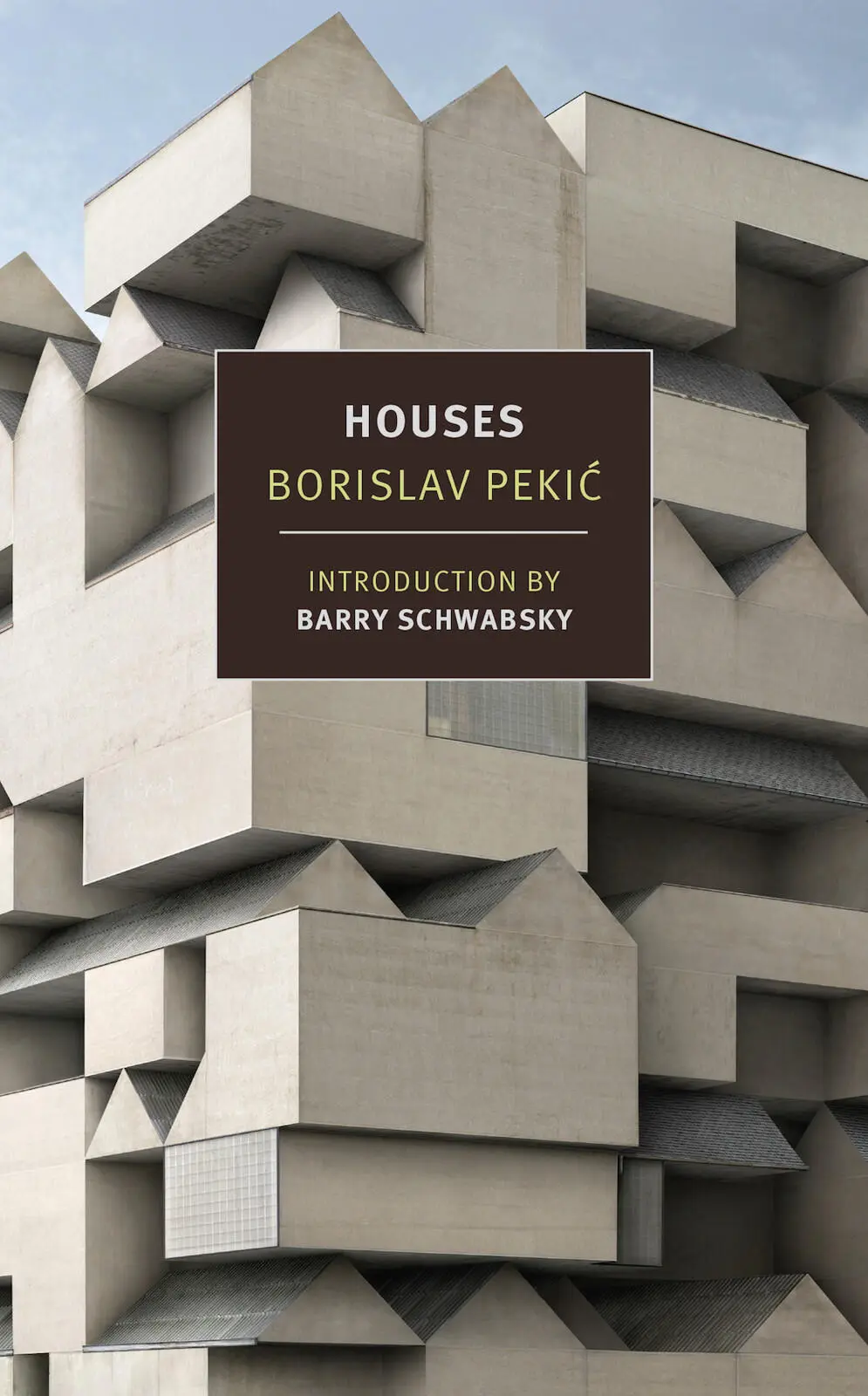
- Название:Houses
- Автор:
- Издательство:NYRB Classics
- Жанр:
- Год:2016
- ISBN:нет данных
- Рейтинг книги:4 / 5. Голосов: 1
-
Избранное:Добавить в избранное
- Отзывы:
-
Ваша оценка:
Houses: краткое содержание, описание и аннотация
Предлагаем к чтению аннотацию, описание, краткое содержание или предисловие (зависит от того, что написал сам автор книги «Houses»). Если вы не нашли необходимую информацию о книге — напишите в комментариях, мы постараемся отыскать её.
Bon vivant, Francophile, visionary, Negoyan spent the first half of his life building houses he loved and even gave names to — Juliana, Christina, Agatha — making his hometown of Belgrade into a modern city to be proud of. The second half of his life, after World War II and the Nazi occupation, he has spent in one of those houses, being looked after by his wife and a nurse, in hiding. Now, on the last day of his life, Negoyan has decided to go out at last to see what he has wrought.
Negoyan is one of the great characters in modern fiction, a charming monster of selfishness and self-delusion. And for all his failings, his life poses a question for the rest of us: Where in the modern world is there a home except in illusion?
Houses — читать онлайн бесплатно полную книгу (весь текст) целиком
Ниже представлен текст книги, разбитый по страницам. Система сохранения места последней прочитанной страницы, позволяет с удобством читать онлайн бесплатно книгу «Houses», без необходимости каждый раз заново искать на чём Вы остановились. Поставьте закладку, и сможете в любой момент перейти на страницу, на которой закончили чтение.
Интервал:
Закладка:
And so, entering Zadarska Street, I stopped to read on the decrepit sloping roof of a battered old house, in crooked, chalked letters: “Reconnaissance Detachment Toza Dragović.” I took this simply as a novelty and not, as might have been expected, a reason to feel disturbed, in that so many years after the war this puerile visiting card of some reconnaissance company of the Royal Army had not been erased, but remained to deface the house.
In the triangle between Srebrnička and Zadarska streets there was a bench which had been squeezed between the wall and a gnarled chestnut tree with such force that its slats, studded with large-headed nails, seemed to have grown right into the tree trunk. It looked as if, because it had served as a seat for so long, one end had reverted to its original form; or as if, by some strange quirk of reversed metabolism, the tree had put forth worm-eaten, flattened branches which parodied human handiwork. I was familiar with that deformed bench, too, only previously it had been surrounded by a small garden which now, still defending inch by inch the approach to the house, was being gradually pushed back by the street.
But the house itself held evil memories for me, not in its outward appearance, which was still fairly well preserved and solid, unmarred by any foreboding cracks, but because of a fullness which is characteristic of T.B. victims, people rotting away under a deceptively healthy exterior; it reminded me of the tragedy of Agatha. What had brought a serious crisis upon Agatha were my relations with Major Bruno Helgar, the only German whom, since he lived in the requisitioned flat downstairs, I had been forced to see with any regularity. Given the hostile attitude to the Occupation, my own forebearance couldn’t be understood, still less approved of, without the knowledge that the entry of the Germans into Belgrade — in other respects a cause for lamentation — didn’t affect me materially. I was sorry, of course, that it had come to this (despite the fact that I had criticized the government for their adverse attitude, and especially because of the provocative street riots which led me so irrevocably to seek a safe asylum in my home), and I of course shared the general unease with which one awaits an administration whose legal mechanism is unknown and whose measures of government cannot be foreseen. But with the exception of the cessation of building activity (I had already on my own largely given up the buying and building of houses), and the requisitioning of accommodations (which also in no way troubled me, for the Germans, in moving out the former inhabitants, took care of my possessions with truly Teutonic scrupulousness; given such an attitude to my houses, the question of financial compensation, although important, was never decisive for me) — with these exceptions, then, the only conflict between us arose as a result of the raid of April 6, 1941, in which the poor, blameless Agatha suffered. The other houses came out of it with minor damage — some were untouched — but Agatha perished, even though her position was not prominent, nor was there any tempting military object nearby.
However, that part of her fate which was the most unusual (when shall I ever stop mourning her?), and which made her a precursor of that solid house on Srebrnička Street, was that the mortal wound she had suffered that April went unnoticed. In the obvious sense of the word, there was no wound; nevertheless, for three full years thereafter, Agatha was in fact dying as she looked the very picture of health. She was expiring silently without any signs of weakness, without a single cry, without that cracking, grinding, and splitting which betray decaying buildings, until at Easter 1944 she gave way and, untouched by any bomb, collapsed of her own accord like a tower of cards. Seven tenants were crushed under her ruins, and the inquiry which was opened on a petition against me by their relatives took as its starting point the ignorant, base, and of course quite erroneous premise that property owners in their pursuit of profit rent houses which are dilapidated and liable to fall down. The inquiry categorically cleared me of that repulsive suspicion. Experts affirmed that Agatha, up to that time a perfectly sound and well-preserved building, had been seriously but unnoticeably damaged internally in the first German bombing — something like a human visceral hemorrhage — so that before she suddenly collapsed she was undermined from inside, decomposed, shattered; they affirmed that the owner had absolutely no way of knowing this and that in that year, 1944, a single distant shock had been sufficient to demolish her. There was no doubt that the house in front of which I was now standing would end up in the same way. And having made this observation, I was ready to proceed along Zadarska Street toward Topličin Venac.
At the line where the cobblestones gave way to a radical band of asphalt and I came out of the shade into the sun, I had the disturbing impression of leaving behind a forsaken region where eternal stillness reigned, broken only rarely by a sound of unknown origin, by some indistinct voice, the dense noise of the wings of a startled bird, the muffled squeak of a gate at the mercy of the wind, or a ship’s siren. I had the impression that the area which I had passed through so far was nothing more than an annex, an unusual continuation of my room; that the sidestreet with its close-set walls was only the corridor leading out of my house; and that the sunlit opening at its end, marked by a square metal sign warning me that I was entering the blue parking zone, was the door through which I would leave. It was as if I had still to take the first step toward Simonida.
I immediately told myself that my worry could not have been occasioned by the crowds I had encountered after stepping out of an empty street. Those people were quietly going about their business; indeed, most of them could have lived in my apartments without my losing self-respect. But I was no longer among them, among my own clientele, for suddenly I found myself in the midst of quite different people: again for the n th time and who knows at what cost, it was March 27, 1941; once again I was hurrying to Stefan’s auction and once again I came upon an unruly mob.
People were milling about in all directions, banging into one another, pushing each other aside like badly directed billiard balls. I had to get out of their way for most of them seemed not to heed where they were going, but on bumping into one another changed their course and with the same surefootedness set off in a new direction determined by the chance collision. It was as if they were bumping against muscular rubber mattresses from which they were flung back still more wildly, and then whirled around bemused in an elastic cage composed of invisible springs. But all of them, densely packed and growing denser as more arrived, were moving down toward Brankova Street and the concrete apron in front of the King Alexander Bridge, where a three-deep cordon of police was waiting for them. Not even those rioters whom the volcanic pressure at the center had driven into my street as into an empty sleeve, were by all appearances grateful at being squeezed out of this frightful mill whose grinding stones, turned by the mill wheel of hate, crushed, pounded, and ground them. No, with visionary blindness they again hurled themselves into it, pushing into the moving current of flesh as into plastic clay, and again merged with it in a ritual ecstasy which deprived them of control over their limbs. There could be no question of any individuality or reasoned initiative here: thus assimilated, faceless, depersonalized, they rushed on toward the bridge, deprived of any individual movement or personal choice of the direction which the demonstration was taking. It was as if all the separate strength of their previously independent bodies had been gathered together by a single all-absorbing superbody or omnibody which, freed from individual cares and restraints, was smashing and destroying everything in their now unburdened name.
Читать дальшеИнтервал:
Закладка:
Похожие книги на «Houses»
Представляем Вашему вниманию похожие книги на «Houses» списком для выбора. Мы отобрали схожую по названию и смыслу литературу в надежде предоставить читателям больше вариантов отыскать новые, интересные, ещё непрочитанные произведения.







Обсуждение, отзывы о книге «Houses» и просто собственные мнения читателей. Оставьте ваши комментарии, напишите, что Вы думаете о произведении, его смысле или главных героях. Укажите что конкретно понравилось, а что нет, и почему Вы так считаете.