Borislav Pekic - Houses
Здесь есть возможность читать онлайн «Borislav Pekic - Houses» весь текст электронной книги совершенно бесплатно (целиком полную версию без сокращений). В некоторых случаях можно слушать аудио, скачать через торрент в формате fb2 и присутствует краткое содержание. Год выпуска: 2016, Издательство: NYRB Classics, Жанр: Современная проза, на английском языке. Описание произведения, (предисловие) а так же отзывы посетителей доступны на портале библиотеки ЛибКат.
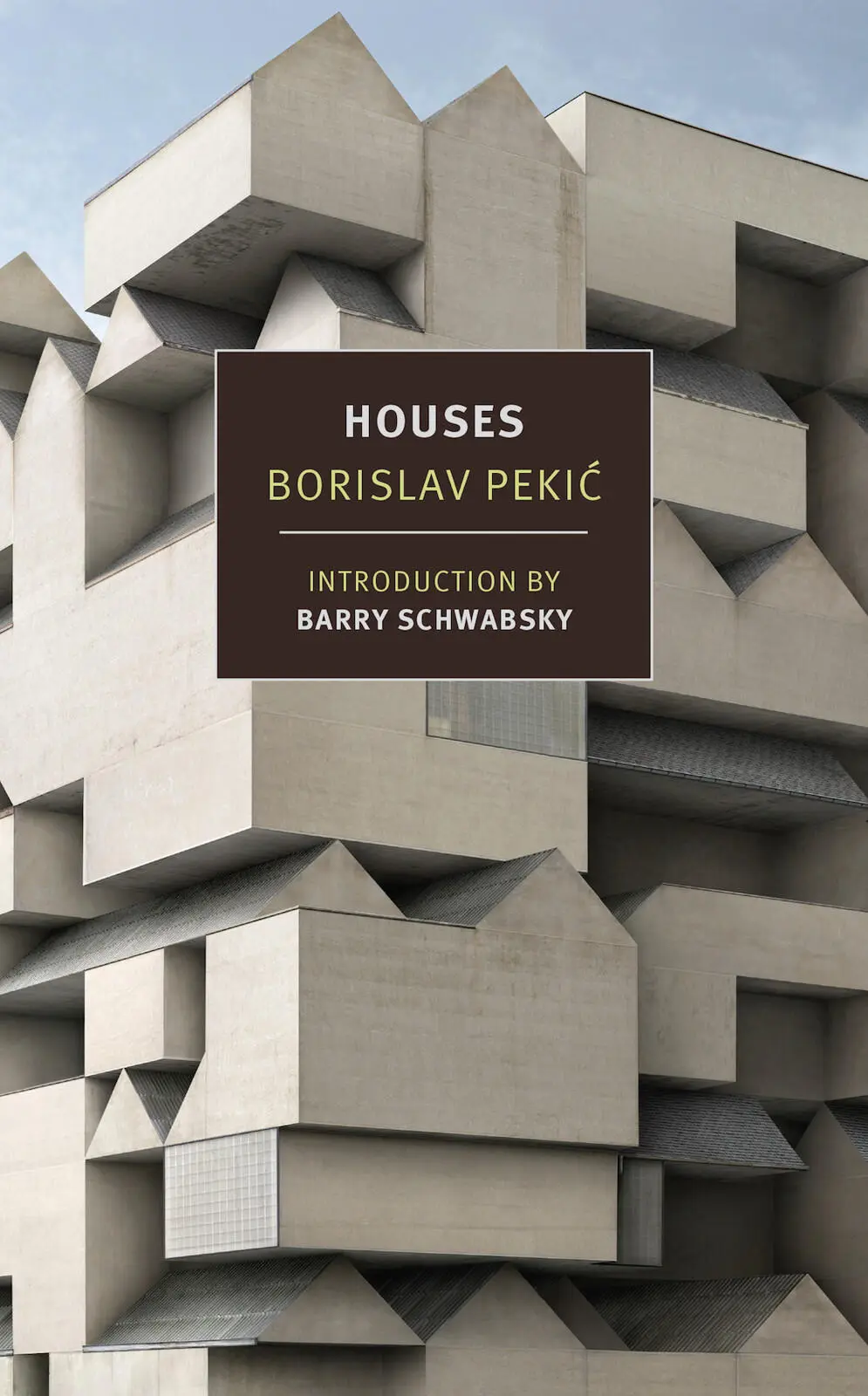
- Название:Houses
- Автор:
- Издательство:NYRB Classics
- Жанр:
- Год:2016
- ISBN:нет данных
- Рейтинг книги:4 / 5. Голосов: 1
-
Избранное:Добавить в избранное
- Отзывы:
-
Ваша оценка:
Houses: краткое содержание, описание и аннотация
Предлагаем к чтению аннотацию, описание, краткое содержание или предисловие (зависит от того, что написал сам автор книги «Houses»). Если вы не нашли необходимую информацию о книге — напишите в комментариях, мы постараемся отыскать её.
Bon vivant, Francophile, visionary, Negoyan spent the first half of his life building houses he loved and even gave names to — Juliana, Christina, Agatha — making his hometown of Belgrade into a modern city to be proud of. The second half of his life, after World War II and the Nazi occupation, he has spent in one of those houses, being looked after by his wife and a nurse, in hiding. Now, on the last day of his life, Negoyan has decided to go out at last to see what he has wrought.
Negoyan is one of the great characters in modern fiction, a charming monster of selfishness and self-delusion. And for all his failings, his life poses a question for the rest of us: Where in the modern world is there a home except in illusion?
Houses — читать онлайн бесплатно полную книгу (весь текст) целиком
Ниже представлен текст книги, разбитый по страницам. Система сохранения места последней прочитанной страницы, позволяет с удобством читать онлайн бесплатно книгу «Houses», без необходимости каждый раз заново искать на чём Вы остановились. Поставьте закладку, и сможете в любой момент перейти на страницу, на которой закончили чтение.
Интервал:
Закладка:
“I thought that a palace like Stefan’s would raise the value of any street,” said Katarina.
“And when have I cared about the money?”
She could see how angered I was by the mere suggestion that I would agree to put my pocket before my devotion to building, my only true activity, for which property ownership was simply a kind of civic alibi: that exciting and intoxicating feeling that I, with my own hands (for in the final issue, it is I who guarantee the means) take from nature as from some usurious possessor earth and ore, stone and wood, and give form to that rough clay, to that stone and wood; the feeling that with my own hands (for here too, don’t I guarantee the means?) I transform them at my designers’ drawing boards into magnificent visions, build them up finally into people’s possessions, possessions which only by name and for a short time are mine. Seeing therefore that she had wounded me deeply, my wife conciliatingly exclaimed that it wasn’t revenue she had in mind at all, nor wealth either, but standing, prestige; la renommée bourgeoise was what she was concerned with, in mentioning which— la renommée bourgeoise —she was really only repeating rather clumsily my own aired opinion that a house’s standing and that of its occupants were in a reciprocal relationship, like a mirror and the face reflected in it: the inhabitants of a house heighten its reputation and the importance of its location, just as a house, by its position, its location, guarantees the importance of its tenants.
At that, I rather skillfully drew her attention to the fact that it was indeed my houses which built up all those suburban districts before what she understood by address became important, and that the opposite was not, or only very rarely, the case. Despite the unquestionably favorable status of those districts — and in no case would I underestimate or deny its real effect on the continuous rise in the value of my properties — if it hadn’t been for me and entrepreneurs like me, and our enterprise, sincerity, professional talents, persistence, farsightedness, and even diplomatic skill (first intelligence and then money, of course, for what can intelligence alone achieve, what good is intelligence without means?), there wouldn’t have been any addresses on the hill at all, and certainly not those worth making any kind of fuss about. Instead, there would have been the garrison’s stables and gun emplacements; they would still be breeding geese on the open fields of Dedinje and Topčider; and the village yokels would still be lightheartedly relieving themselves against the gates of the few carelessly thrown together weekend houses.
“That’s just what I’m saying, Arsénie. If your houses built up Dedinje, why shouldn’t Stefan’s help build up Kosmajska Street.”
“Because there’s no need for anyone to raise Arsénie’s already solid values, and certainly not that lout Stefan with his oafish house!”
“Well, like it or not, you’ll have to raise Aspasia’s rent now.”
“I know. Only then I’ll have to renew her façade and have her painted, and perhaps even install central heating.”
“Well, at least you don’t mind spending the money.”
“Of course I don’t mind!”
Even without the new rental, I had intended to refurbish Aspasia. Clearly I would have spared neither money nor effort in putting her back into shape, but I didn’t want to waste money on making her stand out in the neighborhood. Renovation was necessary for Aspasia, not for my landlord’s pride, and she certainly didn’t need to be surrounded by gypsy shacks.
“I don’t care about money, Katarina, but I do need it for new construction.”
“Always new construction,” she said dispiritedly.
“Yes,” I said without bitterness. “Always new construction.”
There was no point in harsh words. She, poor child, just didn’t understand. She couldn’t understand that possession, like any other living thing — like love, for example, love or fame, power or capability, vice or virtue — must be fed, must grow, become fruitful and multiply, if it wishes to go on.
At this, I somewhat conceitedly set about explaining to her the beneficial significance of the reproductive urge for the industrial and social prosperity of the nation, referring continually to nature, and seeking out its already well-trodden paths, when suddenly she burst into tears. Seeing her distress, I abandoned my exposition. (Our personal contribution to this universal urge for reproduction was at that time, due to the ramifications of my landlord’s affairs, relatively lacking, and the fate of our only son, then not yet born, would later demonstrate that it was better to put a stop to such negligence.)
“For God’s sake, Arsénie, can’t you forget that house just for once?”
That evening we were awake for a long time, both because of the heat, which the proximity of our overheated bodies in the marriage bed increased unbearably, and from worry.
“How can I forget it when he’s ruined a whole street?”
“Sometimes I feel like setting it on fire!”
“And how do you think I feel about it?”
“It and all your own cursed houses!”
“He’s loused up the whole street!”
“The whole filthy town!”
“The whole street, I tell you!”
Indeed, as regards Stefan’s respect for conventions such as the unity of the object with urban space and its character, he could have put up a Chinese junk or some mammoth Polynesian idol at No. 41, had he wished to, and produced the same unseemly effect.
“What can you do now? It’s there.”
Perhaps I could have forced something through the Town Council. I would have received support from the property owners of Kosmajska Street: something of the sort was hinted at (with due respect for my family ties with Stefan) by Mr. Martinović, the wholesale grain merchant at the corner of Kosmaj and Topličin Venac, with whom I had the doubtful pleasure of making my first visit to the monstrosity. But the affair could never get as far as pulling it down, which would have been the only just and logical decision. God knows what kind of administrative circus we would have had to embark on — evidence and counterevidence, committees and subcommittees, complaints and petitions, applications, specialists’ reports, delays and postponements — without any real administrative outcome other than to provoke a dispute with Stefan and to offer the Negovan-Turjaškis yet another chance to accuse me of the Oriental sin of disloyalty to the family.
“I’d end up being called disloyal, and envious into the bargain, but still not achieve what I wanted.”
“I think I’ll go to sleep now,” said Katarina.
“You don’t understand it at all.”
“No, I don’t.”
“That monstrosity of Stefan’s would stay where it is, but I don’t say that nothing at all would be achieved. At least we could make certain that such abominations were stopped in the future, perhaps on the basis of some committee to keep watch over the town, since we still don’t even have an advisory body to defend our town by law from the whims of dilettantes and the nouveaux riches. We want to build a skyscraper — the only reinforced concrete skyscraper in Europe, and so forth — but when you get caught short in the street as I did recently, while tying yourself in knots you have to rush around to a friend’s — if you’re lucky enough to have one — and even then you can’t rush off straight from the door. You have to kiss your hostess’s hand before you can work around to your emergency. Otherwise you’re left only with some statue in the park, or a telegraph post like any little dog. He has to lord it over us, doesn’t he, with his Viennese secessionist horns for architectural candles. He probably thought that Kosmajska Street’s deadly provincialism needed jolting, as if streets were plum trees that have to be shaken, and as if Aspasia, say, wasn’t exciting enough. Some of our buildings are depressing, no question about it. But that my Aspasia with her faced stone and restrained decoration is old-fashioned, as he’s been saying, and rather impoverished-looking, we’ll have all that out in the open and soon, too. And if Stefan imagines that by building his monstrosity he’s found the most effective way of reviving the street, that just shows his own obscene sense of life.”
Читать дальшеИнтервал:
Закладка:
Похожие книги на «Houses»
Представляем Вашему вниманию похожие книги на «Houses» списком для выбора. Мы отобрали схожую по названию и смыслу литературу в надежде предоставить читателям больше вариантов отыскать новые, интересные, ещё непрочитанные произведения.






Обсуждение, отзывы о книге «Houses» и просто собственные мнения читателей. Оставьте ваши комментарии, напишите, что Вы думаете о произведении, его смысле или главных героях. Укажите что конкретно понравилось, а что нет, и почему Вы так считаете.