Borislav Pekic - Houses
Здесь есть возможность читать онлайн «Borislav Pekic - Houses» весь текст электронной книги совершенно бесплатно (целиком полную версию без сокращений). В некоторых случаях можно слушать аудио, скачать через торрент в формате fb2 и присутствует краткое содержание. Год выпуска: 2016, Издательство: NYRB Classics, Жанр: Современная проза, на английском языке. Описание произведения, (предисловие) а так же отзывы посетителей доступны на портале библиотеки ЛибКат.
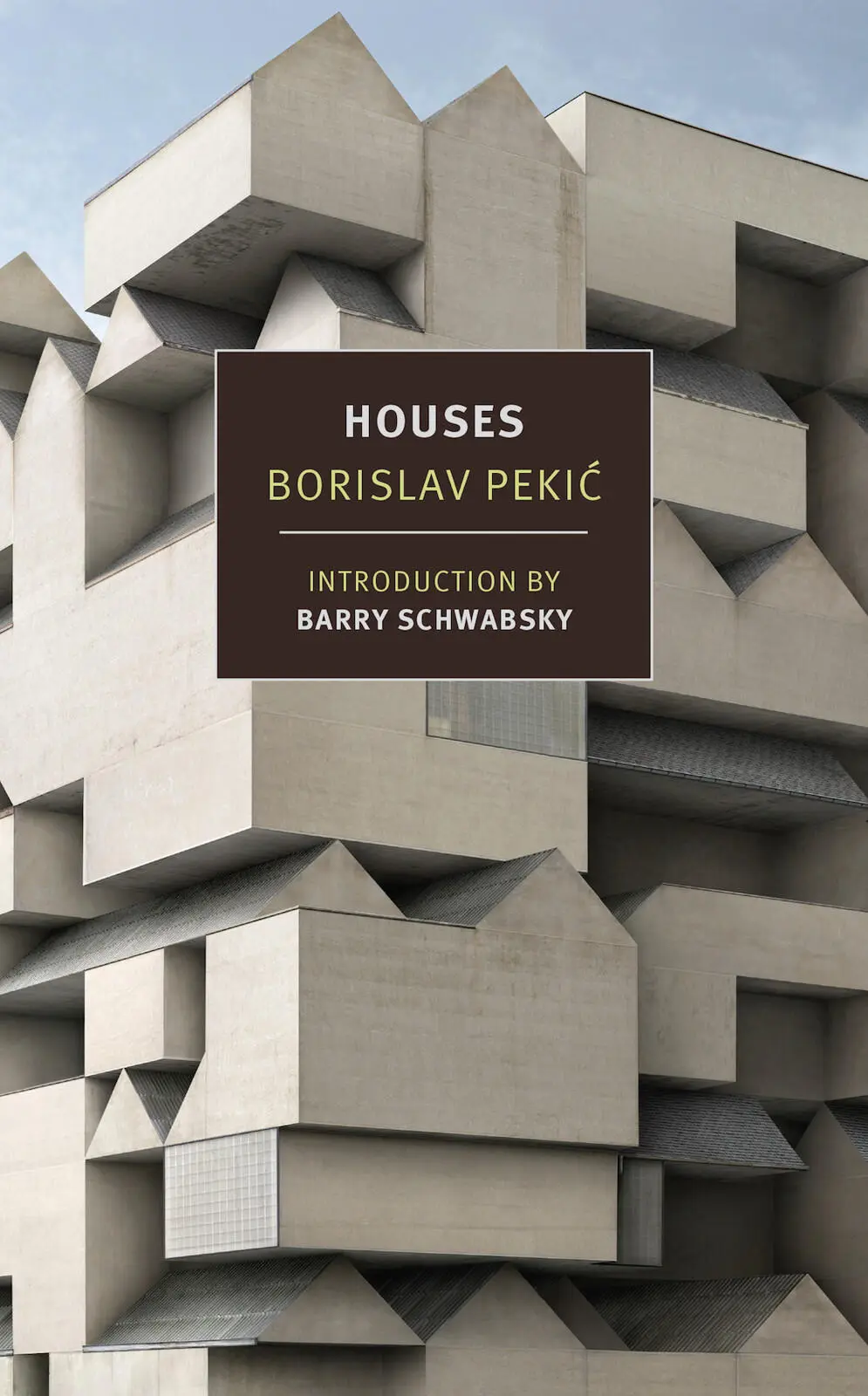
- Название:Houses
- Автор:
- Издательство:NYRB Classics
- Жанр:
- Год:2016
- ISBN:нет данных
- Рейтинг книги:4 / 5. Голосов: 1
-
Избранное:Добавить в избранное
- Отзывы:
-
Ваша оценка:
Houses: краткое содержание, описание и аннотация
Предлагаем к чтению аннотацию, описание, краткое содержание или предисловие (зависит от того, что написал сам автор книги «Houses»). Если вы не нашли необходимую информацию о книге — напишите в комментариях, мы постараемся отыскать её.
Bon vivant, Francophile, visionary, Negoyan spent the first half of his life building houses he loved and even gave names to — Juliana, Christina, Agatha — making his hometown of Belgrade into a modern city to be proud of. The second half of his life, after World War II and the Nazi occupation, he has spent in one of those houses, being looked after by his wife and a nurse, in hiding. Now, on the last day of his life, Negoyan has decided to go out at last to see what he has wrought.
Negoyan is one of the great characters in modern fiction, a charming monster of selfishness and self-delusion. And for all his failings, his life poses a question for the rest of us: Where in the modern world is there a home except in illusion?
Houses — читать онлайн бесплатно полную книгу (весь текст) целиком
Ниже представлен текст книги, разбитый по страницам. Система сохранения места последней прочитанной страницы, позволяет с удобством читать онлайн бесплатно книгу «Houses», без необходимости каждый раз заново искать на чём Вы остановились. Поставьте закладку, и сможете в любой момент перейти на страницу, на которой закончили чтение.
Интервал:
Закладка:
So Arsénie Negovan, Vice-President of the Chamber of Commerce, sank so low as to settle accounts with the banks as part of a mob. And after he had been carried away by, let’s say, excitement, and had shouted stupidly, “And the banks — banks — the banks, too! — instead of coming to his senses and beating a retreat, he went on:
“It’s the fault of the Yiddisher banks!”
In such a senseless manner and quite without dignity — couldn’t he see what was going on around him? — he had caused the audience to focus, as if moved by a giant hand, on him. From everywhere came resounding echoes of his ridiculous exclamation (“That’s right!” “Down with the usurer banks!” “Let’s hear him!”). And those nearest him — above all the bovine suffragette in black and the veteran with a hook for an arm — took hold of him and, despite his resistance, raised him high onto someone’s shoulders as if into a saddle, his legs fast around someone’s neck, his unsteady fingers grasping hold of someone’s hair. He found himself face to face with the orator in the trench coat, who was awaiting him with encouraging approval in the shadow of the blazing sky.
As soon as I was more or less settled up there, I thought of my hat. I hoped now I’d be able to spot it. But of course it was nowhere to be seen; the rabble had demolished it.
Surely you felt an urgent need to do some explaining. Deceived by your unfortunate cry and your bedraggled appearance, they took you for one of them, a comrade as it were, and expected you to say something in the spirit of your first pronouncement. But the only thing that you should have said was that you had nothing to say to them , except that you disapproved of their barbarous behavior; that you wanted to be lowered to the ground; and that a path should be cleared for you to Kosmajska Street because you had more important business to attend to.
From the perspective of a promenade through more or less empty streets, dozing beneath a veil of slanting greenish light crisscrossed here and there by housewives sluggishly returning home from the market or by a civil servant hurrying to his office — from such a peaceful, leisurely perspective, that was truly all that Arsénie K. Negovan should have communicated to the people below him. But in the context of the rebellious mood of the streets, including the unpleasantness of losing my hat, the torn-off buttons, those evil placards, and especially the red banner beneath which, as under a royal canopy, the preceding orator was enthroned — not to mention my memories of Solovkino — any explanation of the kind suggested would have been devoid of reality. In that sense, my life had always differed from my work. Even if I had attempted some sort of explanation, they wouldn’t have heard me. No one would have heard me. It had already gone too far.
But couldn’t you have tried something else? Wasn’t there something behind your acceptance of the role of street orator?
Something behind it?
Stop and think for a moment. You’d listened to the whole speech, hadn’t you?
Yes. But I was looking at my watch the whole time, hoping that the crowd would disperse and let me reach Kosmajska Street. Indeed, I spent the whole time imagining the events at Niké: Stefan welcoming the buyers, serving them drinks, wondering why I’d failed to show up.
But you still listened to the speech — so carefully that even now, after many years, you can repeat it to the last detail.
Who knows if that’s what was really said!
Let’s suppose it was. Just as we accept without question everything else you remember. Yet at no other time had you felt called upon to intervene — even when he was talking about financial speculation. Why Arsénie? Why?
Well, there was truth in what N.N. was saying. Of course that business about our Czechoslovak brothers was all just street-corner rhetoric. But the part about our economic policy was true, primitively interpreted certainly, but the absolute truth just as I myself had preached it — and to which, incidentally, I’d dedicated my lecture to the Sisters of Serbia.
The lecture you never gave.
The lecture I never gave.
Suddenly you saw your chance, Arsénie, you still had the lecture in your head, as clearly as if it were before you in print, just as it had been before your canceled appearance at the Kolarac Institute. The audience was there in front of you, receptive and ready, like the Serbian Sisters had they been given the chance.
It was all about the collapse of the property system, the replacement of that real, human system by a new, unreal, inhuman one, the transformation of objects into symbols, things into numbers. And you abandoned caution, all civic dignity, you forgot the passage of time, the auction which would begin at any moment. You forgot your beloved Niké, you became the worst kind of paid agitator, in the middle of the street, and with no hat and a torn coat at that.
“Honored Lady President! Esteemed ladies! Gentlemen!”
Someone burst out laughing, but he was silenced by other citizens who had greater respect for the seriousness of the moment.
“I am speaking to you according to the program—”
“Long live the Communist Party program!”
“—As I said, to set out before you the economic life of Belgrade, I shall take in the economic factors of the whole country and indeed of the whole continent, tear off the mask from that incompetent and alien policy which at last, here and now, has brought us to disaster!”
“Down with the antinational government! Down with the gravediggers of Yugoslavia!”
You raise your hand to silence the audience. You need to concentrate. Interruptions disturb you.
“Esteemed ladies, gentlemen! The very last moment has arrived for us to speak without ambiguity or prevarication…”
“Better war than the Pact, better the grave than be a slave!”
“… and especially the existence of the ordre de propriétaire , that toiling breed of people who, like Antaeus on his powerful shoulders, have been carrying the weight of social progress!”
“Long live the working masses!”
“And we ask ourselves what could more worthily express a nation’s capacity for existence than the vitality of its ownership class, and we answer boldly at once: rien, rien du tout, absolument rien!”
“Louder!”
Now you must be very serious in what you remember, Arsénie; all at once the events have begun to mingle, as if emulsifying, as if they were sinking back into the anonymity of a general impression from which only your sharpest words can be distinguished. Over there to one side, no more than a few yards from you, a group of young men are laughing out loud.
Yes, those youths. Clear faces. An exceptionally favorable sign. The general mood is good, people are relaxing, and the anger is disappearing; it seems that at last, as they say, I’ve got them.
“What’s all this about, folks?”
“Never mind, hear him out!”
“He’s crazy!”
“Just you keep going, Grandpa!”
“Shut up over there — let him alone!”
“If we cast just a superficial glance at the state of our national economy, what do we see? An amazing picture of calamity: quarries shut down; speculation in timber; the synthetic cartel dictating prices to us in association with I. G. Farben; unfair increase in the cost of skilled building services; incompetent upstarts in our architectural design bureaus who are allowed to have their own way…”
“Enough! Enough!”
“… the complete absence of regulatory plans and any kind of urbanist ideas. On the other hand…”
“Go fuck yourself!”
“… with the helpless feelings of well-meaning owners, we see impoverished citizens unable to put roofs over the heads of their children, while the finest flats stand empty. For houses, esteemed ladies, are like human souls: if we don’t inhabit them, they are lost. And most of all, ladies and gentlemen…”
Читать дальшеИнтервал:
Закладка:
Похожие книги на «Houses»
Представляем Вашему вниманию похожие книги на «Houses» списком для выбора. Мы отобрали схожую по названию и смыслу литературу в надежде предоставить читателям больше вариантов отыскать новые, интересные, ещё непрочитанные произведения.








Обсуждение, отзывы о книге «Houses» и просто собственные мнения читателей. Оставьте ваши комментарии, напишите, что Вы думаете о произведении, его смысле или главных героях. Укажите что конкретно понравилось, а что нет, и почему Вы так считаете.