Borislav Pekic - Houses
Здесь есть возможность читать онлайн «Borislav Pekic - Houses» весь текст электронной книги совершенно бесплатно (целиком полную версию без сокращений). В некоторых случаях можно слушать аудио, скачать через торрент в формате fb2 и присутствует краткое содержание. Год выпуска: 2016, Издательство: NYRB Classics, Жанр: Современная проза, на английском языке. Описание произведения, (предисловие) а так же отзывы посетителей доступны на портале библиотеки ЛибКат.
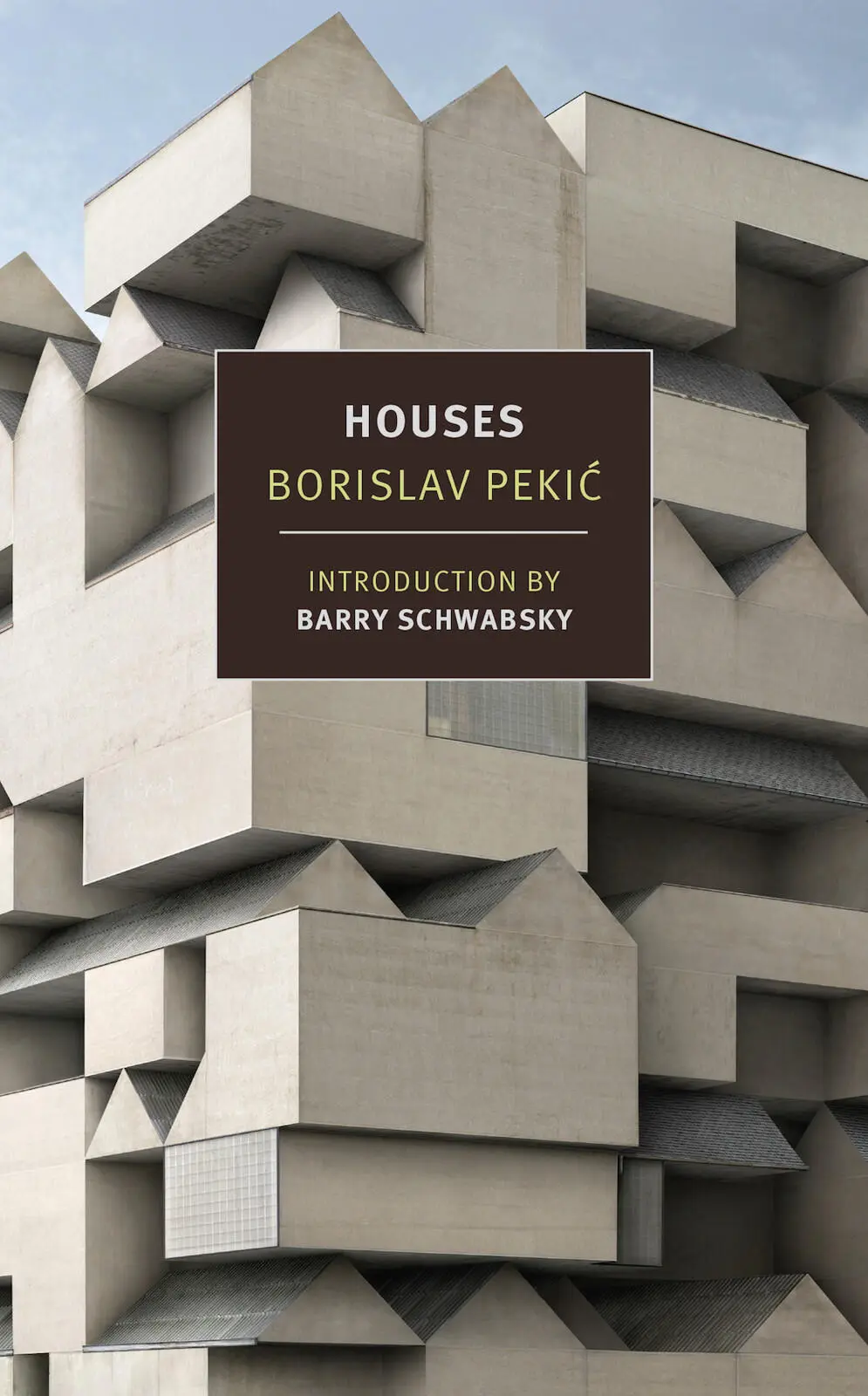
- Название:Houses
- Автор:
- Издательство:NYRB Classics
- Жанр:
- Год:2016
- ISBN:нет данных
- Рейтинг книги:4 / 5. Голосов: 1
-
Избранное:Добавить в избранное
- Отзывы:
-
Ваша оценка:
Houses: краткое содержание, описание и аннотация
Предлагаем к чтению аннотацию, описание, краткое содержание или предисловие (зависит от того, что написал сам автор книги «Houses»). Если вы не нашли необходимую информацию о книге — напишите в комментариях, мы постараемся отыскать её.
Bon vivant, Francophile, visionary, Negoyan spent the first half of his life building houses he loved and even gave names to — Juliana, Christina, Agatha — making his hometown of Belgrade into a modern city to be proud of. The second half of his life, after World War II and the Nazi occupation, he has spent in one of those houses, being looked after by his wife and a nurse, in hiding. Now, on the last day of his life, Negoyan has decided to go out at last to see what he has wrought.
Negoyan is one of the great characters in modern fiction, a charming monster of selfishness and self-delusion. And for all his failings, his life poses a question for the rest of us: Where in the modern world is there a home except in illusion?
Houses — читать онлайн бесплатно полную книгу (весь текст) целиком
Ниже представлен текст книги, разбитый по страницам. Система сохранения места последней прочитанной страницы, позволяет с удобством читать онлайн бесплатно книгу «Houses», без необходимости каждый раз заново искать на чём Вы остановились. Поставьте закладку, и сможете в любой момент перейти на страницу, на которой закончили чтение.
Интервал:
Закладка:
Niké no longer existed . My enchanting Niké was dead, dead and buried beneath an offensively ugly stele in the shape of a public promenade. Not only she but her closest family had been brutally rooted out — probably according to some inhuman principle of co-participation in misfortune. Everything that was there in her place seemed so unreal that, completely unhinged by this somnambulist vision, I thought — what am I saying, I hoped — that I had lost my way (this isn’t Kosmajska Street, it’s the street of some Biryuzov!), and that as soon as I pulled myself together I’d find the right one, where Niké would be waiting for me. But the awareness that I was leaning on Kleont Negovan’s house, and that my disappointed gaze could turn to Aspasia whenever it wanted, brought me harshly back to the fact that Niké was no more, that if I wished, I could walk around her tomb.
And you, Arsénie, you were so certain that you knew everything about the outside world simply because you found out about your brother’s death? There are other things too which have ceased to exist in the meantime — your Niké, for example — and who knows what else. Of course, they would have stayed alive if you hadn’t seen them dead.
I directed my steps toward the square as if approaching a deathbed, a deathbed without a corpse, a concrete and grassy catafalque from which the coffin had long ago been removed. Where a luxurious fireplace with Moses’ hybrid face had once stood, there were now red and green benches. Dry, dusty grass grew from the vestibule; on the first step of that portal which had caused me so much irritation, there now stood a rusty hydrant; in the middle of the salon where I had imagined the gathered buyers, was a wrought-iron tube with flowers; and over it all rose the empty stories of the burning June air. Nothing was left of Niké. Not even the cadaverous breath of a cemetery. Even the most insignificant carrion leaves a skeleton behind under the sky’s mantle; our own dead give off incomprehensible phosphorous signs from under the earth; ruined buildings resist destruction and withdraw deep underground, keeping their own remembrance in the scarcely discernible shape of their former foundations; shattered stars are scattering particles even now. But of Niké there was no trace — only a cross-shaped pathway stamped on the barren earth like a brand. And the picture of Niké in the Chinese embossed ivory frame on my desk.
Nothing held me here now. I walked on toward Aspasia, but with the feeling that I owed something to Niké’s memory. It would have been heartless to leave without making an attempt to find out under what circumstances she had been destroyed. The most natural thing, of course, would have been to call on Kleont. But that would have required an explanation for which, at the moment of mourning, I was least of all disposed.
As I approached Aspasia I noticed a sign: a clumsily drawn shoe, and next to it white as chalk: SHOEMAKER — SOFRONIJE ŽIVIĆ—COURTYARD: TURN RIGHT. Sofronije Živić, shoemaker? No, there was no one with that name among my tenants. Nor had Golovan told me of a shoemaker in Aspasia. But it was quite clear why he had remained silent. He knew well that I didn’t allow workshops in my houses, still less crude signs hung over their doorways. There could be no further doubt that my lawyer had been lying to me about many details concerning my houses. In this light, his obliging behavior became understandable and his exaggerated conscientiousness took on a different meaning. Standing beneath that chalklike shoe, I remembered another illuminating incident. I had asked that the business records be brought to me for inspection. The weather was bad, the temperature ten degrees below zero. Golovan had come personally, by car in fact, to hand over the books. Feeling guilty about disturbing him, I had asked him why in God’s name he hadn’t sent the books with one of his clerks. He replied that he had prepared them personally in order to provide me with supplementary information. This explanation had seemed reasonable, and it gratified me to see in it that professional pride which had disappeared from commercial affairs. But in actual fact Golovan had feared lest I question his subordinates and so find out everything he had been concealing from me. I decided that a clarification of this puzzling situation would be my first concern on returning to Kosančićev Venac.
As I feared, the shoemaker Sofronije Živić worked on his loathsome shoes in a workshop of unbaked bricks which, parasitelike, clung to Aspasia’s defenseless back. A workshop resembling a disgusting tick which sucked out of the parent house’s body all the strength it possessed. And of course, under such conditions Aspasia’s garden was no longer a picture-book rosary but an abandoned polygon paved with bricks, halfway between a cesspool and a stockyard.
From the shoemaker, in his apron of shiny brown leather — to whom, incidentally, my name meant nothing — I managed to learn very little, except that he had settled there in 1950, that he took in footwear of all European types from boots and sandals to dress shoes and slippers, that the area had been heavily bombed, and that before he moved here, the ruins had been removed and the little park built in its place.
What could I do? I thanked the shoemaker and left. Only when I had gone halfway along Carica Milica Street did I remember that I hadn’t even looked at Aspasia.
My bookkeeping had always been irreproachably accurate; there were no inexplicable gaps or ambiguities. Subsequent alterations, falsifications, and deletions were unthinkable in the affairs of Arsénie Negovan. Every entry was written down punctually and precisely in the appropriate column. More than that, for each individual house I had kept in detail a kind of running record or diary in which, just as a proud father notes down important dates in the margins of the family Bible, I recorded important moments in the life of my houses: all the stages of their development on paper and their burgeoning growth on the building site; their short childhood, that carefree time in which they were not inhabited; their marriages, as I called their transitory associations with their tenants; and their temporary illnesses or misfortunes, followed by old age and death. Even those which for various reasons I disposed of — unwillingly, always with a sense of shame — were still entered in that account book as if they were mine, as if I were still caring for them, which in fact I secretly was: I established a discreet surveillance over them and in an indirect way I influenced their destinies, though to all appearances they were in the hands of others.
The bookkeeping columns dedicated to Niké, however, were half-empty. The last entries referred to Stefan’s letter (the invitation to the auction); then, under March 27, 1941, a space had been left where I intended to note down the price for which I bought the house. Under a later date was the information that on the evening of the 27th, as I was being carried back to Kosančićev Venac, the house was sold to Mr. Jovan Martinović, a wholesale grain dealer. Beneath Niké no line had been drawn; her account had not been balanced.
Was it because I had been guilty of her misfortune?
Was I guilty?
Alors , suppose that I hadn’t come upon the demonstrators, or that I’d pushed my way through the mob, taken part in the auction, and bought Niké. What difference would it have made, during the bombing in which she was destroyed? I couldn’t have protected her from the bomb: she would have been hit anyway.
No, Arsénie, you can’t give a true answer until you know how she was hit and to what extent she was damaged. Perhaps with a certain effort and expense she could have been put right and restored. Her plans still existed. (Even so, would that new, resurrected Niké have been my Niké, or just her successful imitation?) Perhaps Mr. Martinović hadn’t regarded such an error as either profitable or useful. For Mr. Martinović it had just been a heap of ruins like any other. I had to pay a visit to Mr. Martinović. Only he could give me the information that would establish the true measure on my part in her downfall.
Читать дальшеИнтервал:
Закладка:
Похожие книги на «Houses»
Представляем Вашему вниманию похожие книги на «Houses» списком для выбора. Мы отобрали схожую по названию и смыслу литературу в надежде предоставить читателям больше вариантов отыскать новые, интересные, ещё непрочитанные произведения.




Обсуждение, отзывы о книге «Houses» и просто собственные мнения читателей. Оставьте ваши комментарии, напишите, что Вы думаете о произведении, его смысле или главных героях. Укажите что конкретно понравилось, а что нет, и почему Вы так считаете.