Borislav Pekic - Houses
Здесь есть возможность читать онлайн «Borislav Pekic - Houses» весь текст электронной книги совершенно бесплатно (целиком полную версию без сокращений). В некоторых случаях можно слушать аудио, скачать через торрент в формате fb2 и присутствует краткое содержание. Год выпуска: 2016, Издательство: NYRB Classics, Жанр: Современная проза, на английском языке. Описание произведения, (предисловие) а так же отзывы посетителей доступны на портале библиотеки ЛибКат.
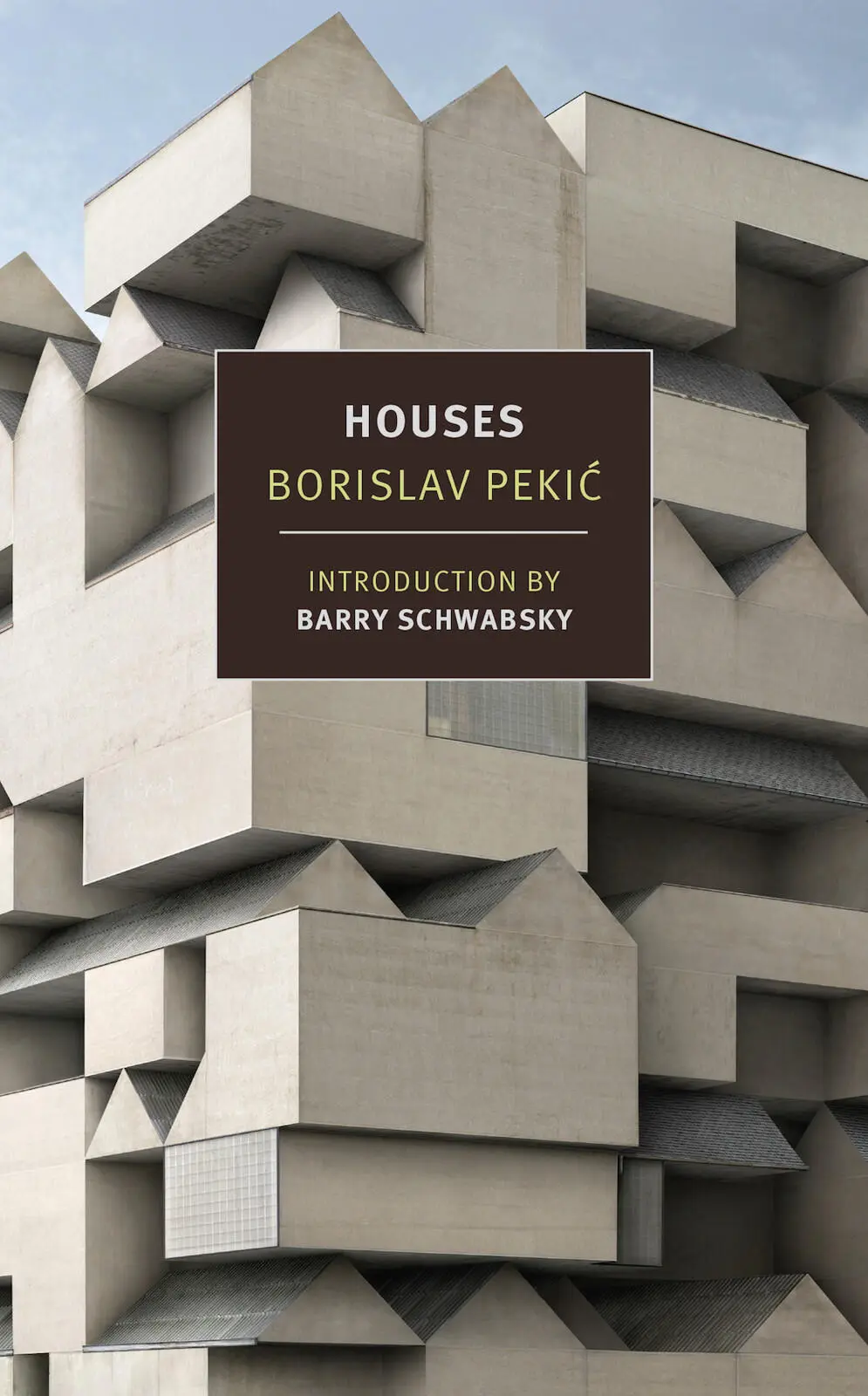
- Название:Houses
- Автор:
- Издательство:NYRB Classics
- Жанр:
- Год:2016
- ISBN:нет данных
- Рейтинг книги:4 / 5. Голосов: 1
-
Избранное:Добавить в избранное
- Отзывы:
-
Ваша оценка:
Houses: краткое содержание, описание и аннотация
Предлагаем к чтению аннотацию, описание, краткое содержание или предисловие (зависит от того, что написал сам автор книги «Houses»). Если вы не нашли необходимую информацию о книге — напишите в комментариях, мы постараемся отыскать её.
Bon vivant, Francophile, visionary, Negoyan spent the first half of his life building houses he loved and even gave names to — Juliana, Christina, Agatha — making his hometown of Belgrade into a modern city to be proud of. The second half of his life, after World War II and the Nazi occupation, he has spent in one of those houses, being looked after by his wife and a nurse, in hiding. Now, on the last day of his life, Negoyan has decided to go out at last to see what he has wrought.
Negoyan is one of the great characters in modern fiction, a charming monster of selfishness and self-delusion. And for all his failings, his life poses a question for the rest of us: Where in the modern world is there a home except in illusion?
Houses — читать онлайн бесплатно полную книгу (весь текст) целиком
Ниже представлен текст книги, разбитый по страницам. Система сохранения места последней прочитанной страницы, позволяет с удобством читать онлайн бесплатно книгу «Houses», без необходимости каждый раз заново искать на чём Вы остановились. Поставьте закладку, и сможете в любой момент перейти на страницу, на которой закончили чтение.
Интервал:
Закладка:
I hadn’t yet announced my intention of retiring, though I had hinted that I might transfer the renting and selling of houses to Golovan’s agency. As I might have foreseen, Katarina was delighted at the idea of my partial retirement, for she had always been jealous of my houses. She saw in Simonida, Sophia, Aspasia, Theodora, Agatha — with the superficial, benign naiveté of an exploiter — only walled, whitewashed, and painted cages for the collection of rent. She regarded my private relationships with them as, at the very least, eccentric. Yet when we had first become acquainted she proclaimed my passion “slightly unusual, different”; I believe it was my loyalty to architecture, and my capacity for elevating commerce to the status of art, which set me apart from her other suitors.
Anyway, Katarina received the news of my retirement with satisfaction. The poor woman even began to make plans. She said that at least in our old age — I was then fifty and she was nearly forty-five — we could live free of worries. After the war we could travel. We had traveled before the war, but never entirely for pleasure. Usually our transcontinental “wanderings”—only half transcontinental anyway, since I couldn’t bring myself to cross the Curzon Line — were associated with one of my business arrangements; either I had to view some new feature of residential architecture or attend some conference on housing, or I had to conclude a contract with foreign suppliers, so that I always seemed to carry my houses along with me.
There was as yet no word of my secret intention to seclude myself until the end of the war. Somehow that came about of its own volition. I kept on postponing going out of the house until one day Katarina asked me:
“Do you ever intend to go out of the house again, Arsénie?”
“I don’t know,” I said. I was telling the truth: I had no idea.
“What do you mean, you don’t know?”
“That’s just it, Katarina, I don’t.”
“Get a grip on yourself, or you’ll be an invalid for the rest of your life!”
“Nonsense! I feel all right. I’ve never felt better.” That wasn’t absolutely true, but I had no time for confessions. And it was better that way.
As usual, Katarina couldn’t let it be: “You’ve been told to walk in fresh air for at least an hour every day.”
“Don’t you think I do?”
Indeed, I had established my regular walk inside the house. I had opened all the doors between the rooms and made myself a “track” long enough so I didn’t have to turn around every minute, since a change of stride bearing weight on my damaged right leg still caused me pain.
“You call that walking in the fresh air?”
“I’ve opened the windows. We’ll see about going out later on.”
I never actually said that I wouldn’t leave the house until the war was over. I wasn’t in the mood, or it wasn’t the right moment. Sometimes I wasn’t feeling well, since the effects of my injuries were still with me. And lastly, I had at hand my most convincing reason, the only one in which there wasn’t even a suspicion of pretext: I had a lot of work to do. Each day I had to read Golovan’s summaries and various experts’ findings, sort out the rent receipts, approve the signing or termination of leases, documents for which the powers of attorney were insufficient, bring my correspondence up to date, file papers, check the ledgers, put the card index in order, study the photographs which had been coming in for some time, and in general occupy myself with my houses even more actively than when I had had them constantly before my eyes.
Apart from all this — I note it for my own satisfaction — I now had time to complete my education in housing. I had read a great deal before, and knew more than many practicing architects and most city landlords, but it was never enough, always less than what any self-respecting property owner should know of his profession.
Here I shall take advantage of a pause in my narrative.
•
Article 1 . Fully conscious and in possession of all my mental faculties, I hereby express my wishes concerning each section of my personal library in the field of architecture, easily recognizable since all volumes are bound in dark red calf-skin. All these books are to be excepted from the total of my immovable assets at Kosančićev Venac, which I otherwise bequeath to my lawful spouse Katarina Negovan, née Turjaški. The books shall be entrusted as a separate bequest to my nephew Isidor Negovan, son of Jacob Negovan, architect of Krunska Street, No. 19a.
(The list of books which makes up the legacy bequeathed to my nephew, Isidor J. Negovan, will be found with the other documents attached to my last will and testament in a white sealed envelope at the bottom of the top right-hand drawer of my desk. The key to this drawer is hanging from my belt with my other keys.)
•
But again, can I bid them farewell without a single good word for them? Of course I can’t say that those books about architecture made me fall in love with houses. They only explained to me why I love them. From them I was schooled in houses’ physiology, their circulatory system, their epidermic defensive envelope, even their stomachs, their sensitive stomachs, not to mention their life process. In addition to those features common to the majority of houses, I was particularly troubled by these secondary differences, I’ll call them differences of class and race, which despite the same materials that created them, distinguish the Morić Khan in Sarajevo from the Carleton Hotel in Cannes; Mansart’s Maison Lafitte from Eigtved’s twin palaces in Copenhagen; Hood’s Daily News Building in New York from Loos’s House of Commerce in Vienna; Perret’s building on Rue Franklin in Paris from Gaudi’s Casa Mila in Barcelona; or even my Daphina, designed by J. K. Negovan, from Wright’s Falling Water.
Lastly, also bound in calfskin on my shelves, were the biographies of the great master builders which I had obtained through the kindness of Jacob Negovan, through Mr. Kon the bookseller, or in the course of my journeys abroad. From books, then, I had come to know the mysterious process of a house’s conception, initiated long before its violent birth on the building site.
So as I have said, I had more than enough work, and an abundance of pretexts: my illness, business affairs, the war, the Occupation. In the final analysis, doesn’t everyone have the right to take a breather, to retire, to collect himself? When some famous person goes into a monastery, walls himself up suddenly in the stone box of a hermit’s cell, we show approval, but when a businessman takes brief refuge under the roof of his own house, he comes up against strident objections. Anyway, I went on repeating, I am, my friends, in excellent shape, you can expect to see me out again very soon. Yes, yes, out and about. When? That, unfortunately, I can’t say. In all probability, I’ll go out when the situation clarifies itself and I manage to find out what’s really going on outside. Incidentally, isn’t everything taking its normal course? I attend to my work, my professional interest in my houses hasn’t diminished. What’s more, it’s been strengthened through the action of an intermediary. (However much confidence I entertained toward Golovan — far better if I hadn’t! — my lawyer served me almost as an adding machine, a writing implement, or a tool which, while functioning irreproachably, had to be oiled regularly, supervised, and corrected.) We entertain as before; Katarina still has her Thursday sessions — true, because of work pressures I drop in on them less often, but we listen to the radio, subscribe to newspapers. In short, contact with the outside world is maintained in all respects.
Читать дальшеИнтервал:
Закладка:
Похожие книги на «Houses»
Представляем Вашему вниманию похожие книги на «Houses» списком для выбора. Мы отобрали схожую по названию и смыслу литературу в надежде предоставить читателям больше вариантов отыскать новые, интересные, ещё непрочитанные произведения.








Обсуждение, отзывы о книге «Houses» и просто собственные мнения читателей. Оставьте ваши комментарии, напишите, что Вы думаете о произведении, его смысле или главных героях. Укажите что конкретно понравилось, а что нет, и почему Вы так считаете.