Borislav Pekic - Houses
Здесь есть возможность читать онлайн «Borislav Pekic - Houses» весь текст электронной книги совершенно бесплатно (целиком полную версию без сокращений). В некоторых случаях можно слушать аудио, скачать через торрент в формате fb2 и присутствует краткое содержание. Год выпуска: 2016, Издательство: NYRB Classics, Жанр: Современная проза, на английском языке. Описание произведения, (предисловие) а так же отзывы посетителей доступны на портале библиотеки ЛибКат.
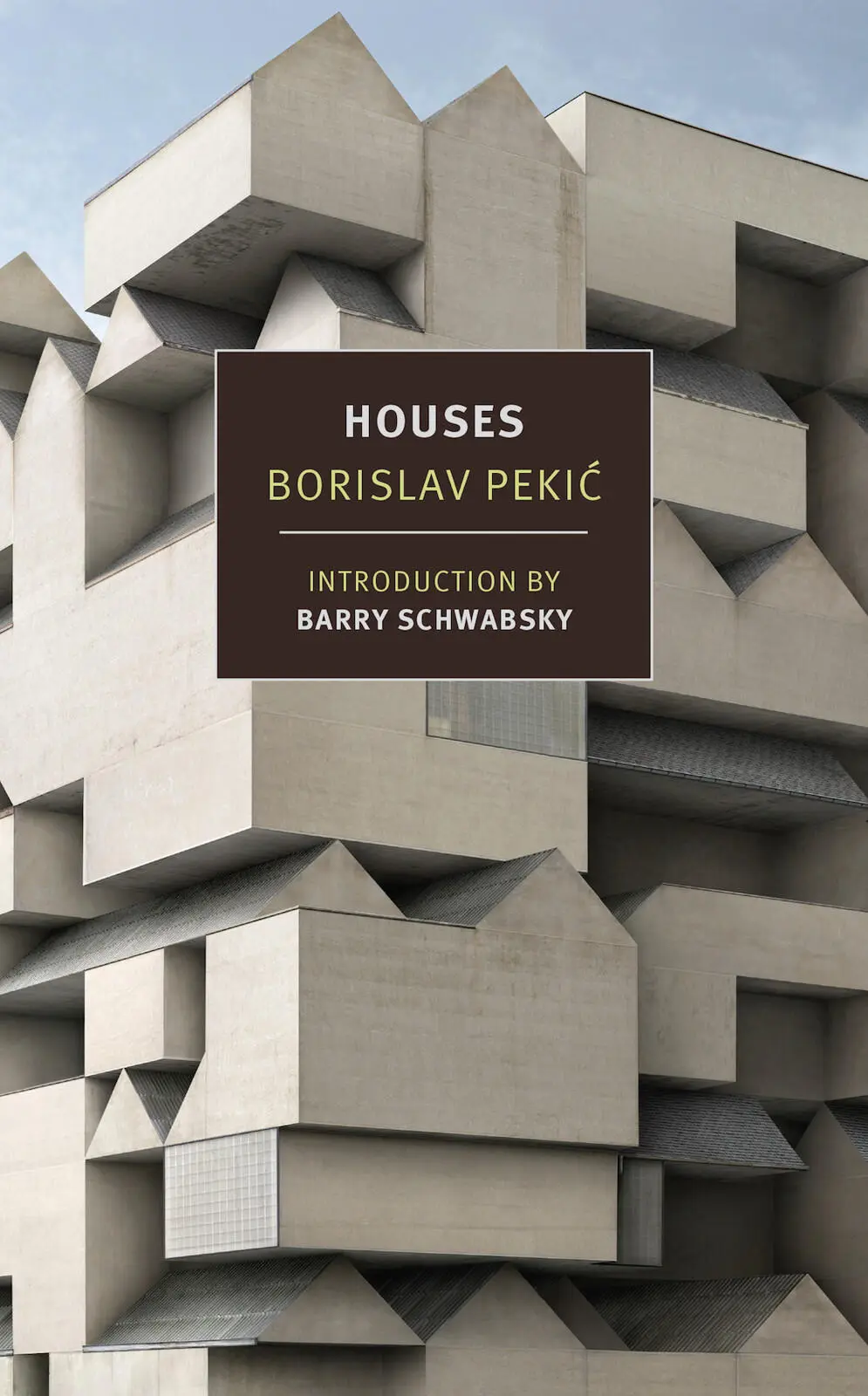
- Название:Houses
- Автор:
- Издательство:NYRB Classics
- Жанр:
- Год:2016
- ISBN:нет данных
- Рейтинг книги:4 / 5. Голосов: 1
-
Избранное:Добавить в избранное
- Отзывы:
-
Ваша оценка:
Houses: краткое содержание, описание и аннотация
Предлагаем к чтению аннотацию, описание, краткое содержание или предисловие (зависит от того, что написал сам автор книги «Houses»). Если вы не нашли необходимую информацию о книге — напишите в комментариях, мы постараемся отыскать её.
Bon vivant, Francophile, visionary, Negoyan spent the first half of his life building houses he loved and even gave names to — Juliana, Christina, Agatha — making his hometown of Belgrade into a modern city to be proud of. The second half of his life, after World War II and the Nazi occupation, he has spent in one of those houses, being looked after by his wife and a nurse, in hiding. Now, on the last day of his life, Negoyan has decided to go out at last to see what he has wrought.
Negoyan is one of the great characters in modern fiction, a charming monster of selfishness and self-delusion. And for all his failings, his life poses a question for the rest of us: Where in the modern world is there a home except in illusion?
Houses — читать онлайн бесплатно полную книгу (весь текст) целиком
Ниже представлен текст книги, разбитый по страницам. Система сохранения места последней прочитанной страницы, позволяет с удобством читать онлайн бесплатно книгу «Houses», без необходимости каждый раз заново искать на чём Вы остановились. Поставьте закладку, и сможете в любой момент перейти на страницу, на которой закончили чтение.
Интервал:
Закладка:
Then came the crisis which I have already described: the chance discovery that my Simonida was to be torn down; doubts about Golovan, Katarina, and their professional reports; the fear that something was happening to my other houses as well.
That very morning, June 3, convinced that it was still not too late, I had impatiently waited for Katarina and Mlle. Foucault to leave.
I was actually going out!
With a feeling of relief and adventurous pride I got up from the bench and, as much as my years would allow, hurried off toward Simonida, where I hoped the professional rebirth of Arsénie Negovan, property owner, would begin.
How best to approach the house in these unusual circumstances?
It was important to re-establish our onetime personal relationship, maintained during my hermitlike seclusion by means of photographs and Golovan’s suspect submissions. I cannot but admit that everything I had undertaken since going out of the house was more like the pilgrimage of a dispirited old man, searching for the past in unfamiliar places where he had erected its landmarks as memorials, than the march of the architect forging his future plans. Simonida was my last chance to end this futile wandering, to spend the rest of the day usefully for both myself and my possessions.
My pride in my house was, alas, rudely shaken when, en route, I found myself quite by chance in front of the most insignificant of them: the only house which, thanks to the builder’s pigheadedness and my unforgivable negligence (I had been away on a journey) enjoyed that life in an evil way, an adequate, but truly evil way and the only one that I shall speak of without respect or love. I would very gladly leave her out, but everything that is written down here on receipts and rent accounts is nevertheless my legal testament, and in such a loan from death there is no point in lying.
This “house”—which I must summon up all my courage to call mine — did not have a name. Even her model, built as a result of Katarina’s forgetfulness or carelessness of my own, was chopped up with an ax and burned the very day its illegitimate creator brought it from the office. In short, she was expelled as a monstrosity from the tribe of my houses, and the fact that she hadn’t been sold was due partly to the war, partly to the fall in market prices, and partly to Golovan’s negligence. Finally, to round it all off, this house was truly ugly with her blind, prisonlike walls, clumsily bared, with bilious yellow ceramic moldings on the parapets, and bands of flowery white natural cement in horizontal spurts, with windows like gun emplacements, with a gate which called to mind the sooty doors of a baker’s oven. Despite this, I shall proceed with it in the following manner:
•
Article 2 . It is my unalterable wish that my house (three stories and a high basement) at Gračanička Street, No. 18, should be given for his lifetime’s enjoyment to Mr. Jovan Martinović, formerly a wholesale grain dealer of Topličin Venac, No. 11, with the proviso that after his death the house should revert to the permanent ownership of my universal heir, designated in these documents; but under no circumstances should any member of Mr. Martinović’s family (most particularly his widow) have any right to the house by any word or intention of this testament.
•
The next building which lay in my path was the Renaissance palace belonging to the National Bank, which for numerous reasons I should have given a wide berth. Primarily because of its purpose: I had no time to idle away on structures not meant for accommodation. Nevertheless, I stopped in front of it long enough to show respect to the memory of its builder, the deceased architect Constantine Jovanović. Not at all, of course, because of this ponderous uninspired, truly masculine building, but because of our personal relations. When in 1882 the Tajsić fields had been divided up into building lots, Constantine, on the instructions of the colonial importer K.S., drew up plans for a family house at Vračar; a rare feminine house among his forceful and muscular works, which I later bought and christened Irina, having registered her on Saint Irina’s Day. He also began the plans for Athenaida in Senjak, but died before he could finish her.
Since I have mentioned the first of my architects, it would clearly be unjust to remain silent about the others. I was very close to some of them: we planned and built houses which I still own today. Others designed houses which I bought and quickly resold — houses that merely passed through my hands, whose efficient fingers were ever ready to grasp anything successful, unusual, elegant, and comfortable, but let slip anything which fell below my passion for perfection. In almost every case, however, the architects’ commercial interests — so incompatible with my own concerns — became a source of constant misunderstanding between us. For what builder can understand why his house is sold and not someone else’s, or why, instead of his house, a competitor’s is bought? Consequently, I can say that my friendship with my architects usually lasted just as long as my ownership over their respective houses. But eventually, exasperated by their hysterical irritability, I was forced to rely almost entirely on my uncle Constantine (despite his advanced years) and his son, the architectural engineer Jacob Negovan (even though Jacob’s capabilities were limited) to carry out the work. This is not to say that Jacob was a nonentity, for that would be doing him an injustice, which I would like to avoid because of Isidor. But even if he had been as clever as his son, he could scarcely have kept up with all those brilliant architects whom I had had to reject because of their unsufferable temperaments. In any case I was building less by then, as most of Europe was at war; my fear for my noble houses, at the thought of what had happened to Rotterdam and Warsaw, gradually led me to my spiritual and professional paralysis.
I can also recall those younger designers, my contemporaries. Collaboration with them was even more difficult; somehow they began to understand architecture as a free expression of their own inventiveness and not in the natural way, as the most perfect realization of the client’s needs and wishes. With them (to hell with them, for all their talent!) I always risked an unpleasant surprise if I didn’t define every condition by contract and supervise its implementation from the drawing-board on, watch over the papers, and check the construction on the building site; for sometimes they designed what I wanted on paper, but built what they wanted on the building lot.
Since the National Bank has induced me to mention the architects with whom I worked — to the discredit of the Negovan name — I must shed some light on the quarrel between those onetime friends and collaborators, Emilian Josimović of the Lyceum and my grandfather, Simeon Negovan, landowner. If I can’t help those now dead, nothing prevents me from transferring my gratitude to those who can profit from it, and of endorsing the bill of exchange to the heirs and descendants of Isidor’s generation in the following manner:
•
Article 3 . I will that, after deduction of maintenance costs and taxes, the rent from my houses on Sveti Sava, Poincarret, and Kornelija Stanković Streets be collected in a trust fund, and at the end of each year there shall be designated by the Serbian Royal Academy of Sciences a worthy sum to reward the best work of residential architecture within the town of Belgrade, but only that not exceeding three stories.
There is no objection in this legacy if other donors wish to associate themselves with the fund by their endowments, on the condition that the name “Arsénie Negovan Fund” be retained. As for the prizes, they may be given whatever name is deemed suitable.
Читать дальшеИнтервал:
Закладка:
Похожие книги на «Houses»
Представляем Вашему вниманию похожие книги на «Houses» списком для выбора. Мы отобрали схожую по названию и смыслу литературу в надежде предоставить читателям больше вариантов отыскать новые, интересные, ещё непрочитанные произведения.





Обсуждение, отзывы о книге «Houses» и просто собственные мнения читателей. Оставьте ваши комментарии, напишите, что Вы думаете о произведении, его смысле или главных героях. Укажите что конкретно понравилось, а что нет, и почему Вы так считаете.