Borislav Pekic - Houses
Здесь есть возможность читать онлайн «Borislav Pekic - Houses» весь текст электронной книги совершенно бесплатно (целиком полную версию без сокращений). В некоторых случаях можно слушать аудио, скачать через торрент в формате fb2 и присутствует краткое содержание. Год выпуска: 2016, Издательство: NYRB Classics, Жанр: Современная проза, на английском языке. Описание произведения, (предисловие) а так же отзывы посетителей доступны на портале библиотеки ЛибКат.
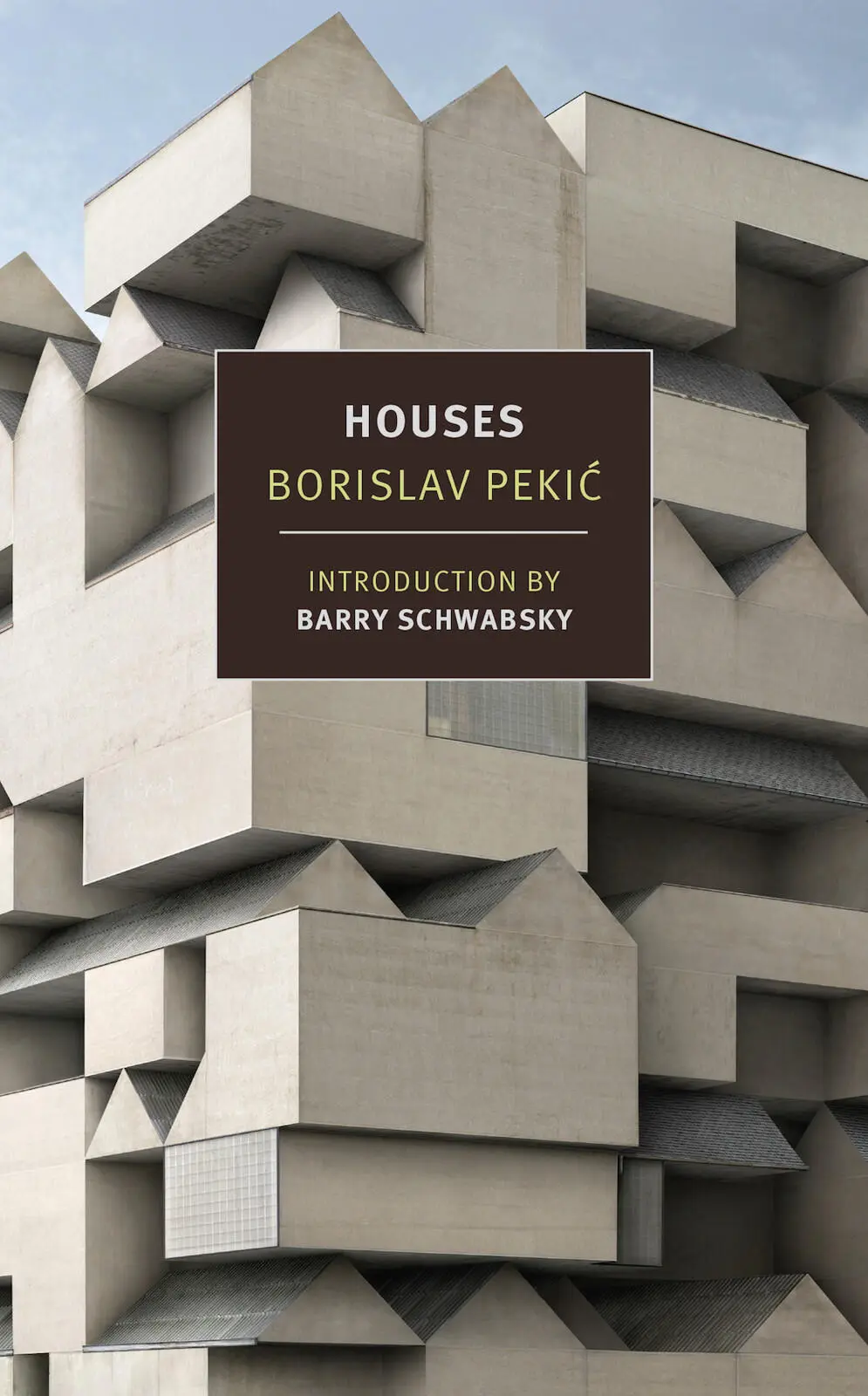
- Название:Houses
- Автор:
- Издательство:NYRB Classics
- Жанр:
- Год:2016
- ISBN:нет данных
- Рейтинг книги:4 / 5. Голосов: 1
-
Избранное:Добавить в избранное
- Отзывы:
-
Ваша оценка:
Houses: краткое содержание, описание и аннотация
Предлагаем к чтению аннотацию, описание, краткое содержание или предисловие (зависит от того, что написал сам автор книги «Houses»). Если вы не нашли необходимую информацию о книге — напишите в комментариях, мы постараемся отыскать её.
Bon vivant, Francophile, visionary, Negoyan spent the first half of his life building houses he loved and even gave names to — Juliana, Christina, Agatha — making his hometown of Belgrade into a modern city to be proud of. The second half of his life, after World War II and the Nazi occupation, he has spent in one of those houses, being looked after by his wife and a nurse, in hiding. Now, on the last day of his life, Negoyan has decided to go out at last to see what he has wrought.
Negoyan is one of the great characters in modern fiction, a charming monster of selfishness and self-delusion. And for all his failings, his life poses a question for the rest of us: Where in the modern world is there a home except in illusion?
Houses — читать онлайн бесплатно полную книгу (весь текст) целиком
Ниже представлен текст книги, разбитый по страницам. Система сохранения места последней прочитанной страницы, позволяет с удобством читать онлайн бесплатно книгу «Houses», без необходимости каждый раз заново искать на чём Вы остановились. Поставьте закладку, и сможете в любой момент перейти на страницу, на которой закончили чтение.
Интервал:
Закладка:
“What a scoundrel you are!” I say as Timon Negovan approaches me, takes me by the arm, and inquires whether I’ve yet found a building contractor to take over Constantine’s projects. No, not yet. I’ll never find anyone to measure up to Constantine. I’ll have to do something soon, of course. There’s no place for indecision. The building season is nearing its end, the rainy season has already started, and any further delay in construction could be disastrous.
Timon agrees and walks off. Once again Fedor is behind me:
“Is there a single person here, apart from Jacob, who has come to honor Constantine? Everyone knows that our most esteemed builder was mad ! He built grandiose bridges across rivers to areas that had no roads — in the belief that roads would be built as soon as bridges could carry them across the rivers! He built a leaning tower fit to rival Pisa, but so crooked that it toppled over even before its completion! He would have been ruined if you hadn’t restrained him through credits from Timon’s bank.”
Whatever Constantine built was irreproachable. However, while his bridge was truly majestic it served no useful purpose. And his tower had been undeniably crooked, and it too had no purpose. (Yes, he lacked that purposefulness which distinguishes the rest of us Negovans. In that respect, more’s the pity, Fedor was right, the late Constantine had been a good but unusual builder.)
“Well, he was original,” I concede grudgingly.
“He was more than just original, Uncle, he was mad, and you know it.”
“Do you think I’d have worked with him if he were crazy?”
“It was precisely because he was crazy that you did! He didn’t steal from you, or try to cheat you with bad construction work, or falsify accounts, or exceed time schedules. And because you were his nephew he built houses for you below cost”—(this last is a lie)—“and the houses he built were sound, strong, and solid as a rock, just like himself.” (This about the quality of his work is true.)
We are approaching the mound of earth by the grave. In front of us, through the black silk forest of umbrellas, the coffin is being carried out of the hearse and placed on the bier; the mourners range themselves around it in tight rings. Yet again I try to reason with this insolent young man, having made up my mind to complain to his father George tomorrow about his abominable behavior.
“Before terminating this undignified dispute, I must point out to you that the late Constantine was my relative, friend, and business partner. In all three capacities I loved and respected him equally!”
(I had certainly respected him. It had hardly been possible to avoid an awe-filled reverence toward something that — heedless of rest, caution, and all obstacles, even of purpose — hovered round us like elemental bad weather, like a seismic catastrophe. In Uncle Constantine there was indeed something of those Biblical architects who ordered the wilderness with their bare hands, dislocated whole towns with a single magical sign, and built and destroyed palaces overnight. Even so I hadn’t loved him, and if asked why, I couldn’t have explained it. Perhaps my reserved nature, sensitivity, and moderation were offended by Constantine’s Tartar-like behavior, the unbridled wantonness of a conqueror who lives permanently on horseback and with a flourish carries out his work from the saddle. Or perhaps in that distaste, which of course had no bearing on our working partnership, there was something of a secret hatred of scientific architects who gave birth to buildings from within themselves, whereas I, with all my money, could only be the midwife. Even though Constantine had never been to a school of architecture and knew less about architecture than I did, as a builder he was closer to that mysterious process, the creation of a house .)
“You may have loved him, but you certainly didn’t respect him. In fact, you despised him because of his madness. And I , Uncle Arsénie, I loved him because of his madness. Even as a child I adored his nonsensical bridges over nowhere; his crooked, fairy-tale towers; his readiness to roll up his sleeves and mix lime just to feel the sheer joy of building something; the deep voice with which he summoned up the stone crushers; his down-to-earth Turkish oaths; but most of all, the fact that he genuinely loved those houses even though they didn’t belong to him. You loved them because they were yours!”
We are gathered around the rust-colored mound dug out of the grave. Mr. Arsenijević, Vice-President of the Builders Association, is leaning over the wet lectern, preparing to make a speech. The tomb has been built in accordance with Constantine’s own drawings. The rain is falling on the leaves and the dull gray marble slabs, on the umbrellas taut like drumskins, and on the tarpaulin sheet which had earlier covered the coffin. Knowing no other way of preserving the solemnity of the ceremony, I promise Fedor that after the funeral I will be available to explain everything concerning my relationship with Constantine if only he’ll calm down now, if only, for God’s sake, he’ll keep quiet.
“And it was your building on which the scaffolding collapsed — should I keep quiet about that, too?”
“It collapsed on his building. It just happened to be a house he was building for me.”
“That whore of a house killed him. He built it and it killed him. In true Negovan style, the house just shook him off once it didn’t need him any more, once he got to the roof!”
At last the Vice-President of the Builders Association began his speech, like a deity whose immediate intervention renders any human continuation superfluous. If he hadn’t begun, I would have hit Fedor without further hesitation — paternally, of course. I am sure that was just what he was waiting for, and that he would have returned my blow. But on all sides there were demands for silence and we were separated; I went off to take my place alongside the coffin.
The accusation that Fedor leveled at my house, and through her at me, was that I was responsible for any injury she inflicted on anyone. (The house was called Efimia, after Efimia, daughter of Lord Drama and wife of the Despot Uglješa, since her exterior was to have been a copy of the monastery of Saint George at Stari Nagoričan.) But she was mine only in the sense that she was built for me and at my expense; according to law and custom, during the building and right up to the time when she was handed over to me by the Building Works Commission, all the responsibility for her behavior rested exclusively with her builder, Constantine. This, of course, in no way diminished my regret over the accident. Constantine could have gone around to any other site that day, and climbed up on any other scaffolding; by ill luck, any of them could have been unsoundly erected (though we mustn’t ignore his Herculean weight), and under any one of them the lime pit could have been left open. Yet despite Efimia’s guiltlessness, I never had the heart to move into her, and although I had intended her for Katarina and myself, I hurriedly sold her, taking care to make but little profit on the sale. As for Constantine, he didn’t die immediately after his fall. He remained an invalid for some time and, strange though he was, not mad but irrational. Not in the least God-fearing or considerate of my feelings, he got his son to build him a tomb in the shape of Efimia. As a reproach to me he kept its model, just like the model of a church depicted in the donor’s embrace, on his night table beside his medicine cabinet, right up until the day he died.
Here, finally, I have an opportunity to indicate how I wish to be buried, that is, if present circumstances (which bode little good) allow distinguished people to be buried at all; if I’m not buried in a ditch, like those of my class whose extermination I once witnessed; and if events generally take a turn in our favor.
Читать дальшеИнтервал:
Закладка:
Похожие книги на «Houses»
Представляем Вашему вниманию похожие книги на «Houses» списком для выбора. Мы отобрали схожую по названию и смыслу литературу в надежде предоставить читателям больше вариантов отыскать новые, интересные, ещё непрочитанные произведения.




Обсуждение, отзывы о книге «Houses» и просто собственные мнения читателей. Оставьте ваши комментарии, напишите, что Вы думаете о произведении, его смысле или главных героях. Укажите что конкретно понравилось, а что нет, и почему Вы так считаете.