Borislav Pekic - Houses
Здесь есть возможность читать онлайн «Borislav Pekic - Houses» весь текст электронной книги совершенно бесплатно (целиком полную версию без сокращений). В некоторых случаях можно слушать аудио, скачать через торрент в формате fb2 и присутствует краткое содержание. Год выпуска: 2016, Издательство: NYRB Classics, Жанр: Современная проза, на английском языке. Описание произведения, (предисловие) а так же отзывы посетителей доступны на портале библиотеки ЛибКат.
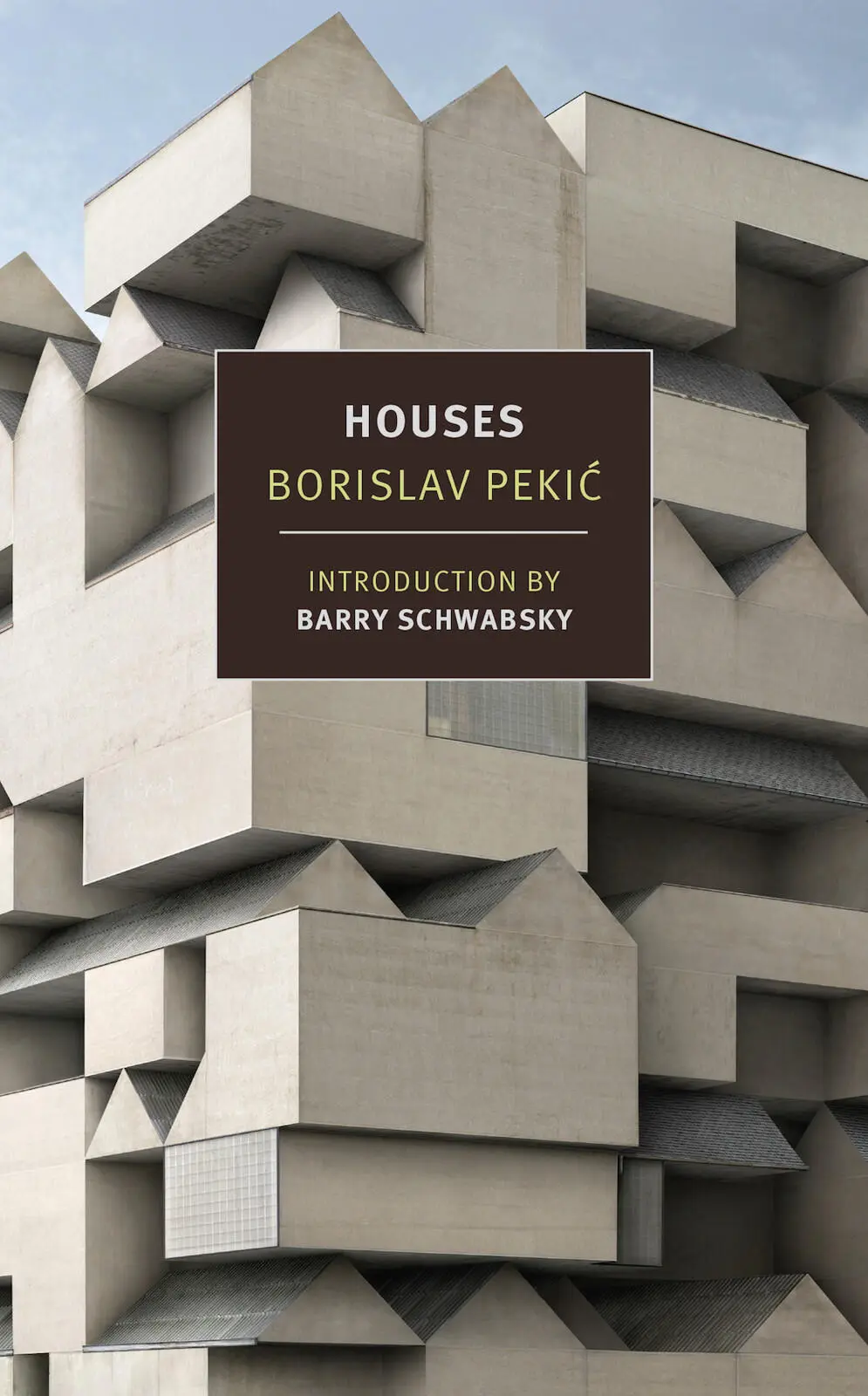
- Название:Houses
- Автор:
- Издательство:NYRB Classics
- Жанр:
- Год:2016
- ISBN:нет данных
- Рейтинг книги:4 / 5. Голосов: 1
-
Избранное:Добавить в избранное
- Отзывы:
-
Ваша оценка:
Houses: краткое содержание, описание и аннотация
Предлагаем к чтению аннотацию, описание, краткое содержание или предисловие (зависит от того, что написал сам автор книги «Houses»). Если вы не нашли необходимую информацию о книге — напишите в комментариях, мы постараемся отыскать её.
Bon vivant, Francophile, visionary, Negoyan spent the first half of his life building houses he loved and even gave names to — Juliana, Christina, Agatha — making his hometown of Belgrade into a modern city to be proud of. The second half of his life, after World War II and the Nazi occupation, he has spent in one of those houses, being looked after by his wife and a nurse, in hiding. Now, on the last day of his life, Negoyan has decided to go out at last to see what he has wrought.
Negoyan is one of the great characters in modern fiction, a charming monster of selfishness and self-delusion. And for all his failings, his life poses a question for the rest of us: Where in the modern world is there a home except in illusion?
Houses — читать онлайн бесплатно полную книгу (весь текст) целиком
Ниже представлен текст книги, разбитый по страницам. Система сохранения места последней прочитанной страницы, позволяет с удобством читать онлайн бесплатно книгу «Houses», без необходимости каждый раз заново искать на чём Вы остановились. Поставьте закладку, и сможете в любой момент перейти на страницу, на которой закончили чтение.
Интервал:
Закладка:
“ Voilà , Mr. Šomodjija, as you can see, I’m sitting here regretting that I ever entrusted one of my favorite houses to you and allowed that shameless lawyer Golovan to supervise you. But before you hear what I think of your disloyal actions and what I intend to do, I’m willing to hear your explanation. If you have one, naturellement !”
But the former concierge (I say “former” because I had decided that his replacement was urgent), probably faced with the impossibility of finding excuses, leaned toward me with both hands on his stick, completely overwhelmed by shame, and moved from one foot to the other while anxiously striving in his meager Serbo-Hungarian vocabulary to justify for himself. He had heard, he said, from the lawyer Golovan that méltóságos úr Arsen , esteemed Mr. Arsen, had been taken ill from too much worry, and that he hadn’t left his room at Venac since the war. But he, Tomaž, becsulet szavamra , honest to God, went several times to visit méltóságos úr Arsen to give an account of his house on Paris Street, but, becsulet szavamra , when he got to Venac esteemed Mrs. Katarin told him that esteemed Mr. Arsen couldn’t receive him. But Tomaž, becsulet szavamra , was sorry, but understood and went back to Paris Street. Two months later he again went to Venac, but esteemed Mrs. Katarin again told him that it was strictly forbidden that méltóságos úr Arsen see Tomaž and worry. Then later lawyer Golovan, at night in October, told him: “Maestro Tomaž, we’re very sorry but you can’t take care of esteemed Mr. Arsen’s house any more, though you can still live upstairs, padláson , in attic.”
I was on the point of asking him if he meant to complain of the manner in which the lawyer had given him notice. But I realized that, in the heat of my desire to renew my professional authority, I would have acknowledged that he had worked here for years without my approval and knowledge. So instead I confirmed that certain instructions of that nature had indeed been given, but that they seemed to have been taken too literally.
“That’s right, esteemed Mr. Arsen, that’s what Tomaž thought. Tomaž knows what goes on, like in October when Bela Kun and the mob came, shouting no more masters, no more méltóságos úr Arsen , now all are equal, all brothers! But Tomaž knew that would be catastrophe. And Tomaž thought that maybe méltóságos úr Arsen would come back one day, so from his own good heart he painted windows, brought new tiles, and swept every day. Then a man from the Magistrate came and said the house would be pulled down, so Tomaž should repair nothing more. Then Tomaž went for the last time to see Mr. Arsen, but esteemed Mrs. Katarin came outside the house and said, becsulet szavamra , let them pull it down, let them pull all down! So tell me the truth, esteemed Mr. Arsen, what more could I do?”
What more, indeed? Although he hadn’t yet reached Martinović’s distracted state, his thoughts often wandered, and he mixed up people, events, and years. Thus his dismissal had become entangled with Bela Kun’s violence, and he spoke unhappily of Simonida, as if for some time she hadn’t belonged to me at all. But at the same time it was certain that my suspicions had done him a painful injustice, and I was left with only one means to redress it: Tomaž Šomodjija would be the first person honored with the announcement of the “return of Arsénie Negovan,” and the first one invited to share in it.
“Does that mean that esteemed Mr. Arsen has come back?” His body straightened up, his every word was accompanied by a hearty bang on the bench with his ironclad stick. “Esteemed mister is again taking work in his own hands?”
“ Bien sûr! That’s why I came.”
“And Maestro Tomaž will again be in the service of méltóságos úr Arsen , caring for the house on Paris Street?”
“Of course.”
“ Becsulet szavamra? ”
“ Becsulet szavamra , Maestro Tomaž. From this very moment on!”
Even now I feel a tingling of pride when I recall with what pleasure, eagerness, and hope we took pencils and notebooks from our coats — he the battered account book which I had given to him with Simonida’s keys, and I the saffian leather notebook which I had always taken with me on inspections. In the latter, under March 1941, I had written the date of Niké’s auction — my last pro memoria . As for Šomodjija’s account book — all my superintendents had similar ones — he jotted down in it all the important events in Simonida’s life, and whatever was needed for her care. I used to read it on the spot, crossing out the unnecessary requests but transferring the appropriate ones to my saffian notebook, so that I could verify their implementation.
Before crossing over to Simonida, I opened the notebook and immediately below the note about Niké (as if the narrow white space beneath didn’t signify an absence of twenty-seven years), I wrote clearly: June 3, 1968, Simonida .
“That’s it,” I said. “Now we can get down to work.”
To get to the house, we had to go around the crane, which had dug itself in like a wooden catapult in the middle of Simonida’s weed-infested garden. It was rusted, broken in pieces, and full of dust, but from its greedy, protruding iron head hung a hook with a weight. The iron ball hung there peaceably, as if gathering strength to launch itself upon my last-born’s tender walls. I went up to the machine and noticed with pleasure that it was itself quite damaged by the blows it had inflicted on houses. Still, the foul and ugly machine was awaiting its moment, not knowing that it would never come. For I had already thought of a plan by which Simonida could defend herself from demolition.
“Maestro Toma, that garage must be removed and the barrier fence restored as soon as possible.”
“Remove garage,” said the concierge as he wrote. “Restore barrier fence.”
“Fill in the façade, wash it, and spray it with paint.”
“Wash, fill, and spray façade.”
“I’ll decide on the color later, but I think it’s going to be pearl.”
“And what about the pointing, esteemed Mr. Arsen?”
“Scrape out the pointing neatly, scrape the grills on the cellar windows, the courtyard wall, and the balcony with a wire brush. Coat with red lead and paint in black.”
While I fingered the oak front door, tapping like a doctor on the peeling outer layer of its surfaces, I heard Maestro Toma explaining my presence to the neighbors.
“That méltóságos úr Arsen , he will not allow his house to be pulled down.”
“Maestro Toma, note down: restain the front door and varnish it. What state are the other doors in?”
But we were already inside Simonida. From the athletic hallway one might think that the bulk of the house lies to the left. But no, there she quickly ends in a side wall; only on the right can one move forward into attractive perspectives. If you open one of those doors, you find yourself in a totally unexpected gallery lined with elegant carved woodwork reminiscent of the icons of a Mount Athos altar screen. Where you think you’ll find a palatial room, you’ll encounter a warm, dark chamber. Your view will break out into open space just where you expected a wall. The walls are not subordinated to any known geometrical system; the ceilings change heights with disturbing agility. For this unusual house there are no valid laws, no rules. At first you feel deceived, humiliated, perhaps angry. Then, just as you’re on the verge of losing patience, you realize that you cannot rest without penetrating her secret, and so you go around her again, taking the same route. But now the rooms are entirely different. You know no more of her than before, but whatever the rent, you accept her. That was what my Simonida was like: unexpected, mysterious, inconstant, magical — a conjuror’s box whose gifts never end.
Читать дальшеИнтервал:
Закладка:
Похожие книги на «Houses»
Представляем Вашему вниманию похожие книги на «Houses» списком для выбора. Мы отобрали схожую по названию и смыслу литературу в надежде предоставить читателям больше вариантов отыскать новые, интересные, ещё непрочитанные произведения.





Обсуждение, отзывы о книге «Houses» и просто собственные мнения читателей. Оставьте ваши комментарии, напишите, что Вы думаете о произведении, его смысле или главных героях. Укажите что конкретно понравилось, а что нет, и почему Вы так считаете.