Borislav Pekic - Houses
Здесь есть возможность читать онлайн «Borislav Pekic - Houses» весь текст электронной книги совершенно бесплатно (целиком полную версию без сокращений). В некоторых случаях можно слушать аудио, скачать через торрент в формате fb2 и присутствует краткое содержание. Год выпуска: 2016, Издательство: NYRB Classics, Жанр: Современная проза, на английском языке. Описание произведения, (предисловие) а так же отзывы посетителей доступны на портале библиотеки ЛибКат.
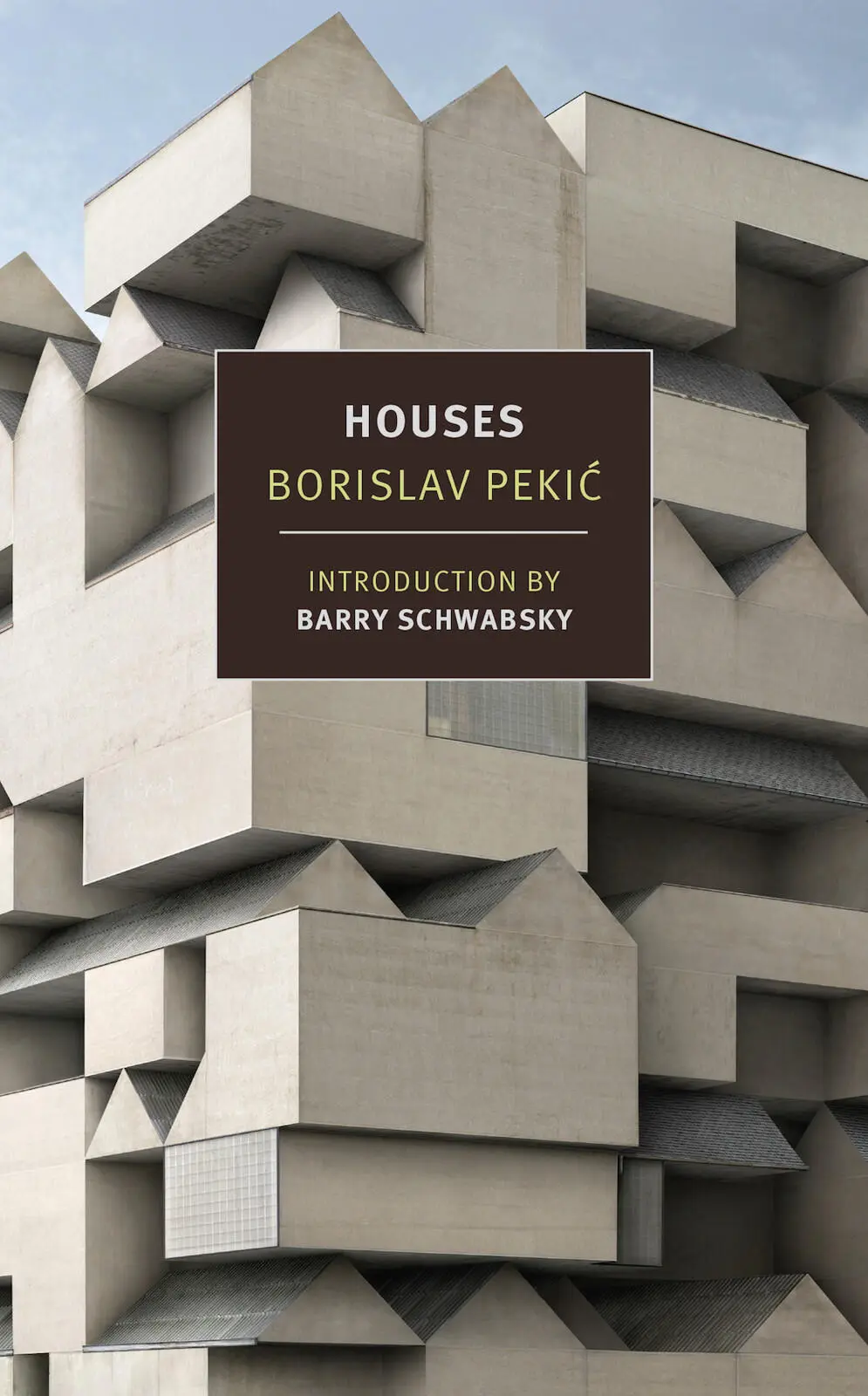
- Название:Houses
- Автор:
- Издательство:NYRB Classics
- Жанр:
- Год:2016
- ISBN:нет данных
- Рейтинг книги:4 / 5. Голосов: 1
-
Избранное:Добавить в избранное
- Отзывы:
-
Ваша оценка:
Houses: краткое содержание, описание и аннотация
Предлагаем к чтению аннотацию, описание, краткое содержание или предисловие (зависит от того, что написал сам автор книги «Houses»). Если вы не нашли необходимую информацию о книге — напишите в комментариях, мы постараемся отыскать её.
Bon vivant, Francophile, visionary, Negoyan spent the first half of his life building houses he loved and even gave names to — Juliana, Christina, Agatha — making his hometown of Belgrade into a modern city to be proud of. The second half of his life, after World War II and the Nazi occupation, he has spent in one of those houses, being looked after by his wife and a nurse, in hiding. Now, on the last day of his life, Negoyan has decided to go out at last to see what he has wrought.
Negoyan is one of the great characters in modern fiction, a charming monster of selfishness and self-delusion. And for all his failings, his life poses a question for the rest of us: Where in the modern world is there a home except in illusion?
Houses — читать онлайн бесплатно полную книгу (весь текст) целиком
Ниже представлен текст книги, разбитый по страницам. Система сохранения места последней прочитанной страницы, позволяет с удобством читать онлайн бесплатно книгу «Houses», без необходимости каждый раз заново искать на чём Вы остановились. Поставьте закладку, и сможете в любой момент перейти на страницу, на которой закончили чтение.
Интервал:
Закладка:
•
I was just concluding my revolutionary concept when on all sides I noticed an unusual excited movement. I would have noticed it earlier had I not been so preoccupied with my calculations. The people were all hurrying toward the railroad embankment. And the roadway was jammed full of red fire engines and military trucks with rubberized green canvas tops. I had no particular urge to join that animated movement, and certainly not to let it carry me along as a current carries a splinter of wood. I stopped an agitated passer-by who seemed, despite the camera slung around his neck, a reasonable-looking man, and asked him: “Excuse me, sir, can you tell me what’s happening on the other side of the embankment?”
The man looked at me pleasantly, but without understanding. “ Je m’excuse. Je regrette bien. Je ne parle pas serbe .”
“ Oh, excusez-moi, je voulais seulement demander ce qui se passe la-bàs derrière la digue .”
“ Une révolte, monsieur ,” the man said enthusiastically. “ Une révolte !”
“ Quelle révolte? ”
“ Une révolte magnifique! ”
Was it really happening again? At first I couldn’t believe it. Being a foreigner, the man could easily have misinterpreted the disturbance. It must be a huge fire menacing the town, and now the soldiers and firemen were on their way to control it.
But I too was hurrying toward the embankment. Fortunately, none of my houses lay on the Zemun side. Since I wasn’t personally threatened by the fire, and furthermore was incapable of looking on helplessly while houses were being destroyed, I would have returned home if I hadn’t known how unpredictable the whims of fire are. I considered it opportune — and all the more so since I was once again committed to my business affairs — to take a closer look, and to undertake my own defensive measures should the blaze be spreading toward my houses.
“Is the fire a big one, young man?”
“What fire? It’s a riot, old man, a riot!”
I was astounded. “Are you saying things are out of hand down there?”
“What’s the matter with you? They’re marching on Belgrade!”
Still hoping to clear up the misunderstanding, I addressed another onlooker who was limping toward the embankment.
“In heaven’s name, sir, somebody just told me that a mob is trying to force its way into town. Is it true?”
“It’s true,” he said without stopping. “But they won’t make it, the bastards!”
I fell in beside him. “No one could be happier than I about that. But how do you know they won’t?”
“I used to be in the army.”
“My late brother was in the army, too. Perhaps you’ve heard of him? General George Negovan? I’m Arsénie K. Negovan and my business is houses.”
“I was a colonel. I was in command of a battery.”
I knew nothing about military units, but despite his unduly direct speech and behavior, which I put down to barrack-room upbringing, the colonel inspired me with confidence. I kept as close to him as I could, all the more so since he shared my disgust at what was happening on the Zemun side of the embankment.
The citizens from behind were pushing me toward the underpass, on whose arch was written: BOAC LINKS ALMOST ALL THE COUNTRIES OF THE WORLD. As I began to be drawn up the slope, I made up my mind to see with my own eyes what heights of incompetence the royal government had attained in their defense of owners’ interests — an incompetence which I had described in my talk about banks and bankocracy. For a property owner on the threshold of a large-scale building operation such as I had conceived during the journey to the New Township, it was of the greatest importance not to have to worry about the future of financial investments.
Even so, it’s difficult to believe that this was the real reason for my ill-considered approach. The direction I took must have been influenced by a secret hope that there along the railway embankment I would obtain satisfaction for the mob’s malicious attack on me on March 27, 1941, that here at last I would be revenged.
The railroad tracks crossed a sandy stretch and descended toward a dusty field covered with thistles, on which lay rolls of rusty metal fencing, concrete pipes, torn sacks of cement, and broken bricks, as if on some abandoned building site. Along the tracks and in the curve of the underpass the army, in steel helmets and standing three deep, had formed a cordon to block off the approach to the town.
“That’s not the way to do it,” said the colonel. “They ought to block the road with trucks, set up road blocks.”
I took my binoculars out of their canvas case and trained them on Zemun. At first I could see nothing. Adjusted to a different range, the lens was blurred and opaque. As I turned the regulating knob, from out of the thick winter fog in front of me they swam into view; at their head was a standard-bearer waving a red flag, and it seemed as if I was drawing them toward me, luring them forward out of that fog, and not at all as if they were moving forward of their own murderous volition, gathering speed from way back in ’41 when they came down Pop-Lukina Street. With a sharp twist of the knob, I sent them hurrying back into anonymity. The strength of my index finger and thumb, between which I held the tiny wheel that adjusted the lens, was for an instant greater than all the soldiers waiting there beneath the embankment.
Nothing was moving out there where I’d seen them a little earlier. Then they reappeared with the flag-bearer at their head, swarming forward of their own accord, although I was careful not to move the knob of the binoculars again. Clearly I hadn’t removed them far enough — only a few steps back into the fog, out of which they now surged toward me again. I spun the wheel sharply: they disappeared. But this time a shorter period elapsed before, unaided by me, the red flag appeared out of the fog into which I had banished it. I knew that the intervals would get shorter and shorter, that my binoculars wouldn’t halt them, so I stopped adjusting them. I stood on the embankment as if in a theater gallery, and waited.
Soon they appeared. They dispersed the powerless mist of the lens and came on. There were more and more of them. It was as if the diseased, cataractlike fog from which they kept soundlessly appearing would never stop producing them. They were carrying their red flags, of course, and Yugoslav flags, but with the Jewish-Bolshevik red star, as if they had already seized power and were giving it a visible symbol. They were also carrying some sort of pictures, and placards which I couldn’t make out because they were too far away. And I had no need to, for I knew in advance what was written on them. They always demanded the same thing. They wanted my houses. They had wanted them in March 1941 and They wanted them now in June of 1968!
“I can’t see what’s written on their placards,” I said.
The colonel handed me a pair of bulky binoculars with a black metal casing. “Here, use mine.”
“They look powerful.”
“Artillery binoculars. None stronger.”
“Thank you. But then they’ll be too close.”
The colonel looked at me askance. “They will be, very soon.”
The man behind me, against whom I was pressed, spat noisily. I could feel his breath on my neck.
The colonel was right. Soon, even my binoculars couldn’t keep them back. Now the pictures that they were carrying on poles could be seen with the naked eye. One was Lenin. I didn’t recognize the others, but they surely belonged to the same coterie. Scrawled across one of the placards in red was: FREEDOM, TRUTH, JUSTICE! DOWN WITH CORRUPTION! (I had no quarrel with that, though I would have added, “and banking.”) NO MORE UNEMPLOYMENT. I HAVE BEEN BEATEN UP. (I was, too, I thought, looking at the young man with the bandaged head who was carrying the placard.) THE REVOLUTION IS NOT YET FINISHED! (It needs to start first, you son of a bitch. But it looks as if it has started already.) DOWN WITH THE RED BOURGEOISIE!
Читать дальшеИнтервал:
Закладка:
Похожие книги на «Houses»
Представляем Вашему вниманию похожие книги на «Houses» списком для выбора. Мы отобрали схожую по названию и смыслу литературу в надежде предоставить читателям больше вариантов отыскать новые, интересные, ещё непрочитанные произведения.




Обсуждение, отзывы о книге «Houses» и просто собственные мнения читателей. Оставьте ваши комментарии, напишите, что Вы думаете о произведении, его смысле или главных героях. Укажите что конкретно понравилось, а что нет, и почему Вы так считаете.