Borislav Pekic - Houses
Здесь есть возможность читать онлайн «Borislav Pekic - Houses» весь текст электронной книги совершенно бесплатно (целиком полную версию без сокращений). В некоторых случаях можно слушать аудио, скачать через торрент в формате fb2 и присутствует краткое содержание. Год выпуска: 2016, Издательство: NYRB Classics, Жанр: Современная проза, на английском языке. Описание произведения, (предисловие) а так же отзывы посетителей доступны на портале библиотеки ЛибКат.
- Название:Houses
- Автор:
- Издательство:NYRB Classics
- Жанр:
- Год:2016
- ISBN:нет данных
- Рейтинг книги:4 / 5. Голосов: 1
-
Избранное:Добавить в избранное
- Отзывы:
-
Ваша оценка:
Houses: краткое содержание, описание и аннотация
Предлагаем к чтению аннотацию, описание, краткое содержание или предисловие (зависит от того, что написал сам автор книги «Houses»). Если вы не нашли необходимую информацию о книге — напишите в комментариях, мы постараемся отыскать её.
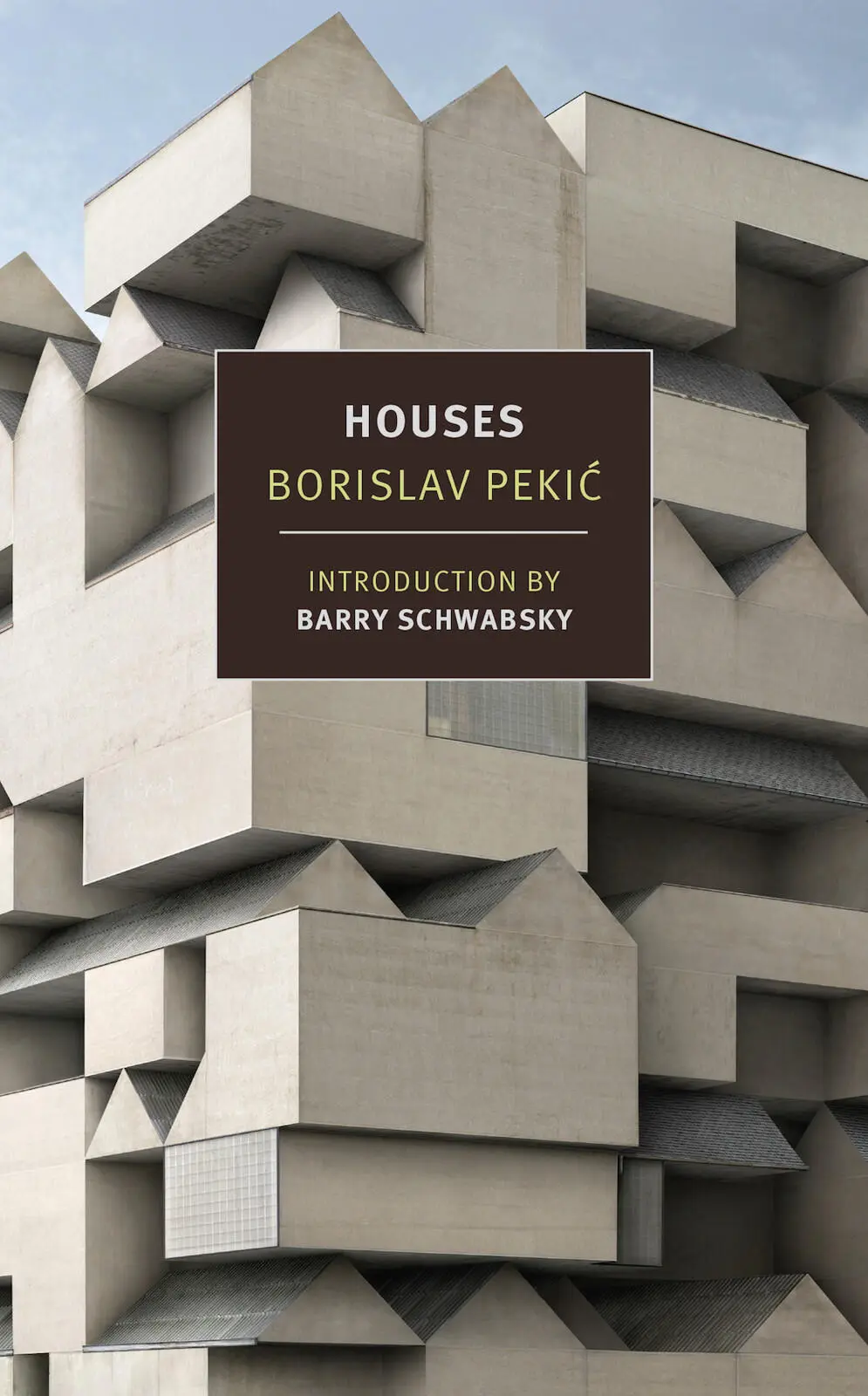
Bon vivant, Francophile, visionary, Negoyan spent the first half of his life building houses he loved and even gave names to — Juliana, Christina, Agatha — making his hometown of Belgrade into a modern city to be proud of. The second half of his life, after World War II and the Nazi occupation, he has spent in one of those houses, being looked after by his wife and a nurse, in hiding. Now, on the last day of his life, Negoyan has decided to go out at last to see what he has wrought.
Negoyan is one of the great characters in modern fiction, a charming monster of selfishness and self-delusion. And for all his failings, his life poses a question for the rest of us: Where in the modern world is there a home except in illusion?
Houses — читать онлайн бесплатно полную книгу (весь текст) целиком
Ниже представлен текст книги, разбитый по страницам. Система сохранения места последней прочитанной страницы, позволяет с удобством читать онлайн бесплатно книгу «Houses», без необходимости каждый раз заново искать на чём Вы остановились. Поставьте закладку, и сможете в любой момент перейти на страницу, на которой закончили чтение.
Интервал:
Закладка:
“The key is her unexpectedness,” I said, “but that key is lost.”
“Pair of new keys,” wrote the concierge.
“Do you know why?”
“ Nem tudom , esteemed Mr. Arsen.”
“Because right up to the quattrocento, architects thought themselves masters of their buildings. And owners of houses, too, of course. And why, Mr. Tomaž, why did they believe that?”
“ Nem tudom , esteemed Mr. Arsen.”
“Because for centuries — ever since the dolmens and menhirs — it was thought that buildings were ordinary manufactured articles, inheriting the inanimate nature of their materials. It was thought that a stone in a wall was as dead as a stone in a field, that a beam differed from its oak ancestor only in the form it was shaped by the carpenter. What a mistake, what an unforgivable error!”
The time had come for me to leave Simonida. Although there was no threat that my sortie would be discovered — Katarina had not planned to return from town until the afternoon — it was essential for me to rest and gather my strength for the delicate conversation which I intended to have with her. Before going, I wanted to draw Šomodjija’s attention to several additional repairs. In that connection, I experienced so pleasant a surprise that here I must break off my confession for a moment.
•
Article 7. As a special legacy, to Mr. Tomaž Šomodjija, the caretaker of my house on Paris Street, I leave for his lasting ownership the basement of my three-story house on Rigas de Feras (No. 24), and a cash sum totaling the twenty-three years of caretaker’s wages of which, through no fault of mine, he was deprived.
•
Before I had made a single one of my additional observations, Maestro Tomaž said:
“If the esteemed Mr. Arsen will allow, I will show him a list of repairs.”
From his account book he took out a long list which he began to read from; it left out neither the replacement of the broken guttering and the worn stair treads (seven in number) nor anything else. In view of all that, how could I have not written in a legacy for him?
After I had promised to return the next day, I gave Maestro Toma one last instruction of which I wish to leave no record. I’ll only say that it concerned the crane in Simonida’s garden.
“ Becsulet szavamra? ” I asked.
“ Becsulet szavamra! ” promised Simonida’s caretaker.
As I walked away to the streetcar stop, I heard Maestro Toma’s excited voice behind me: “That méltóságos úr Arsen , he will not let his house be pulled down!”
I got on a Number Two, certain that when I returned the next day, the crane wouldn’t be lying in wait for me in Simonida’s courtyard.
•
I got on the streetcar — which I calculated would carry me as far as the underpass named after the Blessed Late King Alexander. There, I would be but a few steps from home. I never dreamed that this restful ride wouldn’t bring my outing to an end, and that in its unplanned but voluntary prolongation the most unusual events still awaited me. Compared with these events, everything that had taken place that morning was only a gradual introduction, a restrained prelude before the furious scherzo that was to threaten both me and my houses. But everything in its turn.
And so the Number Two moved off along Paris Street and came out on the bend jutting out toward the delta, from where the view was so familiar that I could count the buildings from memory and describe in detail every human trace within the wide sweep of my binoculars.
As a result, suddenly I felt at home again, as if I’d returned from some foreign city. This nostalgic feeling of the returned wanderer would doubtless only have increased with the approach to Kosančićev Venac, had not the New Township made its appearance out of the sunlit haze in the west. Of course it was as familiar to me as all the rest, but for the first time my view of it was linked to the possibility, if I was so disposed, of actually going around it, touching it, smelling it, of understanding it from a spiritual angle. And so, while the streetcar accelerated downhill along Karageorge Street toward the King Alexander Bridge, it was clear to me that my pilgrimage hadn’t yet come to an end, that I would rapidly find myself en route to the New Township, and that nothing I could do now would stop it. For my motivation was no longer fear of growing old, which I could overcome by gathering my strength, but fear of spiritual death, of becoming outmoded, of succumbing to what in architecture is known as obsolescence .
I got off the streetcar, and, breathing rapidly, walked over the bridge. This was most unusual, for I had never held any esteem for the Township, and certainly no liking. It could more truthfully be said that from the very moment when the foundations had been laid, I had been in dispute with the invisible designers of those termitelike buildings. Now I was hurrying to meet them, paying scarcely any attention to the white carcasses of reinforced concrete which, like some dissected giant caterpillar, were scattered along the main road; or to the auto repair shops behind their wire fences; or to the abandoned building sites with heaps of ballast, pebbles, and sand; or to the billboards, traffic, passers-by. Having relinquished my neutral position at the window, I had shaken off old prejudices and was approaching the new constructions like a modern and fully operative property owner.
Five hundred apartments, I thought, covering a site of 25,600 meters, with four sides 160 meters in length as against 500 family houses with foundations and Lilliputian gardens, which as a result of the insatiable horizontal spread would take up dead ground of 202,500 precious square meters, with four frontages of 450 meters each. In the former case the electrical conduits and the water and gas mains would come to barely five kilometers; in the second, to at least fifty-six. The apartments would need four structural units: a floor and three walls; each family house would require six, and those six the most complex ones. The floor and walls had to be built into expensive foundations and cellars, while the roof structures would be more expensive still. Five hundred roofs! Five hundred foundations! But the apartments had common foundations and a common roof. What a financial saving!
Finally I would have to think most seriously — and without old-fashioned prejudices — about those hanging façades. And about prefabricated ceilings, too. Expensive, unreliable, time-consuming tradesmen’s crafts would undoubtedly be replaced by industrial work in the factories. For cost and speed of erection, there could be no competition for that kind of construction. But would those factory-built houses devalue the space they dominated, depersonalize it, take away its soul? No, because my houses wouldn’t look like upturned car bodies or armored tanks. Though machine-made, their faces would still be varied, personal, unexpected. And the benefits of garden cities would be preserved: every apartment would have its hanging garden, its compact flower plot à la Semiramis. But of course no one would be able to peer into it; my buildings would defend their tenants’ privacy. And the insulation would be such that they wouldn’t be subjected to noise of others. Free of soot, smoke, and dust, the air which my tenants breathed would not originate in other people’s lungs; the view they rented could not be stolen from them; and even the sun would be brought nearer to them, and while it warmed them it would belong to them alone. With the keys of their home, my tenants would also receive the keys to their own lives, which they had almost forgotten about — keys whose duplicates would belong only to me.
Such gigantic dwellings, particularly if concentrated in the Arsénie Negovan Housing Development, would be placed under complete owner control. Arsénieville would be safe, stable, unchanging, and when in time the buildings were combined into a single mass, into a symmetrical Chauvin-Mazet-like block, they would be as eternal as the tombs of the Pharaohs! Such constructions would no longer have to adapt to anything; everything would have to adapt to them. Hermetically sealed, impenetrable, indestructible, they would thwart forever all hysterical attempts to reconstruct our cities or our lives. There would be no place for subversive dreams of dynamic cities, behind which lurk Bolshevik yearnings for a change of regime.
Читать дальшеИнтервал:
Закладка:
Похожие книги на «Houses»
Представляем Вашему вниманию похожие книги на «Houses» списком для выбора. Мы отобрали схожую по названию и смыслу литературу в надежде предоставить читателям больше вариантов отыскать новые, интересные, ещё непрочитанные произведения.







Обсуждение, отзывы о книге «Houses» и просто собственные мнения читателей. Оставьте ваши комментарии, напишите, что Вы думаете о произведении, его смысле или главных героях. Укажите что конкретно понравилось, а что нет, и почему Вы так считаете.