Borislav Pekic - Houses
Здесь есть возможность читать онлайн «Borislav Pekic - Houses» весь текст электронной книги совершенно бесплатно (целиком полную версию без сокращений). В некоторых случаях можно слушать аудио, скачать через торрент в формате fb2 и присутствует краткое содержание. Год выпуска: 2016, Издательство: NYRB Classics, Жанр: Современная проза, на английском языке. Описание произведения, (предисловие) а так же отзывы посетителей доступны на портале библиотеки ЛибКат.
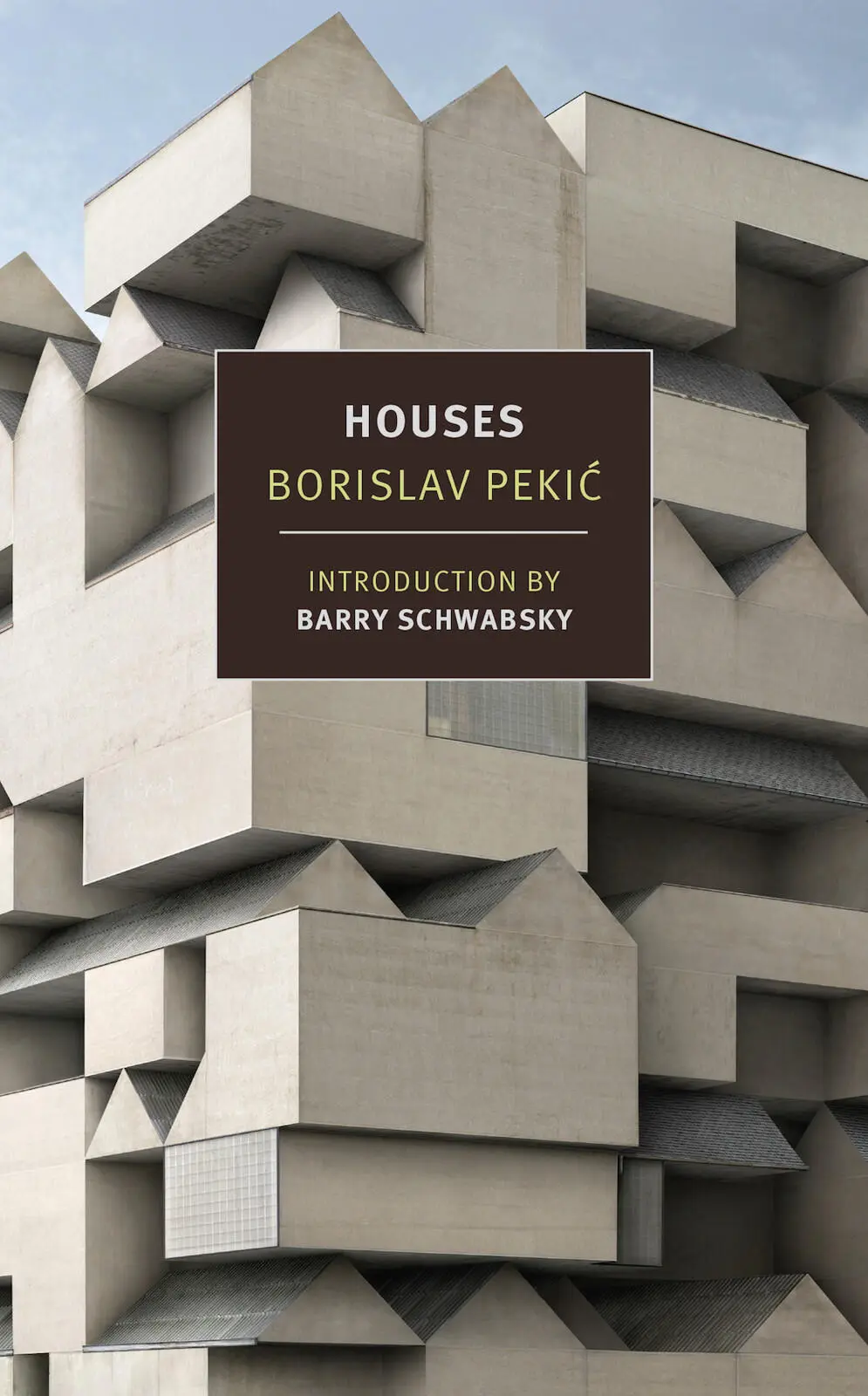
- Название:Houses
- Автор:
- Издательство:NYRB Classics
- Жанр:
- Год:2016
- ISBN:нет данных
- Рейтинг книги:4 / 5. Голосов: 1
-
Избранное:Добавить в избранное
- Отзывы:
-
Ваша оценка:
Houses: краткое содержание, описание и аннотация
Предлагаем к чтению аннотацию, описание, краткое содержание или предисловие (зависит от того, что написал сам автор книги «Houses»). Если вы не нашли необходимую информацию о книге — напишите в комментариях, мы постараемся отыскать её.
Bon vivant, Francophile, visionary, Negoyan spent the first half of his life building houses he loved and even gave names to — Juliana, Christina, Agatha — making his hometown of Belgrade into a modern city to be proud of. The second half of his life, after World War II and the Nazi occupation, he has spent in one of those houses, being looked after by his wife and a nurse, in hiding. Now, on the last day of his life, Negoyan has decided to go out at last to see what he has wrought.
Negoyan is one of the great characters in modern fiction, a charming monster of selfishness and self-delusion. And for all his failings, his life poses a question for the rest of us: Where in the modern world is there a home except in illusion?
Houses — читать онлайн бесплатно полную книгу (весь текст) целиком
Ниже представлен текст книги, разбитый по страницам. Система сохранения места последней прочитанной страницы, позволяет с удобством читать онлайн бесплатно книгу «Houses», без необходимости каждый раз заново искать на чём Вы остановились. Поставьте закладку, и сможете в любой момент перейти на страницу, на которой закончили чтение.
Интервал:
Закладка:
But already I was falling off the embankment. I have no proof that the two of them intentionally pushed me (although I wouldn’t vouch for the man sympathetic to the rioters), but they didn’t hold me back either. And so, still clutching my stick and my binocular case, I rolled down toward the ditch, and surely couldn’t have stopped myself at the foot of the embankment had I not been taken back into the terrible past and imagined that I was falling from the mob’s shoulders in Pop-Lukina Street after my talk about banks and bankers. As it was, I understood that if I didn’t manage to stop myself I’d once again be trampled underfoot, and this time — considering my advanced years and health — without any hope of recovery. And so, thanks to my earlier experience, I arrested my fall without great bodily harm; my stick and binocular case were still firmly in my grip, nor were my pince-nez broken. But my hat was no longer there: it had fallen off and rolled right down into that rioting mob. Having a wide, stiff Boer brim, it rolled easily. I followed it with my eyes for some time, for it was black as pitch and its width made it clearly visible. And its quality, of course. Miraculously, no one had yet trampled it: the rioters’ heels just pushed it away, and like some lame black bird it continued to bounce elastically over the sand.
I was proud of it.
I followed it until at last it stopped under an enormous heel, crushed. Bitterly I raised my eyes: it was the red standard-bearer. He still held the red flag aloft, even though he was being beaten. The soldiers had formed a circle around him and were hitting him with their batons, but the great ox wouldn’t let go of the flag. He was brandishing it like a club and fending off the soldiers. All around, as George would have said, they were fighting “hand to hand.” I couldn’t discern any enthusiasm among the soldiers. They were shouting “Charge!” and “Kill!” but they weren’t shooting or using their bayonets.
Crouching there in the ditch, it seemed to me that this wouldn’t stop the mob. I’m not disputing that the soldiers were hitting them in the back, grinding their boots into their stomachs, trampling them down unmercifully. I couldn’t see everything that was going on in the field because bodies continually blocked my view, and anyway I had no stomach for violence. The standard-bearer hadn’t fallen yet. He was bloodied but still on his feet, waving his flag like a battle-ax. Hammering at him from close quarters, the soldiers were trying to force him into the ditch, where the cramped space wouldn’t allow him to defend himself. They were pushing him toward me and hitting him all over his body, which jerked convulsively but wouldn’t give in.
“ A la tête, frappez-le sur la tête! Hit him on the head!”
Let me elaborate the reasons for my unseemly involvement dans une bagarre . Though the riot was of direct concern to me, since on its outcome depended the safety of my possessions and my personal status, it was unlike me to become involved. Without question, angered by the soldiers’ incapacity to deal with the hooligan carrying the red flag — and all the more, since it was he who had trampled my hat — I shouted loudly: “On the head! Hit him on the head!” Of course they didn’t hear me over the screams and cries of battle. But I have no reason to hide it: I urged our soldiers on. But my encouragement was devoid of passion: a business commitment, so to speak, rather than participation from sheer enjoyment. I did not throw rocks. The soldiers and rioters were throwing rocks at one another — I actually saw that. Completely forgetting myself, I had recourse to what were in fact only ordinary pebbles, no bigger than a child’s fist. Anyone who has ever been on this embankment knows that there are no large rocks there, only a few round pebbles. And I threw them only at the man who was holding the red flag.
It seemed, however, that new and more decisive orders had been given, or that the soldiers roused themselves of their own accord, for they charged into the mob with savage and heroic force that would have pleased even my brother George. The attackers wavered, yielded ground, and then, pursued by the soldiers, took to panic-stricken flight across the field, where only the injured and unconscious remained and among them my trampled hat.
With a certain effort I got up off the ground and went to pick it up. Perhaps I should have gotten away from there as quickly as possible, instead of wandering around after this very ordinary hat. But it was a question of principle: That hat was mine; it belonged to me by inalienable right of ownership. One might say that all revolutions began with hats, with the destruction of the outward signs of dignity.
I had to get it back and put it where it belonged.
“Well, pop, do you want a bash over the head, too?” The soldier blocking my path was pressing a blood-soaked handkerchief to his cheek. “Is that what you’re looking for?”
“The man whom you intend to strike,” I said with dignity, “—only intend , since whether you’ll do it or not remains to be seen — has reached the age of seventy-seven. Sir, with due deference to your situation, I inform you with pride that I am Arsénie K. Negovan, property owner of Kosančićev Venac, Who is only looking for his hat . There it is! Over there! Here are my papers. Voilà .”
Unfortunately, I didn’t have time to show them. The mob was swarming back again, pushing the soldiers against the embankment. I found myself at the very center of the fray. But I didn’t care: in such circumstances the best thing to do is not to submit to events but be oneself. So I continued to search for my hat, which unfortunately lay once again under the mass of infuriated feet. At that wretched and brutal moment it was the sole guaranty of Arsénie Negovan’s dignity.
A young man was lying crumpled on a torn sack of cement. Judging by his appearance, he was seriously injured, but since his eyes were open I assumed he was still conscious. I went up to him and asked if by chance he had seen a rather large hat, un chapeau de Boers?
He didn’t answer, as if he hadn’t heard me. Indeed, there was so much noise that any normal conversation was impossible. I described the hat with my hands.
“Black — large — a Boer hat?”
I don’t know how long I wandered about. Probably I went around and around the same spot repeatedly. I did receive a number of blows. At one moment I stumbled and was pushed. What then followed was as incoherent and absurd as a nightmare. Did I really kill that Bolshevik flag-bearer, beat him to death with my stick with the silver greyhound’s head on the handle? Judging by the strip of red cloth that afterward I found in my hand — it’s right here on my desk in front of me — I would say that I certainly came in contact with him. But that still doesn’t mean that I attacked him because he refused to help me find my hat. When I asked him about my hat, did he provoke me by his foolish flag-waving while there on his knees (for he’d already been brought to his knees)? Did he so frighten and confuse me that I raised my stick in self-defense and felled him with a blow to the back of the head? Did all that happen near the underpass or was it much, much earlier — way back in 1919 when that man, or at least a man very much like him, seized the merchant Mr. K. S. Pamyatin by the hair and dragged him out of his house, where I’d been hiding during the worst of the pogrom? Did it happen when he herded us all — me and Mr. K. S. Pamyatin and his friends in fur coats, cloaks, and capes — into the ditch in front of the house, and raised his club to strike me, but I wrenched the club away from him, knocked him down in the mire, and kept hitting him and hitting him and hitting him?
Читать дальшеИнтервал:
Закладка:
Похожие книги на «Houses»
Представляем Вашему вниманию похожие книги на «Houses» списком для выбора. Мы отобрали схожую по названию и смыслу литературу в надежде предоставить читателям больше вариантов отыскать новые, интересные, ещё непрочитанные произведения.




Обсуждение, отзывы о книге «Houses» и просто собственные мнения читателей. Оставьте ваши комментарии, напишите, что Вы думаете о произведении, его смысле или главных героях. Укажите что конкретно понравилось, а что нет, и почему Вы так считаете.