Borislav Pekic - Houses
Здесь есть возможность читать онлайн «Borislav Pekic - Houses» весь текст электронной книги совершенно бесплатно (целиком полную версию без сокращений). В некоторых случаях можно слушать аудио, скачать через торрент в формате fb2 и присутствует краткое содержание. Год выпуска: 2016, Издательство: NYRB Classics, Жанр: Современная проза, на английском языке. Описание произведения, (предисловие) а так же отзывы посетителей доступны на портале библиотеки ЛибКат.
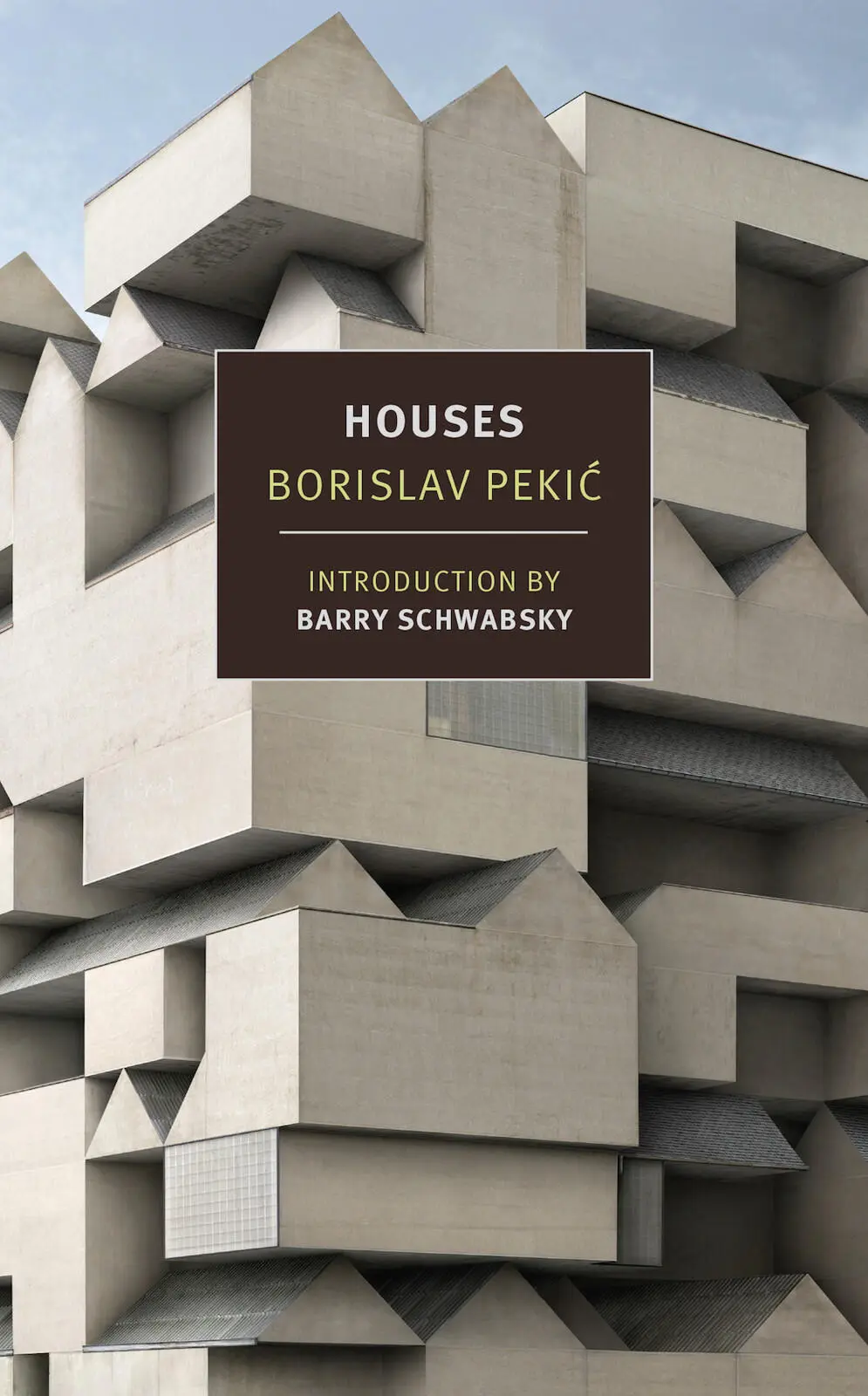
- Название:Houses
- Автор:
- Издательство:NYRB Classics
- Жанр:
- Год:2016
- ISBN:нет данных
- Рейтинг книги:4 / 5. Голосов: 1
-
Избранное:Добавить в избранное
- Отзывы:
-
Ваша оценка:
Houses: краткое содержание, описание и аннотация
Предлагаем к чтению аннотацию, описание, краткое содержание или предисловие (зависит от того, что написал сам автор книги «Houses»). Если вы не нашли необходимую информацию о книге — напишите в комментариях, мы постараемся отыскать её.
Bon vivant, Francophile, visionary, Negoyan spent the first half of his life building houses he loved and even gave names to — Juliana, Christina, Agatha — making his hometown of Belgrade into a modern city to be proud of. The second half of his life, after World War II and the Nazi occupation, he has spent in one of those houses, being looked after by his wife and a nurse, in hiding. Now, on the last day of his life, Negoyan has decided to go out at last to see what he has wrought.
Negoyan is one of the great characters in modern fiction, a charming monster of selfishness and self-delusion. And for all his failings, his life poses a question for the rest of us: Where in the modern world is there a home except in illusion?
Houses — читать онлайн бесплатно полную книгу (весь текст) целиком
Ниже представлен текст книги, разбитый по страницам. Система сохранения места последней прочитанной страницы, позволяет с удобством читать онлайн бесплатно книгу «Houses», без необходимости каждый раз заново искать на чём Вы остановились. Поставьте закладку, и сможете в любой момент перейти на страницу, на которой закончили чтение.
Интервал:
Закладка:
If, however, the property owner has in view the welfare of the nation and the people — even though this may not have been immediately apparent, or his act may even have seemed to harm the nation and the people — then the act can be approached with a clear conscience. Possession is not increased by profit for its own sake; it is increased in order to grow and multiply, and to live for the good of all. I know this from my own experience. Like my grandfather Simeon Negovan, I was exposed to all kinds of animosity even when my motives were the most honest.
I’ll relate only one such incident. During the Great Crisis of ’29 I wanted to take advantage of the ridiculously low price of building materials and also of the particularly low piecework rates. Earlier I had already bought several well-placed sites, on which I decided to build houses. But I had little ready cash available and was forced to count every penny, as they say. At that bad moment even the poorer tenants, particularly those who had no regular income or jobs, began to make excuses to avoid paying their rent, some for as long as six months. The individual sums were not large, but because of the number of delinquents, I showed a large deficit. This deficit threatened to destroy all my building plans. So I set about obtaining my rights. At first, of course, only in a gentle fashion. I paid a visit, reminded here, wrote a letter there, warned, cajoled, and where words were of no avail, began to threaten a little. In this way I finally got satisfaction from the majority. A few I had to take to court, though this was unpleasant for me and I almost became ill from the sessions. Among those evicted there happened to be an old lady living alone, a Russian woman with weak nerves, and as is invariably the case, a general’s widow. It was not surprising that because of her nerves she had to try everything until at last she managed to bring it all to an end. But was I really to blame? I’m not the one who beat her husband to death in a ditch nor did I start that Revolution, to have the widow’s misfortune hung around my neck in Belgrade, thousands of kilometers from her native Sevastopol! It was hardly a bed of roses for me either, and what’s more, Madame General had only herself to worry about, while without exaggeration I bore on my shoulders a whole small town made up solely of my houses, and all the future buildings which I had in my head. Moreover, had I been told about her, I would have closed my eyes. But I quite honestly didn’t know about the general’s widow; she had just moved into No. 18 Gračanička Street. It was probably because of this woman that I hated the house so much that I pulled her flag out of the property owner’s map and burned her model; the architectural reasons for that hatred must have been only secondary, although welcome in that they replaced the true ones. The widow’s windows were on the first floor, but unluckily the basement was high off the ground. Her furniture was already out on the street, waiting in the van. While Golovan was trying to persuade her to leave peaceably and without scandal, she broke away from the policeman and jumped out the window. Truly, it was all very regrettable and I, inasmuch as it was in my power, amply expressed my sorrow. I paid her posthumous debts, incurred her funeral expenses, and even meant to pay damages, but didn’t know to whom.
Therefore, I have the right to assert that this town was built up by people of the mettle of Arsénie, Simeon, and his other grandson, too: Constantine Negovan, whose funeral I couldn’t put out of my mind that morning. For once again, as from Gračanička Street I made out the contours of Kalemegdan Park, I was assailed by memories of his cortege. I am walking slowly along an avenue glistening with rain between huge, looming graves, memorial stones, marble slabs, and granite crosses toward a grave dug in a wet ornamental grove; I am surrounded by a procession, vaulted by umbrellas like black silk flowers, like dark-membraned mushrooms, at a certain distance from the lacquered carriage from whose plate-glass body the coffin shines, a casket girt with silver in a jeweler’s display cabinet; I am walking to the spot where, behind the choir of the Association of Architects, the funeral attendants were lined up in their red jackets, carrying circular wreaths of rosemary, laurel, and purple roses with gilt expressions of condolence printed on their mourning bands.
The procession’s ranks have already formed, the funeral march can barely be heard above the buzz; I move off slowly, keeping myself well behind the front rows of the family in whose midst I should be. But my efforts to get away from Fedor Negovan are fruitless. Clearly, I am the Negovan he has decided to hate today. My turn at last.
“ ‘Make thee an ark of gopher wood; rooms shalt thou make in the ark, and shalt pitch it within and without with pitch, and, behold, I, even I, do bring a flood of water upon the earth.’—I hope you don’t mind if I accompany you, Uncle?”
“Of course I mind! But under the circumstances I can do nothing to stop you.”
“Quite right.” He isn’t grinning in his usual manner, but I’m irritatedly aware that beneath the youthful pockmarked cheeks something pleases him. “That’s what I’m counting on.”
He sucks air in noisily and then, barely opening his mouth, spits in front of him with a dull hiss on the spot where his next step is about to fall.
“Would it be too much to ask you not to spit while you’re in my company?”
“No, but it wouldn’t make any difference. I just can’t seem to stop my own body from unloading itself inside the family circle, entouré de sa chère famille . Just look at them, the bastards: black and gold products of Levantine and Serbian brigandry. The same black morning coats and black bowlers, the same black, egg-shaped heads on their stocky black bodies, the same thin gold wives, gold ornaments, gold teeth, gold manners, gold words, and gold reserves. The Negovans have gathered in their black and gold colors to show the world that they’re still here, that they’ll be here forever even though one of their number is no longer with them!”
“Do you have any special reason for making this already sad duty even more onerous?” I ask.
“Perhaps I have, Uncle,” he answers calmly. We stopped for a moment. “I’ve decided that ordinary funerals are not good enough for a Negovan.”
“What would you suggest?”
“You ought to be burned at the stake! In the main square, urbi et orbi , for everyone to see. In front of the Prince’s statue, say. Like Sardanapalus. With your money, your wives, your servants, your horses, pictures, bonds, and your houses! With all your abilities and success.”
“And coronaries,” I add resignedly, “and gallstones.”
“And gallstones too, of course — those most precious of stones.”
I step discreetly but firmly into the front row, yet he continues brazenly: “Ashes are lasting and dry. First-class packaging. The relative is delivered after being weighed on an apothecary’s scales, and packed in a transparent cellophane box with a printed obituary — in gilt lettering, of course.” Taking my arm, he whispers: “Uncle, why don’t you carry your dead around with you?”
Completely taken aback, I ask:
“My dead? In God’s name, Fedor, what are you talking about?”
“Constantine, Uncle — Constantine Negovan. Wasn’t he killed by one of your houses?”
I decided to ignore him. On no account will I pay attention to his provocation. And I’ll see to it that I don’t present this brat with such an opportunity again.
“You like to show your teeth, don’t you, Uncle Arsénie? And not just any teeth, but your gold teeth. Even from your deathbed. Luckily, Negovans don’t die, they simply replace one another, like the green baize on a roulette table. That’s why you’re invited to pay your last respects to the ever mourned Constantine, son of Simeon Negovan, builder, model father and son, faithful husband and brother, noble relative and friend, esteemed employer and benefactor, skillful Daedalus, architect of the city of Belgrade. Crap! It’s the living Negovans you’re supposed to pay your respects to!”
Читать дальшеИнтервал:
Закладка:
Похожие книги на «Houses»
Представляем Вашему вниманию похожие книги на «Houses» списком для выбора. Мы отобрали схожую по названию и смыслу литературу в надежде предоставить читателям больше вариантов отыскать новые, интересные, ещё непрочитанные произведения.






Обсуждение, отзывы о книге «Houses» и просто собственные мнения читателей. Оставьте ваши комментарии, напишите, что Вы думаете о произведении, его смысле или главных героях. Укажите что конкретно понравилось, а что нет, и почему Вы так считаете.