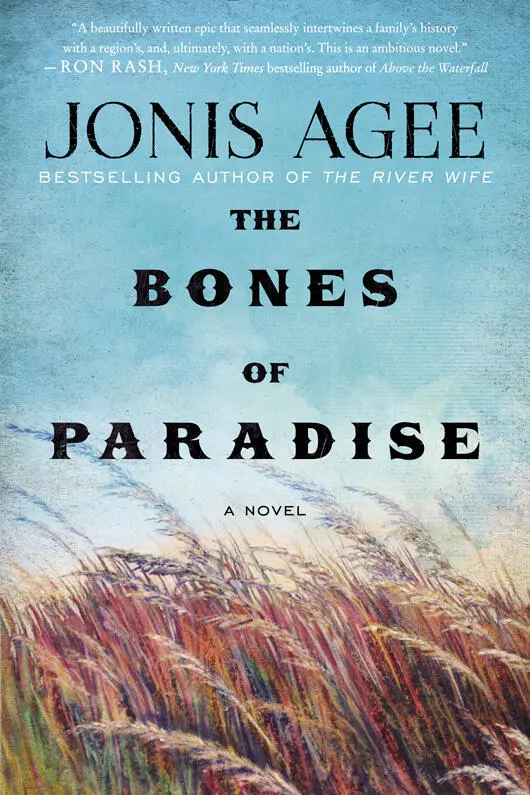
Jonis Agee - The Bones of Paradise
Здесь есть возможность читать онлайн «Jonis Agee - The Bones of Paradise» весь текст электронной книги совершенно бесплатно (целиком полную версию без сокращений). В некоторых случаях можно слушать аудио, скачать через торрент в формате fb2 и присутствует краткое содержание. Год выпуска: 2016, Издательство: William Morrow, Жанр: Современная проза, на английском языке. Описание произведения, (предисловие) а так же отзывы посетителей доступны на портале библиотеки ЛибКат.
- Название:The Bones of Paradise
- Автор:
- Издательство:William Morrow
- Жанр:
- Год:2016
- ISBN:нет данных
- Рейтинг книги:3 / 5. Голосов: 1
-
Избранное:Добавить в избранное
- Отзывы:
-
Ваша оценка:
The Bones of Paradise: краткое содержание, описание и аннотация
Предлагаем к чтению аннотацию, описание, краткое содержание или предисловие (зависит от того, что написал сам автор книги «The Bones of Paradise»). Если вы не нашли необходимую информацию о книге — напишите в комментариях, мы постараемся отыскать её.
returns with a multi-generational family saga, set in the unforgiving Nebraska Sandhills in the years following the massacre at Wounded Knee—an ambitious tale of history, vengeance, race, guilt, betrayal, family, and belonging, filled with a vivid cast of characters shaped by violence, love, and a desperate loyalty to the land. Ten years after the 7th Calvary massacred more than 200 Lakota men, women, and children at Wounded Knee, J. B. Bennett, a white rancher, and Star, a young Native American woman, are murdered in a remote meadow on J. B.’s land. The deaths bring together the scattered members of the Bennett family: his cunning and hard father, Drum; his estranged wife, Dulcinea; and his young sons, Cullen and Hayward. As the mystery of these twin deaths unfolds, the history of the dysfunctional Bennett’s and their damning secrets are revealed exposing the conflicted heart of a nation caught between past and future.
At the center of
are two remarkable women. Dulcinea, returned after bitter years of self-exile, yearns for redemption and the courage to mend her broken family and reclaim the land that is rightfully hers. Rose, scarred by the terrible slaughters that have decimated and dislocated her people, struggles to accept the death of her sister, Star, and refuses to rest until she is avenged.
A kaleidoscopic portrait of misfits, schemers, chancers, and dreamers, Jonis Agee’s bold new novel is a panorama of America at the dawn of a new century. A beautiful evocation of this magnificent, blood-soaked land—its sweeping prairies, seas of golden grass and sandy hills, all at the mercy of two unpredictable and terrifying forces, weather and lawlessness—and the durable men and women who dared to tame it. Intimate and epic,
is a remarkable achievement: a mystery, a tragedy, a romance, and an unflagging exploration of the beauty and brutality, tenderness and cruelty that defined the settling of the American west.
The Bones of Paradise — читать онлайн бесплатно полную книгу (весь текст) целиком
Ниже представлен текст книги, разбитый по страницам. Система сохранения места последней прочитанной страницы, позволяет с удобством читать онлайн бесплатно книгу «The Bones of Paradise», без необходимости каждый раз заново искать на чём Вы остановились. Поставьте закладку, и сможете в любой момент перейти на страницу, на которой закончили чтение.
Интервал:
Закладка:
The gorge rose in J.B.’s throat and he swallowed hard. He felt someone beside him, and heard Father Hansen praying in Latin, the monotone of the chant so discordant J.B. had to walk away. He should have used his guns against the soldiers. He couldn’t use his guns against the soldiers. The snowy ground of the ravine was splotched pink and red and black with blood that looked like shadows of the fallen in the midwinter light of later photographs. Even as he made his way back to where his horses were tethered, the intermittent firing continued as soldiers chased people up to three miles to kill them. Though he tried not to look, he could not help himself.
The relic hunters and soldiers searching for souvenirs were already stripping the bodies, holding up their trophies: moccasins, beaded belts, hair ornaments, necklaces, and ghost shirts, especially with bullet holes and blood, the irony doubling the value in their minds. A group of schoolboys, caught in the midst of a game, lay in a row like a sad picket fence. Bodies everywhere. Later the military would underestimate the number by at least a hundred, a mistake made in part because the Indians retrieved as many of their wounded and dead as they could after nightfall. J.B.’s journey across the camp was a tortured winding path around the grotesque bodies twisted and contorted in every manner of agony with gaping wounds and sometimes worse: the top of a skull taken, the brain matter spilling and freezing pink and gray on the ground, the expression on the face peaceful, a hand resting on the chest as if the man were asleep. A woman with a missing lower jaw and her throat ripped open, her arms extending from her sides, eyes staring up as if she had fallen from the sky. A family whose mangled bodies seemed to exchange shards of bone and blood, faces shocked and outraged.
J.B. thought he heard a small cry, and stopped and knelt beside a woman whose body rested higher than the others. He hesitated, then carefully rolled her off her back and found that the cradleboard strapped there held an infant. The child silently scrutinized his face as he cut the straps off the mother’s shoulders and lifted the board, then removed the baby and cradled it in his arms. A shadow rose behind him as he stood.
“You want I should get rid of that?” A soldier held his rifle so the butt was raised and ready to club the babe. His cartridge belt was hung with booty. He grinned, and J.B. could smell the liquor sweating from his skin.
J.B. shook his head and brushed past the man, prepared to shoot him if needed. He pulled the deerskin wrap over the baby’s head and hurried on toward his horse without any idea what he was going to do. Several scavengers stopped work to stare after him, wondering what prize he’d managed to secure, wondering if it’d be worth it to follow him and take it.
He was untying his horses when Father Hansen found him. “You don’t want that child,” the priest assured him. “I can take care of it. We have room. Don’t worry.”
J.B. sighed, slid his rifle in the saddle boot, and drew his gun, pointed it at the priest, barely registering the other man’s blood-streaked face and hands, the black robe bearing deeper black splashes. There was a bullet crease along his jaw and a knife wound on the back of his hand that the priest ignored as he held out his arms. “You need to leave. Go back to your ranch, your son. There’s nothing here for you. I shouldn’t have asked you to come.” The priest looked around. “Nothing for anyone now.”
Unable to mount his horse or move at all, J.B. stood and waited, heard the wind rustle the grass, the shouts of soldiers torn between their desire to kill the wounded enemy and their obligation to drag them back to the medics for care, and then the first wails of the survivors upon discovery of their dead. Finally his arms loosened, and Father Hansen took the baby, tucked it expertly on one shoulder as he gripped J.B.’s arm. “Go home. Forget this.”
J.B. stared at his retreating back until the priest disappeared into the crowd of gathering Indians searching for their kin.
He intended to ride straight through to the ranch, but snow and bitter cold forced him to stop in Rushville. He was able to find a bed in a large room crowded with twenty cots at the hotel despite the newspaper reporters and government officials and thrill seekers. When he went downstairs to the saloon crowded with soldiers and civilians, he stood at the end, head down over his whiskey glass, unable to avoid overhearing the noise of men celebrating their victory over a vanquished enemy.
He was on the verge of leaving when a man pushed his way into the narrow space beside him and called for whiskey. Turning to J.B., he raised his brow and nodded toward his empty glass. J.B. shrugged. The barkeep poured their glasses full and both men drank them half down.
“Percival Chance,” the man said. He was tall, thin, and handsome in a varnished eastern kind of style, despite the rugged condition of his clothing. He had a thin nose and an angular face with elegant planes, a high forehead with longish blond hair. J.B. imagined he was the kind of man women appreciated. He still had decent teeth.
Chance raised his brow at him and J.B. remembered to introduce himself and thank him for the drink.
The high atmosphere of the saloon fit Chance. As he drank, the color mounted in his cheeks and his eyes seemed charged with electricity as if they held a secret. J.B. wondered if a touch would ignite his own clothing.
Finally Chance spoke. “That was something out there today, was it not?” His language and dialect was an unsettled mixture of sounds, as if he had lived in another country and forgotten how to speak his native tongue. Chance turned his back to the bar and leaned against it, propping his elbows and nodding toward the corner where the loudest group almost shouted in their efforts to out-tell each other’s tales.
“That man in the middle there is my employer, Lord M. We were fortunate enough to take part in the skirmish with the red men today. He’s thrilled and I received a very large bonus—in addition to other benefits.” He pulled an eagle talon necklace from inside his shirt and worked it over his head. Laying it on the bar, he said, “An Indian has to earn this. Shows his prowess and bravery. I’ve always wanted one, though the talons are so sharp they dig into the skin. Indians are more disciplined to endure pain, I’ve found.” He smiled and rubbed the back of his hand, which was raked with long scratches. When he turned his head, J.B. could see three long marks on his neck as well. J.B. pushed away from the bar, suddenly sickened by his suspicions. Skirmish ? He couldn’t dislodge the word now that he’d heard it.
“Oh don’t go—” Chance straightened and lifted his glass in invitation.
J.B. pushed his way through the crowd, unable to tolerate another second of the man’s company. When he met Chance ten years later, he still remembered his suspicions and regretted not beating the man to death right there in the saloon. For the rest of his life, J.B. was haunted by the execution of the Indians, and later the mass grave where soldiers dumped 146 bodies stripped of any possible relic or souvenir, half-naked and unwashed, their forms frozen in grotesque positions by the bitter cold, handled as if they were tainted firewood.
Father Hansen had wanted a witness, but it made no difference. The true story was unthinkable, unheroic, so it was changed by the newspapers, the military, and the government. Afterward, J.B. lived on his Sand Hills land as if he rented it. He felt like he was waiting for a landlord to evict him, no matter what his father believed. And the worst part was that he had traded Cullen for a ranch that could never rightfully be his own. The events of his life felt like a spool of thread he kept trying to trace back and back, never to reach the end.
Читать дальшеИнтервал:
Закладка:
Похожие книги на «The Bones of Paradise»
Представляем Вашему вниманию похожие книги на «The Bones of Paradise» списком для выбора. Мы отобрали схожую по названию и смыслу литературу в надежде предоставить читателям больше вариантов отыскать новые, интересные, ещё непрочитанные произведения.




Обсуждение, отзывы о книге «The Bones of Paradise» и просто собственные мнения читателей. Оставьте ваши комментарии, напишите, что Вы думаете о произведении, его смысле или главных героях. Укажите что конкретно понравилось, а что нет, и почему Вы так считаете.