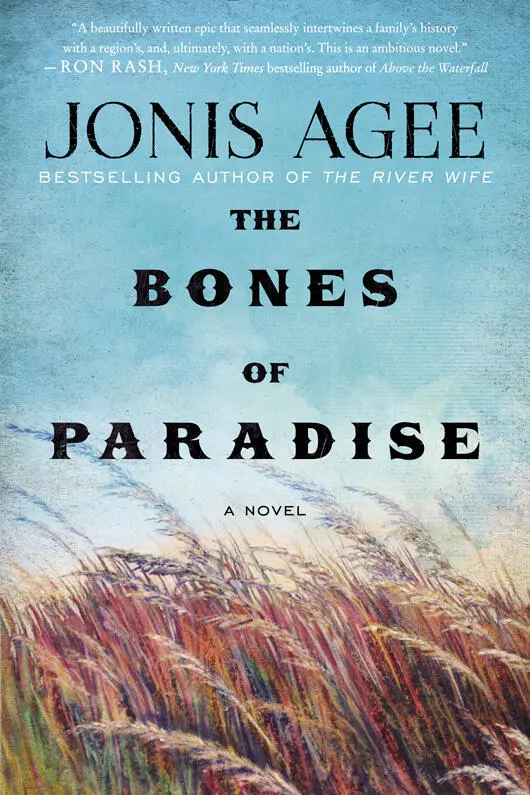
Jonis Agee - The Bones of Paradise
Здесь есть возможность читать онлайн «Jonis Agee - The Bones of Paradise» весь текст электронной книги совершенно бесплатно (целиком полную версию без сокращений). В некоторых случаях можно слушать аудио, скачать через торрент в формате fb2 и присутствует краткое содержание. Год выпуска: 2016, Издательство: William Morrow, Жанр: Современная проза, на английском языке. Описание произведения, (предисловие) а так же отзывы посетителей доступны на портале библиотеки ЛибКат.
- Название:The Bones of Paradise
- Автор:
- Издательство:William Morrow
- Жанр:
- Год:2016
- ISBN:нет данных
- Рейтинг книги:3 / 5. Голосов: 1
-
Избранное:Добавить в избранное
- Отзывы:
-
Ваша оценка:
The Bones of Paradise: краткое содержание, описание и аннотация
Предлагаем к чтению аннотацию, описание, краткое содержание или предисловие (зависит от того, что написал сам автор книги «The Bones of Paradise»). Если вы не нашли необходимую информацию о книге — напишите в комментариях, мы постараемся отыскать её.
returns with a multi-generational family saga, set in the unforgiving Nebraska Sandhills in the years following the massacre at Wounded Knee—an ambitious tale of history, vengeance, race, guilt, betrayal, family, and belonging, filled with a vivid cast of characters shaped by violence, love, and a desperate loyalty to the land. Ten years after the 7th Calvary massacred more than 200 Lakota men, women, and children at Wounded Knee, J. B. Bennett, a white rancher, and Star, a young Native American woman, are murdered in a remote meadow on J. B.’s land. The deaths bring together the scattered members of the Bennett family: his cunning and hard father, Drum; his estranged wife, Dulcinea; and his young sons, Cullen and Hayward. As the mystery of these twin deaths unfolds, the history of the dysfunctional Bennett’s and their damning secrets are revealed exposing the conflicted heart of a nation caught between past and future.
At the center of
are two remarkable women. Dulcinea, returned after bitter years of self-exile, yearns for redemption and the courage to mend her broken family and reclaim the land that is rightfully hers. Rose, scarred by the terrible slaughters that have decimated and dislocated her people, struggles to accept the death of her sister, Star, and refuses to rest until she is avenged.
A kaleidoscopic portrait of misfits, schemers, chancers, and dreamers, Jonis Agee’s bold new novel is a panorama of America at the dawn of a new century. A beautiful evocation of this magnificent, blood-soaked land—its sweeping prairies, seas of golden grass and sandy hills, all at the mercy of two unpredictable and terrifying forces, weather and lawlessness—and the durable men and women who dared to tame it. Intimate and epic,
is a remarkable achievement: a mystery, a tragedy, a romance, and an unflagging exploration of the beauty and brutality, tenderness and cruelty that defined the settling of the American west.
The Bones of Paradise — читать онлайн бесплатно полную книгу (весь текст) целиком
Ниже представлен текст книги, разбитый по страницам. Система сохранения места последней прочитанной страницы, позволяет с удобством читать онлайн бесплатно книгу «The Bones of Paradise», без необходимости каждый раз заново искать на чём Вы остановились. Поставьте закладку, и сможете в любой момент перейти на страницу, на которой закончили чтение.
Интервал:
Закладка:
Unable to secure a bed for the night, J.B. had to choose between returning to the ranch and pushing on. Despite the boy’s cries of hunger and sobs of Mama, Mama, J.B. held him in the front of his saddle. By the time they rode up to the military encampment, Sibley tents stretched wide across the flat landscape, while the thin winter light outlined every object as if it were drawn by a sharp pencil. The tents glowed white against the brown grass and dirt, and the horses in the rope corrals were silent, hipshot, heads down. The smoke from cooking fires and mess tents rose lazily into the white-gray sky.
On a small rise to his right, J.B. saw a man with a box camera on a tripod sighting on the camp in the late-afternoon light. Across the country newspapers printed drawings based on photographs of the Lakota encampment, the dancing, and the cavalry. He figured their reports were largely exaggerated. The Omaha Bee one of the worst for rumors and outright lies. The Omaha Herald tried harder for the truth, but it eluded them when there were powerful money and business interests at stake. He wondered what the government wanted here. He’d heard the Indian agent, Royer, was a fool and a coward, and called in the troops as soon as he could to stop the dancing. Some of J.B.’s men bragged about coming here to fight the “murdering redskins” and to save the white women and children who had earned their rightful place on Indian land. Another reason to come see for himself. If he had to hold his men at gunpoint, he would.
After a night on the hard ground, J.B. woke covered in blankets soaked with cold dew and frost. He saddled their horses and woke Hayward at sunrise. He didn’t want any further discussion, and refused to gratify Hayward’s desire to spend time with the rough soldiers. Once the boy was mounted, J.B. handed him two cold biscuits stuffed with bacon and a canteen of fresh water. He could eat like a cowboy on the trail. Last night he heard that Drum was prowling, and he wanted to avoid him if possible.
The dancing was well under way when they reached the Indian encampment, and J.B. was stunned by the number of tipis and people. Pulling up beside two white men in a buggy along the ragged edge of spectators, he used his binoculars to scan the dancers and supporters. The only guns seemed to be in the hands of young men acting as guards, who blocked anyone who tried to break into the circle and disrupt the dance. Women wore white cotton dresses with blue around the V-neck, painted with flowers and birds and animals. Men wore pale blue shirts painted with butterflies, buffalo, deer, and flowers . . . the life they would bring back when the road to the spirit world opened again. Later, he was told the people believed their garments bulletproof, but that story only appeared among whites after the cavalry drew close and trained their guns on the dancers, who fled to the Stronghold and Wounded Knee Creek.
The dancers moved slowly around the circle, lifting legs with the beat of the big five- and six-man drums. Soon J.B. felt the drumbeat move into his own body; his blood pulsed in his veins, throbbed in his head, demanded he keep count. Beside him, Hayward lifted his feet and knees in rhythm, too. Powdered by months of dancing, the dirt gave beneath his feet, springing back as the earth answered his step. Thoughts began to recede in the distance, and he was on a long road away from the land he knew. The ground itself carried the thudding rhythm into his feet and up his legs. It climbed his spine and encircled his chest, shoulders, neck, and finally smothered his skull until he almost danced himself, his heart beating as one with the others.
“Stay with your pa, boy.” A stranger pulled Hayward back. J.B. nodded his thanks and looked down at the boy, who was as dazed as he was. Maybe they were both tired of being alone. He felt the hope here. Hope in the people dressed in rags, without shoes even in the cold, beloved children running and playing, dogs bouncing at their sides, patched and torn tipis with smoke trickling from the tops, big kettles of watery stew for the dancers outside the loose circle, old men and boys returning from the hunt with barely enough rabbits to feed themselves, the elderly and sick lying on the ground or propped on blankets around the circle so their spirits could encourage the dancers. None of it mattered as much as continuing the dance that would redeem their land and heal the rents the whites had torn in its fabric. J.B. was overwhelmed by the profound sadness: a vision of so much hope in a doomed world. What had he done? It was the first time he questioned his right to the land his father claimed, the land for which he had paid a terrible price.
“That’s a scalp dance,” the bearded white man next to him announced.
“No, that’s an Omaha dance. It’s harmless. Women aren’t part of a scalp dance,” another man said. J.B. glanced at him, noticed the priest’s collar and black robe under the heavy black wool coat. Mission priest. He might know something. J.B. introduced himself and discovered one was a storekeeper from Gordon named Swan, and the other a Jesuit from the Rosebud mission school named Hansen, a tall, thin man with thick blond hair and pale blue eyes.
“There’s that photographer fellow again, Morledge, he’s been here since summer.” Swan pointed to a young man in dark clothing who drifted between groups, apparently welcome by all. “Goes out among them like he’s on a Sunday picnic. Lucky if he doesn’t leave that fine head of hair behind.” Swan was not to be persuaded about the dancers, despite the women and even children who danced through the next several hours without respite. If anything, the rhythmic chanting and steady nodding shuffle took them to the edge of transport, such as J.B. had seen in Missouri tent revivals as a young man. He had never felt it his place to decide another person’s religion, and if the messiah appeared to other folks, so be it. He just hoped to make it through a day.
“Can I look?” Hayward stretched up a hand for the binoculars.
The priest nodded at J.B. as if to say he was doing a good job bringing the boy here to witness.
“Sure hope those troops get off their duffs and put a stop to this nonsense.” Swan pointed to the steady stream of Indian families making their way into the encampment. “Folks around here, whites that is, are scared to death they’ll lose everything they’ve worked for now. Religion, my ass.” He snorted loudly.
“Those whites are squatters wanting to carve up more reservation, Mr. Swan,” the priest said, his tone dry.
“Indians don’t use a tenth of what we gave them. They got no money and they won’t work, what good are they? We beat ’em fair and square. Now the government gives them food so they don’t have to farm. Beef so they don’t have to ranch. Wish I could join up!” He gave a war whoop and did an exaggerated dance step, knees rising like the great pistons of a draft horse.
The priest shook his head and glanced at J.B. with a smile. “Maybe you should.”
J.B. thought about the beef issue on annuity days that he’d witnessed last summer when it was so dry and the ranch struggling. He’d culled the best steers he could find and driven them to the reservation. The families standing on the perimeter looked half-starved and tried not to appear anxious for their cut of beef once their relative rode it down on horseback and shot it, a poor replica of their buffalo-hunting days that made the white spectators cheer and clap as if at Buffalo Bill’s Wild West show. A quarter of skinny beef was to last each family a month, regardless of the number of children or relatives. Last month Royer, the Indian agent, suspended the allotment until the people stopped dancing, and now the families must be hungrier than ever. J.B.’s stomach clenched. If he could, he’d find a way to push some cattle to the reservation, maybe in a place that wasn’t so heavily guarded. He’d think on that. Maybe the priest would help, unless he was starving them to accept his Christian god.
Читать дальшеИнтервал:
Закладка:
Похожие книги на «The Bones of Paradise»
Представляем Вашему вниманию похожие книги на «The Bones of Paradise» списком для выбора. Мы отобрали схожую по названию и смыслу литературу в надежде предоставить читателям больше вариантов отыскать новые, интересные, ещё непрочитанные произведения.





Обсуждение, отзывы о книге «The Bones of Paradise» и просто собственные мнения читателей. Оставьте ваши комментарии, напишите, что Вы думаете о произведении, его смысле или главных героях. Укажите что конкретно понравилось, а что нет, и почему Вы так считаете.