Jonis Agee - The Bones of Paradise
Здесь есть возможность читать онлайн «Jonis Agee - The Bones of Paradise» весь текст электронной книги совершенно бесплатно (целиком полную версию без сокращений). В некоторых случаях можно слушать аудио, скачать через торрент в формате fb2 и присутствует краткое содержание. Год выпуска: 2016, Издательство: William Morrow, Жанр: Современная проза, на английском языке. Описание произведения, (предисловие) а так же отзывы посетителей доступны на портале библиотеки ЛибКат.
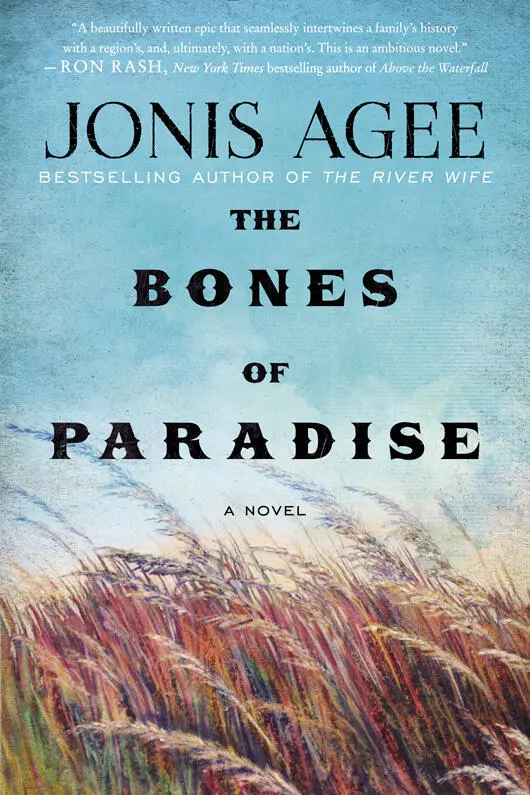
- Название:The Bones of Paradise
- Автор:
- Издательство:William Morrow
- Жанр:
- Год:2016
- ISBN:нет данных
- Рейтинг книги:3 / 5. Голосов: 1
-
Избранное:Добавить в избранное
- Отзывы:
-
Ваша оценка:
The Bones of Paradise: краткое содержание, описание и аннотация
Предлагаем к чтению аннотацию, описание, краткое содержание или предисловие (зависит от того, что написал сам автор книги «The Bones of Paradise»). Если вы не нашли необходимую информацию о книге — напишите в комментариях, мы постараемся отыскать её.
returns with a multi-generational family saga, set in the unforgiving Nebraska Sandhills in the years following the massacre at Wounded Knee—an ambitious tale of history, vengeance, race, guilt, betrayal, family, and belonging, filled with a vivid cast of characters shaped by violence, love, and a desperate loyalty to the land. Ten years after the 7th Calvary massacred more than 200 Lakota men, women, and children at Wounded Knee, J. B. Bennett, a white rancher, and Star, a young Native American woman, are murdered in a remote meadow on J. B.’s land. The deaths bring together the scattered members of the Bennett family: his cunning and hard father, Drum; his estranged wife, Dulcinea; and his young sons, Cullen and Hayward. As the mystery of these twin deaths unfolds, the history of the dysfunctional Bennett’s and their damning secrets are revealed exposing the conflicted heart of a nation caught between past and future.
At the center of
are two remarkable women. Dulcinea, returned after bitter years of self-exile, yearns for redemption and the courage to mend her broken family and reclaim the land that is rightfully hers. Rose, scarred by the terrible slaughters that have decimated and dislocated her people, struggles to accept the death of her sister, Star, and refuses to rest until she is avenged.
A kaleidoscopic portrait of misfits, schemers, chancers, and dreamers, Jonis Agee’s bold new novel is a panorama of America at the dawn of a new century. A beautiful evocation of this magnificent, blood-soaked land—its sweeping prairies, seas of golden grass and sandy hills, all at the mercy of two unpredictable and terrifying forces, weather and lawlessness—and the durable men and women who dared to tame it. Intimate and epic,
is a remarkable achievement: a mystery, a tragedy, a romance, and an unflagging exploration of the beauty and brutality, tenderness and cruelty that defined the settling of the American west.
The Bones of Paradise — читать онлайн бесплатно полную книгу (весь текст) целиком
Ниже представлен текст книги, разбитый по страницам. Система сохранения места последней прочитанной страницы, позволяет с удобством читать онлайн бесплатно книгу «The Bones of Paradise», без необходимости каждый раз заново искать на чём Вы остановились. Поставьте закладку, и сможете в любой момент перейти на страницу, на которой закончили чтение.
Интервал:
Закладка:
“Will you look at that young fellow!” Swan pointed toward the photographer, who had loaded his equipment on his horse and made his way toward the dance. The guards immediately stopped him, but after some negotiation, allowed him to join the crowd as long as he didn’t unload his camera. J.B. nodded to the two men and led his horse toward the dance, his son behind him.
They stayed a day, talking and watching, sharing the food cooking in big pots over campfires in front of tipis. J.B. liked how his son seemed interested and open to anyone who came near, soon joking and sitting with younger boys and girls resting from the dance or joining in their games. Close to dark, J.B. accepted the priest’s offer to spend the night in his tipi. At least they wouldn’t wake to wet blankets. After a supper of cornmeal in a thin meat broth of some sort, a Ghost Dancer named Jack Red Cloud, son of the famous chief and one of the first dancers, came to the tipi to discuss the increasing presence of the cavalry. A handsome young man with strong features, he posed the question that had bothered J.B. for months. Jack Red Cloud refused to look at the stranger as he addressed Father Hansen, and asked, “You have your religion, why won’t you allow us to have ours?” The Jesuit shook his head once and stared at the fire in the center of the tipi, until finally he said, “It’s not up to me. Ask the president. Ask Congress.”
“American Horse agrees with them, says don’t fight the white government. We’ll all be killed. How can that be right?” When the priest didn’t reply, instead staring moodily into the fire, Jack Red Cloud stood and left, muttering to himself. J.B. was torn by the argument. He thought every person had the right to believe as they wanted, but the Indians were in a tricky position. Was it really so important to continue a doomed cause? The government was wrong to starve the families, but maybe the Indian leaders should consider their survival, instead of insisting on make-believe. But if it was make-believe, why were white people so upset about it? Surely they didn’t believe the Indians regained their power by dancing. J.B. threw a stick on the fire, watched the flames lick then gather it in until it turned orange and powdered into red coals. He glanced at Hayward asleep in his blankets, dark blue circles under his eyes like bruises.
“They have to be careful,” the priest said with a sigh. “Big Foot is very sick, in the hands of the military. Who knows what they intend to do with him. Tribal factions and the military want Sitting Bull dead. Royer wants Little arrested, but the dancers protect him.” He hunched, holding himself. “This isn’t going to end well. More people arriving daily. Indian agent calling for troops to stop the dance and the so-called threat. Man’s a fool!” He suddenly stood and flung something into the fire that looked like a rosary. J.B. couldn’t be sure as it sank into the ashes and disappeared.
J.B. left Pine Ridge after three days and felt he’d witnessed a historic moment: the conversion of thousands of people to a new religion. Everywhere he sat and talked to Indians who spoke only of living in peace with creation again, without war and hunger, a world where their children could return to their families and be raised in the traditional ways in harmony with the animals and all people. It was a Christian vision without hell and damnation. On his way back through the cavalry encampment, J.B. stopped at the tent of General Brooke. He explained his assessment, saying, “The Indians are only practicing their religious beliefs. It’s peaceful. No threat at all.”
Brooke laughed openly at him. “All respect, sir, but you have no experience with these people.”
“There are a lot of elderly, women, and children out there. Hardly anyone has a gun. Most of the young men have died or run off,” J.B. protested.
The general nodded and stared at him. “You’re lucky the hostiles didn’t slit your throat or steal your guns, my friend. You don’t know the force we’re dealing with. They have weapons hidden all over that camp, and I intend to find them, or they will be made to pay.”
A glint in his eyes assured J.B. that the general believed his words, and would happily massacre the entire camp without a thought. The military seemed bent on retribution for Custer and the Seventh Cavalry’s defeat at Little Bighorn. And when the Indians were finally blotted out, the Black Hills and all the reservation lands would be open for white settlement. The argument still raged in Congress. There was money to be made here.
J.B. went through Rushville again, and noted the train that arrived loaded with more troops, horses, and supplies, as if a major battle would soon be fought. It worried him, but he reassured himself that it was a religious celebration, nothing more. Surely the military would eventually recognize that. He stopped at the telegraph office again, noticed the Indian girl tidying the place. The operator, Crockett, was notorious for his slovenly ways, and it was a treat to enter the room without the stench of sweat and garbage. When he asked after Dulcinea, Crockett shook his head, and from the waves of alcohol coming off him, J.B. felt he probably didn’t understand the question. The Indian girl paused after Crockett stumbled to the back, and motioned him closer.
“Chadron,” she whispered. He thanked her and quickly composed a message saying he’d be in Rushville late December if she sent word. The girl looked at him, read the message, and glanced toward the other room where Crockett’s drunken snores rattled the dishes. J.B. laid the coin on the counter and left reassured.
Over the next month, he followed the mounting alarm over the Ghost Dance on Pine Ridge. He read papers from Chadron, Gordon, and Omaha, and rode into town as often as he could get away. Elaine Goodale Eastman, an Indian agent, said the ghost shirts only became bulletproof after the army arrived, and that should be evidence this was a peaceful gathering. He couldn’t rid his mind of the images: gaunt children in threadbare clothes playing happily while their families danced and prayed to change their futures. At night he held Hayward for longer than usual and let him sleep with him when bad dreams threatened.
Then the news turned desperate. A Sioux cowboy passing through from North Platte to Pine Ridge told them Sitting Bull was murdered on December 15, by agency police at Standing Rock Reservation. The army feared he was urging his followers to join the Ghost Dancers and create an uprising. Buffalo Bill had come to Sitting Bull, his old friend, and tried to trick him into surrendering, but the ruse failed and Bill departed. The Indian ate sparingly though he was clearly hungry, and J.B. and Vera both urged more food on him. When he pushed away from the table he thanked them and J.B. let him sleep on the sofa so he’d have at least one warm night. In the morning, Vera gave him all the leftover beef, a chicken, and twenty biscuits she woke early to bake. Later, when Buffalo Bill was granted the use of the braves who held out in the Stronghold after Wounded Knee, J.B. wondered if the cowboy, Roy Dancing Spear, was among them. The men were allowed few choices: become part of Bill’s show and travel to Europe, go to prison, or be relocated to Oklahoma, where the Lakota people were the most hated by all the other tribes.
CHAPTER TWENTY-NINE
In late December J.B. received a message from Father Hansen that urged him to return to Pine Ridge. J.B. was in a quandary. He didn’t want to leave Hayward, and had no notion that he’d be of any help, yet the man asked and he still couldn’t shake the images of those children. The priest said the military was poised to attack simply because it was winter, they were cold, and their patience had worn thin with a people who wouldn’t stop dancing despite the lack of food and warmth. Families starved, and it made no difference. They danced with rags wrapped around their feet. Finally, a large contingent of Indians fled the encampment, but were followed by the army, found and taken to Wounded Knee Creek, and assured they’d be safe. One of their leaders, Big Foot, ill with pneumonia, was among them.
Читать дальшеИнтервал:
Закладка:
Похожие книги на «The Bones of Paradise»
Представляем Вашему вниманию похожие книги на «The Bones of Paradise» списком для выбора. Мы отобрали схожую по названию и смыслу литературу в надежде предоставить читателям больше вариантов отыскать новые, интересные, ещё непрочитанные произведения.








Обсуждение, отзывы о книге «The Bones of Paradise» и просто собственные мнения читателей. Оставьте ваши комментарии, напишите, что Вы думаете о произведении, его смысле или главных героях. Укажите что конкретно понравилось, а что нет, и почему Вы так считаете.