Jonis Agee - The Bones of Paradise
Здесь есть возможность читать онлайн «Jonis Agee - The Bones of Paradise» весь текст электронной книги совершенно бесплатно (целиком полную версию без сокращений). В некоторых случаях можно слушать аудио, скачать через торрент в формате fb2 и присутствует краткое содержание. Год выпуска: 2016, Издательство: William Morrow, Жанр: Современная проза, на английском языке. Описание произведения, (предисловие) а так же отзывы посетителей доступны на портале библиотеки ЛибКат.
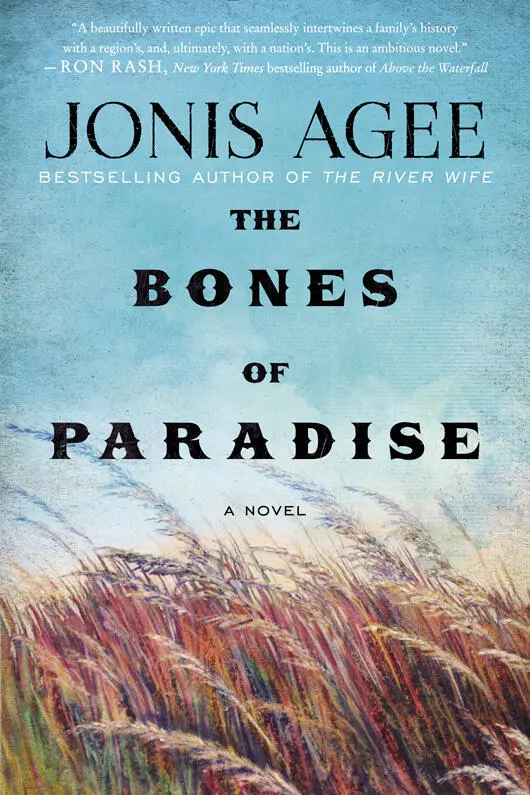
- Название:The Bones of Paradise
- Автор:
- Издательство:William Morrow
- Жанр:
- Год:2016
- ISBN:нет данных
- Рейтинг книги:3 / 5. Голосов: 1
-
Избранное:Добавить в избранное
- Отзывы:
-
Ваша оценка:
The Bones of Paradise: краткое содержание, описание и аннотация
Предлагаем к чтению аннотацию, описание, краткое содержание или предисловие (зависит от того, что написал сам автор книги «The Bones of Paradise»). Если вы не нашли необходимую информацию о книге — напишите в комментариях, мы постараемся отыскать её.
returns with a multi-generational family saga, set in the unforgiving Nebraska Sandhills in the years following the massacre at Wounded Knee—an ambitious tale of history, vengeance, race, guilt, betrayal, family, and belonging, filled with a vivid cast of characters shaped by violence, love, and a desperate loyalty to the land. Ten years after the 7th Calvary massacred more than 200 Lakota men, women, and children at Wounded Knee, J. B. Bennett, a white rancher, and Star, a young Native American woman, are murdered in a remote meadow on J. B.’s land. The deaths bring together the scattered members of the Bennett family: his cunning and hard father, Drum; his estranged wife, Dulcinea; and his young sons, Cullen and Hayward. As the mystery of these twin deaths unfolds, the history of the dysfunctional Bennett’s and their damning secrets are revealed exposing the conflicted heart of a nation caught between past and future.
At the center of
are two remarkable women. Dulcinea, returned after bitter years of self-exile, yearns for redemption and the courage to mend her broken family and reclaim the land that is rightfully hers. Rose, scarred by the terrible slaughters that have decimated and dislocated her people, struggles to accept the death of her sister, Star, and refuses to rest until she is avenged.
A kaleidoscopic portrait of misfits, schemers, chancers, and dreamers, Jonis Agee’s bold new novel is a panorama of America at the dawn of a new century. A beautiful evocation of this magnificent, blood-soaked land—its sweeping prairies, seas of golden grass and sandy hills, all at the mercy of two unpredictable and terrifying forces, weather and lawlessness—and the durable men and women who dared to tame it. Intimate and epic,
is a remarkable achievement: a mystery, a tragedy, a romance, and an unflagging exploration of the beauty and brutality, tenderness and cruelty that defined the settling of the American west.
The Bones of Paradise — читать онлайн бесплатно полную книгу (весь текст) целиком
Ниже представлен текст книги, разбитый по страницам. Система сохранения места последней прочитанной страницы, позволяет с удобством читать онлайн бесплатно книгу «The Bones of Paradise», без необходимости каждый раз заново искать на чём Вы остановились. Поставьте закладку, и сможете в любой момент перейти на страницу, на которой закончили чтение.
Интервал:
Закладка:
When he heard the news, J.B. decided to go, despite the frigid weather and the snow that would bury them any day now. He brought extra clothing, blankets, and food on a packhorse. Hayward was left in the care of Jorge and Willie Munday, since Vera and Higgs had taken the train to Denver. The hands wore grim expressions as he waved good-bye, and something in the pit of his stomach told him they were right. He had no business in the middle of this. He secretly hoped to see his wife, but he couldn’t tell them that either.
When J.B. arrived at Wounded Knee Creek and met Father Hansen on the evening of December 28, the soldiers were drunk on whiskey a freighter sold out of the back of his wagon. Hardly anyone slept that night with the drunken yelling, singing, and fighting, and on the morning of the twenty-ninth the camp’s mood was tense, soldiers prepared to shoot at any provocation, Indians wary despite the children playing around tipis, and the dancers and drummers organized at first light. As Father Hansen and J.B. drank their coffee and ate hard biscuits, they remarked on the sense of dread and hostility among the surly troops. “The army wants to attack,” Father Hansen warned. “Their patience is gone. They’ll attack. There’s nothing else they can do.”
“Then why am I here?” he asked in a bitter voice. The man had no right to drag him into this mess.
Father Hansen stared at him, then shrugged. “I couldn’t think of anyone else who cared enough.”
“To do what?” J.B. wanted to hit the priest.
“To bear witness. Someone has to know the true story. The army’s already writing their version, the one that makes them heroes. I thought between us we could gather the facts. The truth.” He shook his head. “Something terrible is about to happen, and there isn’t a damn thing we can do about it but stand and watch.” He clenched his fists and hit the ground, producing a crackling in his bones.
J.B. saw he was right, and wished he hadn’t turned down the earlier offer of whiskey. As far as he could tell, there were no weapons in the camp except for the guards’ Winchesters. He wondered where the young photographer was, where any photographer was when a fight could erupt at any moment. He saddled his horse as a precaution, pulled the rifle from the boot, confirmed it was loaded, and then checked the load in his revolver. He made sure he had extra ammunition in his saddlebags, took a handful of bullets and slid them into his buffalo coat pocket. He didn’t question his actions. He knew how quickly things could change. In the back of his mind he wondered exactly who he was going to shoot. Shortly after, as the bystanders watched from what seemed a safe distance, Colonel Forsyth and Major Whitside demanded the Indians hand over their weapons.
The soldiers held their breath while the Indian leaders met and finally brought a handful of old, broken rifles and muskets to Forsyth and Whitside, dropped them on the ground before the two men, and refused to meet their eyes. Father Hansen drew a sharp breath and J.B. grabbed his arm to stop him from rushing into the confrontation. The officers indicated that the guards must hand over their rifles, too, and allow them to search the camp. A long, heated argument followed while four big Hotchkiss cannons were wheeled into place on the hillsides around the camp. J.B. looked at the soldiers lying or kneeling on the ground, guns at the ready, fingers on triggers, except when they took time to puke or gulp water to nurse their hangovers.
When the dancing was set to begin, a man hit the group drum once, twice, and the men and women in their ghost shirts moved into a ragged circle, oblivious to the guns trained on them. Beside him, J.B. heard Father Hansen take a deep breath as he pointed at the Indian who chanted and raised his arms in the air. “Stosa Yanka, Sits Up Straight,” he said, “will signal the dance to begin.” The man bent, grabbed a handful of dirt, and threw it at the sky, offering the road for the return of the buffalo—
Later the officers would testify that they thought the thrown dirt a signal to attack, despite the women and children in full view. And when a rifle was fired into the air by one of the Indians, the red-eyed, confused soldiers took it as their cue to begin.
J.B. threw up his arms and started to yell stop but Father Hansen grabbed his arm and pulled him backward as returning bullets cut close in the din of gunfire, men shouting, and horses and women and children screaming. Several Indians ran to their tipis to retrieve hidden weapons while camp animals and people scattered, running in all directions for cover. J.B. and the priest crawled to the end of the soldiers’ line as the other white onlookers ran for their buggies and horses. J.B. did not draw a gun. He was afraid of what he might do, especially when he saw the men prepare to fire one of four big Hotchkiss guns on the rise nearby.
“There’s no target,” he muttered, then shouted, “There’s no target!” as the gun roared, splashing through two women running away. After that, J.B. witnessed the sickening horror of superior weapons against an unarmed people, and the exhaustion of patience. The soldiers’ fear surfaced in a kind of violence he had only heard about from earlier days. Some of the Seventh Cavalry from Custer’s old command was part of the deployment, so there was a special vengeance at work, too. J.B. felt paralyzed to do more than witness as the soldiers rose from their positions to chase down stragglers, finish off children and crippled old people. It happened so quickly. Later he would learn that Big Foot, sick with pneumonia, was one of the fallen.
A cry went up among the ranks that people were escaping at the ravine on the opposite side of the camp, and a group of soldiers took after them. At that point J.B. rose and followed. His head swam in the terrible sounds and sights of the massacre, hoping he could stop the horror, despite Father Hansen’s shout at him to stay. By the time he came to the ravine, the soldiers were already shooting down the fleeing women, children, and old people. A woman and child were felled by the same bullet as it passed through her back and took the top of the baby’s skull. The men cheered. Two young sisters holding hands with their younger brother between them met a shower of gunfire that produced red roses on their legs and arms, torsos and faces, and they fell still linked, as if made of pasteboard. The elderly were the easiest targets, and the soldiers were methodical in cutting them down. A hunched old woman, her gray braids long enough to sweep the ground, tried to hobble past by creeping along the edge of the ravine. A soldier kept his rifle trained on the back of her neck, as if hunting a wounded deer. Finally, he squeezed the trigger and watched with satisfaction as she fell. Her head was severed from her shoulders and rolled a foot beyond the body as if it still inched toward escape. Often two or three soldiers fired on the same person and the body would fall, spurting blood from a dozen wounds.
The atmosphere was almost joyful, a kind of play at work as they took turns and pointed out the wounded who needed to be shot again until not even a foot twitched. J.B. looked at his hands and found he still held his pistol and rifle. He wanted to raise his weapons and kill every soldier in sight, but could not lift his arms, could only watch. As if in a dream, he saw two white men, not soldiers, chase a mother and young daughter. They passed out of sight where the ravine curved, narrowed and deepened. He hoped it was a trap for the white men, yet knew that it wasn’t. He heard the men hooting as if chasing coyotes for the kill. It was too late to save them. He was too late.
When there were no more Indians to escape, the firing finally stopped, and there was only silence. The bodies in the ravine lay unmoving. The soldiers stepped back, and some collapsed and shook their heads as if to clear the terrible sight from their eyes. It was obvious now what they had done. They could embrace it, bury the corrosive memory to etch them like acid, killing them slowly, or they could shrink from it in horror and relive it for the rest of their lives as if the dead could rise like spirits looking for form.
Читать дальшеИнтервал:
Закладка:
Похожие книги на «The Bones of Paradise»
Представляем Вашему вниманию похожие книги на «The Bones of Paradise» списком для выбора. Мы отобрали схожую по названию и смыслу литературу в надежде предоставить читателям больше вариантов отыскать новые, интересные, ещё непрочитанные произведения.







Обсуждение, отзывы о книге «The Bones of Paradise» и просто собственные мнения читателей. Оставьте ваши комментарии, напишите, что Вы думаете о произведении, его смысле или главных героях. Укажите что конкретно понравилось, а что нет, и почему Вы так считаете.