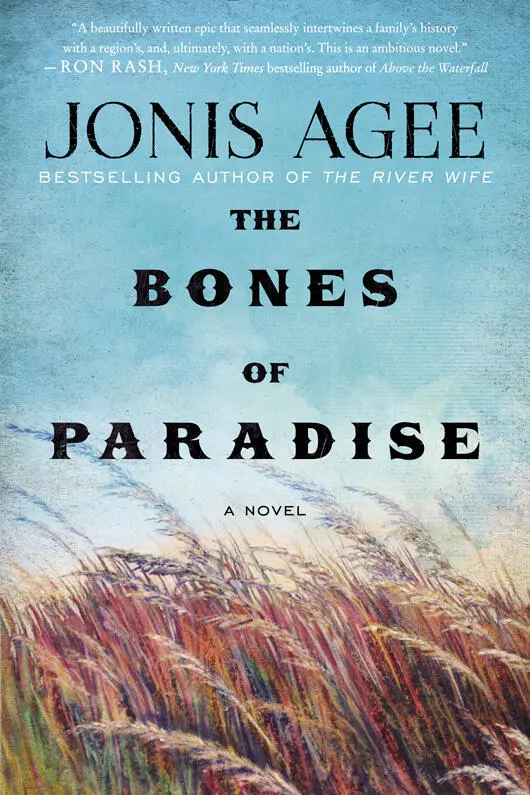
Jonis Agee - The Bones of Paradise
Здесь есть возможность читать онлайн «Jonis Agee - The Bones of Paradise» весь текст электронной книги совершенно бесплатно (целиком полную версию без сокращений). В некоторых случаях можно слушать аудио, скачать через торрент в формате fb2 и присутствует краткое содержание. Год выпуска: 2016, Издательство: William Morrow, Жанр: Современная проза, на английском языке. Описание произведения, (предисловие) а так же отзывы посетителей доступны на портале библиотеки ЛибКат.
- Название:The Bones of Paradise
- Автор:
- Издательство:William Morrow
- Жанр:
- Год:2016
- ISBN:нет данных
- Рейтинг книги:3 / 5. Голосов: 1
-
Избранное:Добавить в избранное
- Отзывы:
-
Ваша оценка:
The Bones of Paradise: краткое содержание, описание и аннотация
Предлагаем к чтению аннотацию, описание, краткое содержание или предисловие (зависит от того, что написал сам автор книги «The Bones of Paradise»). Если вы не нашли необходимую информацию о книге — напишите в комментариях, мы постараемся отыскать её.
returns with a multi-generational family saga, set in the unforgiving Nebraska Sandhills in the years following the massacre at Wounded Knee—an ambitious tale of history, vengeance, race, guilt, betrayal, family, and belonging, filled with a vivid cast of characters shaped by violence, love, and a desperate loyalty to the land. Ten years after the 7th Calvary massacred more than 200 Lakota men, women, and children at Wounded Knee, J. B. Bennett, a white rancher, and Star, a young Native American woman, are murdered in a remote meadow on J. B.’s land. The deaths bring together the scattered members of the Bennett family: his cunning and hard father, Drum; his estranged wife, Dulcinea; and his young sons, Cullen and Hayward. As the mystery of these twin deaths unfolds, the history of the dysfunctional Bennett’s and their damning secrets are revealed exposing the conflicted heart of a nation caught between past and future.
At the center of
are two remarkable women. Dulcinea, returned after bitter years of self-exile, yearns for redemption and the courage to mend her broken family and reclaim the land that is rightfully hers. Rose, scarred by the terrible slaughters that have decimated and dislocated her people, struggles to accept the death of her sister, Star, and refuses to rest until she is avenged.
A kaleidoscopic portrait of misfits, schemers, chancers, and dreamers, Jonis Agee’s bold new novel is a panorama of America at the dawn of a new century. A beautiful evocation of this magnificent, blood-soaked land—its sweeping prairies, seas of golden grass and sandy hills, all at the mercy of two unpredictable and terrifying forces, weather and lawlessness—and the durable men and women who dared to tame it. Intimate and epic,
is a remarkable achievement: a mystery, a tragedy, a romance, and an unflagging exploration of the beauty and brutality, tenderness and cruelty that defined the settling of the American west.
The Bones of Paradise — читать онлайн бесплатно полную книгу (весь текст) целиком
Ниже представлен текст книги, разбитый по страницам. Система сохранения места последней прочитанной страницы, позволяет с удобством читать онлайн бесплатно книгу «The Bones of Paradise», без необходимости каждый раз заново искать на чём Вы остановились. Поставьте закладку, и сможете в любой момент перейти на страницу, на которой закончили чтение.
Интервал:
Закладка:
Another look at their faces, gaunt and burned by the wind, and he got out the biscuits from breakfast and a chunk of beef and a can of peaches, which he couldn’t stomach anymore. At first they declined, and then they tucked into that food like they hadn’t eaten in days. Cullen knew how that was. After a while, he realized the baby was too quiet, its breathing patchy, then hoarse, then snorting and silent. The woman ate with one hand while she rested her fingertips on the baby’s skull and cheek.
When they’d eaten all the food, the man cleared his throat and said, “We’d be beholden for a place to sleep. Baby’s too sick to travel and my wife’s all in.” He laid his big raw-looking hands flat on the table and shook his head once, trying not to glance over at the baby, who was mewling now, too sick for a proper cry. The man was about to the end of his rope and his eyes teared. He wiped them away like he got something caught in them.
His wife laid a hand on his arm but didn’t take her eyes off the baby.
“What’s wrong with it?” Cullen asked.
The couple looked at each other and something like guilt passed between, which made Cullen nervous. Finally the man heaved a big sigh and pushed away from the table. His long, angular face looked hand-built from scrap wood, a person could read the bones so clearly and they didn’t exactly line up as they should. There were smallpox scars on his cheeks and the thick thatch of red-blond hair was cut in an uneven bowl around his face. He had yellow-brown eyes that offset everything else. Made Cullen wonder if the baby had the same eyes.
“Diphtheria, might be the diphtheria,” the woman spoke for the first time in a soft voice filled with the kind of yearning that sent a shiver down the back. The boy stared at her and she stared right back. She had a plain oval face, the features set up so regular the eye passed right over them, but the longer he looked the more was revealed. Like the unremarkable nose turned up at the end, the medium brown eyes red-rimmed, and the cheekbones starting to show. A person could tell that when she lost the puppy fat she would have one of those high-toned faces except for the chin that hadn’t decided yet whether to shove out or sink in, or maybe it was the way she didn’t lift her face. She was always looking down at that baby, even when it wasn’t there. She’d been chewing her cracked lips, there was a scab in the corner of her mouth, and her skin was blotched red and white. Cullen spent all that time noticing the details, like the fact there was no wedding band on her finger, and that her nails were rimed black with dirt, and that her clothes were actually ragged layers, men’s and women’s both, and her feet bound with rags to keep the man-sized boots on, as if they’d shared the contents of his wardrobe. Cullen tried not to think of that word she’d used.
“We took off soon as it hit the ranch,” the man said with a sigh. “Thought we’d made it away safe.” He looked at him with those yellow-brown eyes, like a dozy cat’s almost, and Cullen couldn’t look away.
“Don’t mean to bring harm,” he whispered. Cullen nodded and said they could stay. The baby mewled and coughed and its lungs grew thick and it couldn’t seem to bear more than the touch of the woman’s fingertips. When she tried to pick it up, it contorted weakly and bloody spit gurgled from its mouth and nose.
At noon Drum came stomping into the house, slammed the door against the wind, took one look at the couple, and jerked his thumb at the door. They silently gathered themselves. The woman picked up the satchel and held it against her chest as they shuffled out the door. Cullen wanted to send food along, at least a can of peaches, but Drum was there, removing his coat, impatient for them to leave. When the door shut behind them, he gestured toward the dish-strewn table. “Throw it all out.” Later Drum made him scrub the table with salt and lye soap and burn the clothes he wore.
Deep in memory, Cullen didn’t realize how close he was to the one-room church the Sand Hills families shared. He halted his horse and looked to the east where the church stood two hills over.
That spring he’d heard the couple had made it to another ranch and left the baby, which died, and nobody ever had a name for any of them. Cullen sat with them that whole morning and never thought to ask. A storm came up, and it was a miracle the baby lived long enough to die in a house. He hoped the couple didn’t perish until they found safety again. Stubs later told him that Drum heard about the epidemic in town and was terrified when he saw the strange horses. Cullen didn’t speak to him for six months after that.
When the owners of the ranch where the baby died built the church on their land and invited all their neighbors, he and Drum were the only ones who didn’t show. Then they buried the baby, and again, Drum wouldn’t go. Cullen went later. It was spring and the hills were dotted with brown-and-white cows and new calves, a pretty sight. After all that snow the wildflowers came busting out, and the wind was soft and warm without being hot. It was that kind of spring day when the sky didn’t seem close enough to bother and the horse felt good but not too good. Cullen wished for a person to ride along with. It was a different feeling than being in the line shack, where his anger kept him company. Out in the hills, the land was so endless a person felt himself slipping away if he wasn’t careful. There was so little to butt up against, to give a person shape, to stop or start him or make him turn away. A person in the hills could do just about anything he wanted. Besides that, there was so much to see, to point out to another person in a way that made it better to see it. That was what he remembered, before Drum took him, how his mother would show him a brown-and-yellow butterfly in the grass and stop him holding it too tight before he set it loose. Or a big yellow-and-black spider in a web drawn between the sunflowers she watered. Sometimes he’d say to his horse, Look at that, and point out the flock of red-winged blackbirds turning like a hand, palm up, palm down, then shaking loose over the hillside like pepper.
Drawing up to the church now, he was surprised by the mown grass and the newly painted white walls. Inside smelled of the fresh cedar beams and pews. There was a brand-new pump organ up front, and the brass-lined wood stops gleamed in the shadows. Cullen sat, placed his fingers on the keys, and pumped the pedals until he produced a wheezy squall that was hard on the ears. There was the same potbellied stove to take the chill off come winter and the kerosene lamps along the walls. He never understood how people could bow down to something like the huge rough-hewn cross that towered from the wall up front. The trees had to come from the reservation or were hauled all the way from Chadron, maybe. Cedar. It lasted. He ran his fingers over the axe-chipped surface, wondering that they had not bothered to plane it smooth. The wood felt warm to the touch, and he turned to see if the light streaming in the tall windows bathed the cross.
The little cemetery was out back. From the weathered markers, it was probably where some original settlers had buried their dead. The pink stone slab was larger than most and stood out so the eye couldn’t stop seeking it, OUR BABY chiseled into its smooth surface. The grave itself was short and had sunk a few inches with the years. At least the kid got out before everything went to shit, he thought. But even as he rounded the side of the church, planning to ride the hell out of there for town, he felt drawn back. He tried pushing his legs forward but they slowed and stopped. Glancing at the church, he saw the tiny white skull of a bird, probably a blue jay judging from the hook-shaped beak, sitting on a windowsill. “Okay,” he said, “all right, yes.” He picked it up, careful not to crush it, for it was light and fragile as a locust shell, and placed it in his palm. When he reached the grave again, he turned his hand and let the skull edge onto the top of the pink headstone, and made sure it caught there before he patted the back of the stone and left. A breeze came up as he passed the church with a light sweet smell that stayed with him to the outskirts of town, where he thought, I will not live to tell this story.
Читать дальшеИнтервал:
Закладка:
Похожие книги на «The Bones of Paradise»
Представляем Вашему вниманию похожие книги на «The Bones of Paradise» списком для выбора. Мы отобрали схожую по названию и смыслу литературу в надежде предоставить читателям больше вариантов отыскать новые, интересные, ещё непрочитанные произведения.




Обсуждение, отзывы о книге «The Bones of Paradise» и просто собственные мнения читателей. Оставьте ваши комментарии, напишите, что Вы думаете о произведении, его смысле или главных героях. Укажите что конкретно понравилось, а что нет, и почему Вы так считаете.