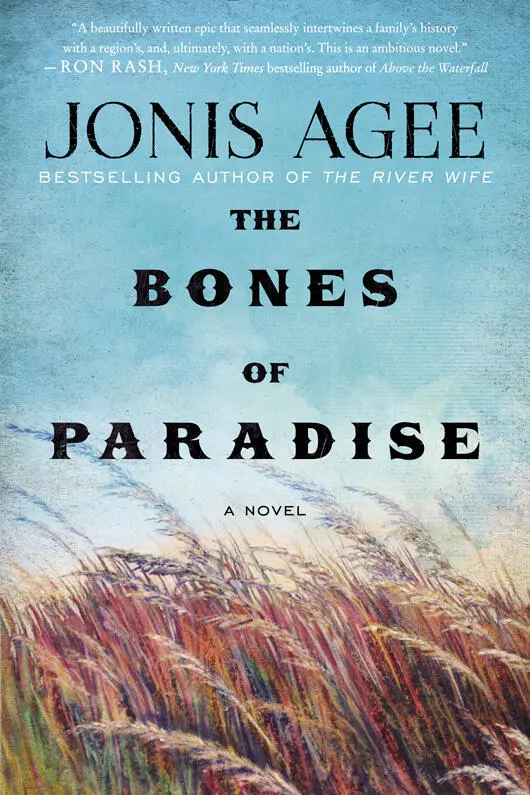
Jonis Agee - The Bones of Paradise
Здесь есть возможность читать онлайн «Jonis Agee - The Bones of Paradise» весь текст электронной книги совершенно бесплатно (целиком полную версию без сокращений). В некоторых случаях можно слушать аудио, скачать через торрент в формате fb2 и присутствует краткое содержание. Год выпуска: 2016, Издательство: William Morrow, Жанр: Современная проза, на английском языке. Описание произведения, (предисловие) а так же отзывы посетителей доступны на портале библиотеки ЛибКат.
- Название:The Bones of Paradise
- Автор:
- Издательство:William Morrow
- Жанр:
- Год:2016
- ISBN:нет данных
- Рейтинг книги:3 / 5. Голосов: 1
-
Избранное:Добавить в избранное
- Отзывы:
-
Ваша оценка:
The Bones of Paradise: краткое содержание, описание и аннотация
Предлагаем к чтению аннотацию, описание, краткое содержание или предисловие (зависит от того, что написал сам автор книги «The Bones of Paradise»). Если вы не нашли необходимую информацию о книге — напишите в комментариях, мы постараемся отыскать её.
returns with a multi-generational family saga, set in the unforgiving Nebraska Sandhills in the years following the massacre at Wounded Knee—an ambitious tale of history, vengeance, race, guilt, betrayal, family, and belonging, filled with a vivid cast of characters shaped by violence, love, and a desperate loyalty to the land. Ten years after the 7th Calvary massacred more than 200 Lakota men, women, and children at Wounded Knee, J. B. Bennett, a white rancher, and Star, a young Native American woman, are murdered in a remote meadow on J. B.’s land. The deaths bring together the scattered members of the Bennett family: his cunning and hard father, Drum; his estranged wife, Dulcinea; and his young sons, Cullen and Hayward. As the mystery of these twin deaths unfolds, the history of the dysfunctional Bennett’s and their damning secrets are revealed exposing the conflicted heart of a nation caught between past and future.
At the center of
are two remarkable women. Dulcinea, returned after bitter years of self-exile, yearns for redemption and the courage to mend her broken family and reclaim the land that is rightfully hers. Rose, scarred by the terrible slaughters that have decimated and dislocated her people, struggles to accept the death of her sister, Star, and refuses to rest until she is avenged.
A kaleidoscopic portrait of misfits, schemers, chancers, and dreamers, Jonis Agee’s bold new novel is a panorama of America at the dawn of a new century. A beautiful evocation of this magnificent, blood-soaked land—its sweeping prairies, seas of golden grass and sandy hills, all at the mercy of two unpredictable and terrifying forces, weather and lawlessness—and the durable men and women who dared to tame it. Intimate and epic,
is a remarkable achievement: a mystery, a tragedy, a romance, and an unflagging exploration of the beauty and brutality, tenderness and cruelty that defined the settling of the American west.
The Bones of Paradise — читать онлайн бесплатно полную книгу (весь текст) целиком
Ниже представлен текст книги, разбитый по страницам. Система сохранения места последней прочитанной страницы, позволяет с удобством читать онлайн бесплатно книгу «The Bones of Paradise», без необходимости каждый раз заново искать на чём Вы остановились. Поставьте закладку, и сможете в любой момент перейти на страницу, на которой закончили чтение.
Интервал:
Закладка:
CHAPTER THIRTY-ONE
You’re my Telemachus, Hayward,” his mother said, and the words rolled around in his head like marbles. What does that mean, he wondered, and she explained about a poet and a man named Odysseus gone for years to war and a woman named Penelope left at home, and he wanted to say, but he was the one left, and she the one gone, but her eyes were shiny and her face full of happiness of a kind he rarely saw so he let her keep talking though it was mainly nonsense. He wasn’t fighting off suitors and she all but killed his father. Drove him to do what he did by leaving. He thought of that time his father dragged him to see the reservation, and then his father went again without him, and was never the same after that. If she’d been here, his father would have stayed home, not gotten sad. He thought about Star and wondered if she met his father at Wounded Knee, if that was why they were killed together.
“Your mother has a poetic nature,” Father said one of the few times he ever spoke about her other than to assure him that she loved her son. Hayward pondered that for a moment, then asked, “What does that make us?”
He knew what he was. He was the one left behind, but he didn’t feel sorry for himself. Soon as he found Cullen, he got over that. Cullen told him the truth—that Hayward was the one nobody wanted—grandfather, mother, and father by default, since they inhabited the same space and it was too much trouble to stake him out in the hills like a deformed calf to lure the coyotes.
Mother came into the parlor where he was reading a book of poetry Cullen gave him. She stood there like she was waiting for permission to speak. He glanced up from the book, which was about a bunch of weepy men who felt tender and sad all the time, according to Cullen, who preferred poetry to the adventure stories Hayward liked. When she realized what he was reading, she smiled.
“May I join you?” she asked in the overly polite voice that gritted his teeth.
“This poem, ‘Ode to a Nightingale,’ by Kates?” he said.
“Keats, with a long ‘e,’” she said apologetically.
“He wants to kill himself, doesn’t he?” He paused for effect and her lips parted slightly like she was about to say something. She nodded instead.
He continued, going line by line explaining the poem as Cullen had explained it to him. “But he hears the nightingale, its beautiful, sad song, and it helps him, doesn’t it? So nature and her beauty, if we pay attention, can save our lives.”
She nodded, the expression on her chiseled face almost afraid to show her astonished happiness. She reached out, patted his arm and nodded, believing she’d found her soul mate, the one the poets were always thinking about instead of the real live people around them. It was Cullen she needed for that, he should tell her.
Instead, he closed the book and tossed it on the table between them. “Pretty simpleminded, don’t you think?”
He stood and pulled up the waist of his trousers and tucked in his shirt. “You didn’t think I could read, did you?”
“I taught you to read, son.” She wouldn’t look at him and he felt a twinge of sadness. He’d made his point and hurt her, but it didn’t feel as good as he’d thought.
Truth was, he didn’t want her mooning around him all the time, trying to show him things, trying to make up for the years she wasn’t there, trying to be a thing she gave up and thought she could just come back and reclaim like a hat from the attic. Besides, he could see it upset Cullen. Hayward had a gun, a horse, and a claim to the ranch. He said these things to himself, then his heart did that sick little trick and he wanted to drop to his knees, bury his head in her lap, and beg her not to leave him again. And that made him mad, too.
Then Graver knocked and entered without waiting for an answer. He removed his hat, J.B.’s, glanced at his mother, at him, and back to her.
“You wanted to see me?” he asked. Thing about the man was he didn’t get nervous around his mother, didn’t hem and haw like a raw hand, or duck his head and turn red when he spoke. He was confident, not like Drum, who couldn’t even see another person unless he knocked into them, more like that lawyer Percival Chance or Judge Foote, men who knew their place in the world, like they’d taken hold and made it something. Hayward watched Graver and tried to square his shoulders and relax his hips and arms the way the older man did. He lifted his chin, but not so high he’d end up strutting around like a rooster. Graver looked over, a smile pulled at the corners of his mouth, and he nodded to him, man to man. Better not be laughing at me, Hayward warned with his eyes narrowed like a gunfighter’s. He dropped his hand to his side where the holstered gun should sit and remembered that he’d left it in the bunkhouse when he cleaned it.
Sympathy appeared in Graver’s eyes, and Hayward wasn’t prepared for it. He vowed then and there never to forget his gun again. And not to tell Cullen.
“You did a good job finding that orphan calf and bringing it in,” Graver said, and despite himself, his chest swelled and he risked a glance at his mother. She smiled as if he’d just received good marks in school.
“Have the makings of a good hand, son,” Graver said, and that tipped the whole thing over.
“I’m not your son.”
He did his best imitation of Cullen’s snarl. “Hayward!” His mother stood, fists at her sides, and the boy stepped back.
Graver raised his hand to calm the air, and Hayward studied the gesture at the same time he wanted to knock him down.
She turned her focus to Graver. “Please get my horse ready, we’re going hunting.”
He looked startled, opening his eyes wide and raising his brow. “Not with that horse.”
Her shoulders and back stiffened, and she lifted her chin and looked down her nose at him. “I see no reason.”
“He’s too valuable, ma’am. You have ranch horses trained to stand when there’s gunfire and not spook at the smell of blood.” Graver hurried his explanation and his mother cocked her head like one of the dogs when Hayward gave it a new order.
“We need meat. With all these people, I can’t afford not to bring down a deer or antelope.”
For the first time Hayward agreed with Graver and watched carefully as the man went to work persuading her. J.B. gave orders and kept his head down, so it was hard to learn anything from him. Instead of stepping into the fray, Graver seemed to slouch and lean back, as if the outcome wasn’t as important to him as it was to her. The boy folded his arms across his chest to improve his stance.
“Stud’s not gun trained, is he? Be a shame to lose him.” He kept his voice low and even.
Her shoulders relaxed. “You’re right. Go ahead and get the proper horses ready. We’ll be out shortly.”
Graver put on his hat and turned to leave, then stopped and glanced at him. “Can you help me?”
Hayward shrugged and tried to act as casual as Graver, but his heart pounded. The man had never asked for help before, and with Cullen gone wherever he got to after he shot off old Higgs’s hat and acted rude at supper yesterday, he guessed it wouldn’t hurt.
He climbed over the fence while Graver used the gate to the corral, and they stood eyeing the dozen heads that stared back and circled restlessly until the bay gelding Hayward liked stepped out of the crowd toward him. He always had to know what was going on, sticking his big nose in every kind of business. That was what Hayward liked about him and he usually carried a biscuit in his pocket as a reward. Graver watched as the bay ambled over and nuzzled him. Finally the horse took his shirt cuff in his teeth and tried to lift his hand. Hayward laughed and gave him the treat. As he chewed, he blew warm air on the side of the boy’s neck.
Читать дальшеИнтервал:
Закладка:
Похожие книги на «The Bones of Paradise»
Представляем Вашему вниманию похожие книги на «The Bones of Paradise» списком для выбора. Мы отобрали схожую по названию и смыслу литературу в надежде предоставить читателям больше вариантов отыскать новые, интересные, ещё непрочитанные произведения.




Обсуждение, отзывы о книге «The Bones of Paradise» и просто собственные мнения читателей. Оставьте ваши комментарии, напишите, что Вы думаете о произведении, его смысле или главных героях. Укажите что конкретно понравилось, а что нет, и почему Вы так считаете.