Carmen Boullosa - Cleopatra Dismounts
Здесь есть возможность читать онлайн «Carmen Boullosa - Cleopatra Dismounts» весь текст электронной книги совершенно бесплатно (целиком полную версию без сокращений). В некоторых случаях можно слушать аудио, скачать через торрент в формате fb2 и присутствует краткое содержание. Год выпуска: 2004, Издательство: Grove Press, Жанр: Современная проза, на английском языке. Описание произведения, (предисловие) а так же отзывы посетителей доступны на портале библиотеки ЛибКат.
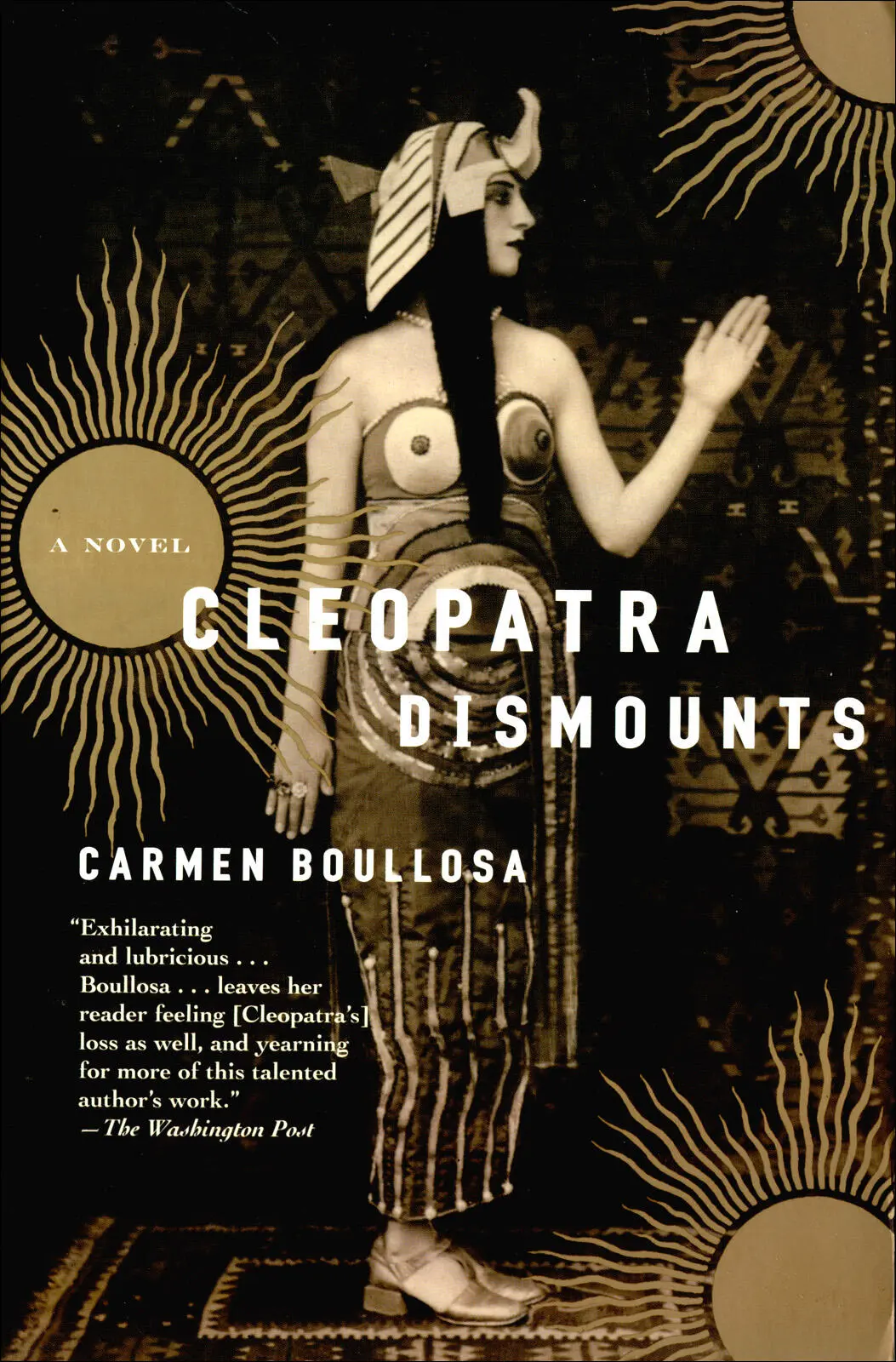
- Название:Cleopatra Dismounts
- Автор:
- Издательство:Grove Press
- Жанр:
- Год:2004
- ISBN:нет данных
- Рейтинг книги:3 / 5. Голосов: 1
-
Избранное:Добавить в избранное
- Отзывы:
-
Ваша оценка:
Cleopatra Dismounts: краткое содержание, описание и аннотация
Предлагаем к чтению аннотацию, описание, краткое содержание или предисловие (зависит от того, что написал сам автор книги «Cleopatra Dismounts»). Если вы не нашли необходимую информацию о книге — напишите в комментариях, мы постараемся отыскать её.
Through the intervention of Cleopatra's scribe and informer Diomedes, Boullosa creates two deliriously wild other lives for the young monarch — a girl escaping the intrigues of royal society to disguise herself and take up residence with a band of pirates; and the young queen who is carried across the sea on the back of a magical bull, to live among the Amazons.
Magical, multifaceted, and rippling with luminous imagination, Cleopatra Dismounts is a work that recalls Jeanette Winterson’s Sexing the Cherry and confirms Carmen Boullosa as an important international voice.
Cleopatra Dismounts — читать онлайн бесплатно полную книгу (весь текст) целиком
Ниже представлен текст книги, разбитый по страницам. Система сохранения места последней прочитанной страницы, позволяет с удобством читать онлайн бесплатно книгу «Cleopatra Dismounts», без необходимости каждый раз заново искать на чём Вы остановились. Поставьте закладку, и сможете в любой момент перейти на страницу, на которой закончили чтение.
Интервал:
Закладка:
We arrived at Rhodes. There we found the virtuous Cato en route for Cyprus. Clodius had put the conservative Cato, his bitterest enemy, in personal charge of the annexation. He claimed Rome had no more honorable man, but he understood it was a splendid way to sideline Cato once and for all.
Cato treated us with contempt. He sent a message that he could not accept an invitation to visit us because he was suffering the effects of laxatives and that Auletes would have to visit him. When my father went to see him, Cato did not even rise from his seat. Even before my father could open his mouth, he called out in an unmannerly style, “What you need to do is turn round and get control of Egypt again. There is no point”—the stink had filled the room—“in your going on to Rome. Now, if you’ll permit me—” He crowned the unfinished sentence with a burst of flatulence.
Once the long fart had subsided, he gestured my father to leave. Worse still, he snapped his fingers to tell him to hurry. He had treated Auletes like a dog! Not much better was the treatment he gave my uncle. Disembarking at Cyprus, he offered to put the captured king in charge of the cult of Aphrodite in Paphos. My uncle was outraged at the proposal. A Ptolemy is descended from the gods himself; he cannot serve them as their submissive priest. He chose suicide.
How much honesty was in this spotless, virtuous, shitting Cato becomes clear when I tell you that his despatches to the Roman Senate were lost in transit. Some 7,000 talents in coin and metals, plates and dining utensils, jewels and exquisite tapestries from the Cypriot treasury, never made it to Rome. He alleged pirates had seized them. We shall see.
We left Rhodes and took up residence in Athens. There one of my maids had the misfortune to die. We carried out the funeral rites and left her buried in Athenian soil.
We had hardly arrived in Rome before Auletes was rushing around, stuffing presents into the hands of senators, consuls, and other notables. He had dreams of returning to Alexandria and regaining his throne. It now belonged, not to Cleopatra Tryphaena, but to his oldest daughter Berenice, after her mother had resigned for her own eccentric reasons. Other people’s pockets were bulging with his cash, while he was forced to move on to Ephesus.
By this time, I was twelve years old. I saw nothing I could clearly count on in my situation. Not that I wanted anything particular for myself; after all, I’d grown up used to instability. But I was stranded in Rome. I knew what I did not want to happen but I had no clear idea how to get what I did want. But I did come up with a plan. It was a guileless one, daringly imaginative in a childish way, and the members of the court supported it, without reservation.
I had fully resolved to leave Rome, where the moneylenders battened on my father, flattering him, offering to get him further loans, preying on his reserves, voraciously devouring the last of his riches, without the least interest in restoring him to his past greatness. My body now began to take on a woman’s lines and gave me the illusion that I was capable of controlling my own destiny, that I was the mistress of my fate. I could not get to Alexandria, nor did I want to. There the woman who bounced around on the throne with no concept of royal dignity would have had me put to death without a second thought, if I had shown up. She was still fiercely jealous of my mother, though my mother, in fact, detested me as much as she did. This was an open secret. And the source of many jokes throughout Egypt.
It was necessary to leave at nightfall, to take advantage of the hours of darkness, before Auletes noticed our absence. The streets of Rome never stopped being busy and we could lose ourselves easily in the throng, once we got inside the city. But we needed to cross from the Via Flavinia to the Appian Way. It was unfortunate that we were not already living inside the walls of Rome. The palace that Pompey had lent my father as a residence was located on the outskirts of the city, not far from the Flavinian Gate. We could not have used a chariot in our escape, for undoubtedly some busybody would have scurried off to tell Auletes, if he’d seen my highly visible retainers on the move. Then we would not even have had time to reach the coast road.
My plan was to leave without attracting attention, but we needed some sort of cover before we could reach Rome. Pompey’s palace had a large balcony overlooking the street. I used to spend hours there to avoid the scenes made by the rattled Auletes as one misfortune after another shook his self-esteem. Even I, a child, was frankly embarrassed by him. From the balcony I had noticed that every morning and evening there passed in front of our house the group of gladiators that belonged to our neighbor, Cato. They came up daily from their lodgings in the city to entertain the many visitors who frequented his dining room. They were nine brawny men. Some were dressed in leather breeches, others were clad in rough, woolen coats, typical of the city’s athletes. One always carried in his hands the helmet he wore in his fights; another, dressed like a Gaul, walked with the top of his shield pressed hard against his stomach in a rather laughable way. There was third who invariably kept his face covered with one sort of mask or another. And there was a very young boy, obviously Greek. I had no idea what he was doing in Rome, working at a job his obvious intelligence did not suit him for.
Morning and evening, in hiding, unseen by them, I watched the gladiators from my balcony. Then one day, I showered petals on them, laughing. Other days I tossed them candies and bread-buns. One day, when the heat was oppressive, I sprinkled them with cool water. As I watched them, they watched me, looking curiously at this bored Egyptian princess who wanted to befriend them. We exchanged an endless number of smiles that made us friends, even though not a word had passed between us. That particular afternoon, as soon as I heard their steps approaching our doors, I made an agreed-upon sign to my maids and we all set out to walk in front of the gladiators, slowly enough to be soon overtaken by them. There had been no question of informing Auletes, who was too sunk in his personal problems, anyway, to worry about Egypt, let alone about those of one of his daughters, a cocky little creature who he thought equal to every challenge, at least when protected by her own men. I had already bribed my father’s guards. Accomplices in my daring, Charmian and two faithful maidservants left with me. My personal bodyguard, a handful of men, had gone ahead, to avoid arousing suspicion, along with half a dozen slaves carrying our clothes and other necessaries. And three musicians.
The following day my father would get the following message that I had left for him:
“Sole and legitimate lord of the Macedonian throne of the Lagids in Alexandria: it hurts me to see that our affairs are going so badly in Rome. I am going to seek help and allies on the rebel coasts of Cilicia. I promise you, father, that I will get to Alexandria, safe and sound, and that the troops I will engage will restore to you all that rightly belongs to you.
Your faithful daughter who loves and adores you,
Cleopatra.”
Unimaginable the effect it would have on him when one of his secretaries read it aloud to him. Would he topple over the wine containers in his fury and grief? Or would he simply sleep long hours, consuming his days in endless dreams? Would he summon his friends to search for me? Or would he settle for dispatching a couple of trustworthy servants to follow my tracks and buy information? Or would he erupt in repeated outbursts of rage? Or would he punish the informants, cursing them furiously, calling them liars, till the wretches changed their story to save their skins and line their pockets? It was unlikely that any of our people would lie to him. Or would some sly Roman guarantee to find me and wheedle more gold out of him for the favor? As long as it wasn’t Robirius! I was full of questions but my companions assured me he was bound to send after me, that a good number of his men would come chasing after us.
Читать дальшеИнтервал:
Закладка:
Похожие книги на «Cleopatra Dismounts»
Представляем Вашему вниманию похожие книги на «Cleopatra Dismounts» списком для выбора. Мы отобрали схожую по названию и смыслу литературу в надежде предоставить читателям больше вариантов отыскать новые, интересные, ещё непрочитанные произведения.









Обсуждение, отзывы о книге «Cleopatra Dismounts» и просто собственные мнения читателей. Оставьте ваши комментарии, напишите, что Вы думаете о произведении, его смысле или главных героях. Укажите что конкретно понравилось, а что нет, и почему Вы так считаете.