Carmen Boullosa - Cleopatra Dismounts
Здесь есть возможность читать онлайн «Carmen Boullosa - Cleopatra Dismounts» весь текст электронной книги совершенно бесплатно (целиком полную версию без сокращений). В некоторых случаях можно слушать аудио, скачать через торрент в формате fb2 и присутствует краткое содержание. Год выпуска: 2004, Издательство: Grove Press, Жанр: Современная проза, на английском языке. Описание произведения, (предисловие) а так же отзывы посетителей доступны на портале библиотеки ЛибКат.
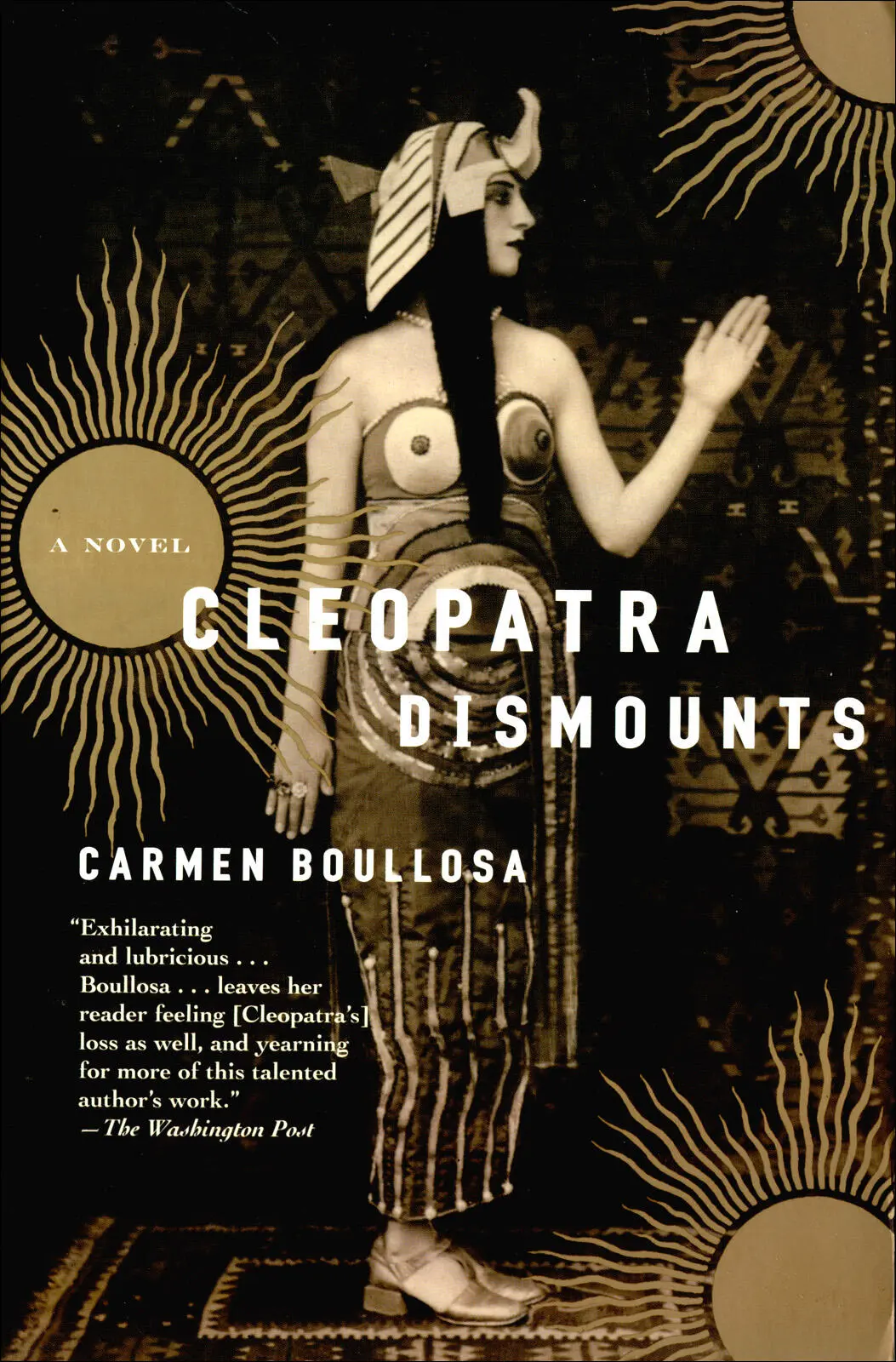
- Название:Cleopatra Dismounts
- Автор:
- Издательство:Grove Press
- Жанр:
- Год:2004
- ISBN:нет данных
- Рейтинг книги:3 / 5. Голосов: 1
-
Избранное:Добавить в избранное
- Отзывы:
-
Ваша оценка:
Cleopatra Dismounts: краткое содержание, описание и аннотация
Предлагаем к чтению аннотацию, описание, краткое содержание или предисловие (зависит от того, что написал сам автор книги «Cleopatra Dismounts»). Если вы не нашли необходимую информацию о книге — напишите в комментариях, мы постараемся отыскать её.
Through the intervention of Cleopatra's scribe and informer Diomedes, Boullosa creates two deliriously wild other lives for the young monarch — a girl escaping the intrigues of royal society to disguise herself and take up residence with a band of pirates; and the young queen who is carried across the sea on the back of a magical bull, to live among the Amazons.
Magical, multifaceted, and rippling with luminous imagination, Cleopatra Dismounts is a work that recalls Jeanette Winterson’s Sexing the Cherry and confirms Carmen Boullosa as an important international voice.
Cleopatra Dismounts — читать онлайн бесплатно полную книгу (весь текст) целиком
Ниже представлен текст книги, разбитый по страницам. Система сохранения места последней прочитанной страницы, позволяет с удобством читать онлайн бесплатно книгу «Cleopatra Dismounts», без необходимости каждый раз заново искать на чём Вы остановились. Поставьте закладку, и сможете в любой момент перейти на страницу, на которой закончили чтение.
Интервал:
Закладка:
At that moment we passed through the gate of the Flaminian Way, and I swung around to check our route. A few steps more and alleyways opened on all sides before us like a labyrinth. Without the gladiators to guide us, we would have been lost at this junction. We could not have crossed the city alone or found the road to Brundisium, for the layout of Rome had none of the planning of Alexandria, precise, harmonious, and clear-cut. The Romans had had no Dinocrates to follow the planning tradition of Hippodamus. The milk of the wolf that nursed Romulus and Remus flowed capriciously and left a record of its twisting path in the tangled alleyways of the city.
Where in Rome could one enjoy the beautiful views available in Alexandria? From the Gate of the Sun to the Gate of the Moon, the guardian deities of the entrances, passes a double line of columns. Round about the midpoint stand the houses of the populace. A little farther along lies a neighborhood named in honor of Alexander the Great. Beside it is a second settlement, magnificently laid out, another line of columns crossing the first, in a series of right angles. However hard one tries, it is impossible to encompass the beauty of the city in a single glance. And none of this includes the palaces. No Roman palace can compare to the gorgeous magnificence of those in Egypt.
But why am I describing Alexandria when we were still in Rome? Let me get back to Rome. The chatter of the gladiators continued nonstop, and we came to the run-down district of Subura, crowded with commonplace people. The rabble swarming the streets were not the only surprise; there was the overpowering stink of the place, a revolting mixture of rotting garbage, excrement, food, and cooking oils — a plague of odors that Alexandria would never have allowed. I had not traversed these streets before or if I had, I had done it fast asleep on my litter with its curtains closed, something that always makes me sleepy. But this time I was not passing in style. The waves of people crashed against us from in front, and the press of the people from behind put a strain on my kidneys. There was always somebody jabbing me with an elbow, with the pole of a litter, or a wine vase. If I hadn’t avoided it, the spike of a soldier would have stabbed my fingers. Loaded carriages charged by without the least concern for pedestrians. Groups of people cooked in the streets and ate standing, talking freely as if nobody could see or hear them, as if, instead of standing, they were lounging on well-stuffed cushions. Others were eating on the move, surrounded by smoke and sweating servants, followed by a mobile kitchen, the poor slaves tottering under enormous vessels carried on the heads, their hasty progress fanning the burning coals into life.
By now night was falling, and we were close to the multistory dwelling where the gladiators slept. They shared the space with the horses of dear old Cato, plus the mob of slaves he kept on hand. He retained them as an investment against hard times, since he had little faith in treasures that could not defend themselves with their fingernails. The red-haired gladiator told us to blend in with a group of obviously foreign travelers we had bumped into. Merchants with beasts of burden and their drivers now separated us from our gladiators, if I may call them that, and left us unprotected. I should make it clear that our guardians were quite negligent, occupied with their own concerns, teasing each other and joking the whole time, flirting with each other with fascinated interest, forming their own private group, generally indifferent to us. On reaching a corner, where the driver of a cart had problems turning and was interrupting the flow of traffic, the gladiators pushed their way out of our group altogether and blended into the group of foreigners. We were left just with Apollodorus. He was passing as a woman quite nicely, less and less like a gladiator habituated to dicing with death, while rich spectators munched away at their meals. So here ended the conversation between the ex-senator turned gladiator and a philosopher of excrement and that newly made Egyptian maiden, Apollodorus.
The crowd hustled us along and Apollodorus led the way. My maids were not at all embarrassed to chat with a man dressed as a woman and began to give him details of our journey. We had planned it carefully on those long evenings when we slunk away from the humiliations that Roman greed and corruption were inflicting on Auletes as he tried to uphold the cause of the Lagids. My maids had remained silent in the presence of the gladiators, deeming them unworthy of their conversation. But Apollodorus looked so much the part of an Egyptian woman that it was hard to call him by his real name. Even though he was risking his hide to a far greater degree than we were, he spoke at ease, with an impeccable diction and an extensive vocabulary that clearly belied his past as a humble shepherd. He asked for the details of our plan. Then, instead of correcting or upbraiding me, he combined his astuteness with mine, adding things I had overlooked, suggesting shortcuts, and in general matching my audacity with his own. Hence from our joint discussions, a naively simple plan was converted into a practical scheme of redemption, as cunning as anyone could hope for.
From that moment on, we were accomplices. He led our way as fast as the density of the crowd allowed. At the house of a cheap mask-maker he brought us to a halt. As we went inside, he told us that this was where the gladiators bought adornments for their contests.
First we crossed a patio where a mass of children were working at low tables supported variously by hooks, columns, and sticks. They were banging away at leather and brass with primitive tools, shaping articles for their master. We stepped into a small, dark room where the hammering was deafening. Apollodorus faked a woman’s voice, speaking in perfect Roman Latin with no trace of a foreign accent, and talked to the owner, inventing a story to explain our presence in this place. The owner — I could hardly see a thing till my eyes adjusted to the gloom — showed no sign of believing a word of it, but he did not question it, either. He simply wanted our business, to sell us something and then get back to bullying the children.
On a large table lay a remarkable variety of masks. The majority were showy, finished in garish colors. On the far left I spotted some that brought a laugh to my lips. They could have been designed expressly for us; a good part of the Egyptian pantheon was facing us, eyeless and bodiless, with caricatured features, all in bright colors. There was Sehmet, Anubis, Horus, Thoth, and Ammon Ra.
“Those are the ones!” I cried out, unable to contain my excitement. “We want those. Exactly what we’re looking for.”
“You mean them animal ones?” asked the owner. He might have known his craft to perfection but in other matters he was a typical Roman ignoramus.
“That is the Egyptian pantheon,” I corrected him sternly. “And the head of Horus is missing the sun and moon.”
Apollodorus shot me a disapproving look and I cut short my theological lecture. He was right. Why bother to argue with this nobody?
One of the children quickly packed the masks we chose. Charmian paid. With womanly grace Apollodorus hoisted the package onto his shoulder and in the twinkling of an eye we were back outside, in the muddy alleyway. From here on our progress speeded up. The streets were less congested. Prostitutes offered their services, sitting on tall chairs in illuminated windows that lent a little light to our progress.
After we passed Porta Capena, above which an aqueduct ran, we found a cart awaiting us on the Appian Way. It belonged to the seamen who were to carry us from the port of Brundisium over the waters of the Mediterranean. It was a rough, rustic vehicle, and was still partly loaded with sacks of sand or soil. It had obviously been organized by these barbaric Romans, for they had yoked four bulls to it, sacred animals in Egypt. There was barely room for us, what with all our baggage and the slaves who had been sent ahead. My personal mounted guard would protect us but we had agreed they would follow at some distance in order not to attract attention. Never before had Cleopatra traveled in such mean circumstances, in an unroofed cart, without dignity or comfort, like a piece of cargo, and certainly not by night, the last time Auletes would choose for traveling.
Читать дальшеИнтервал:
Закладка:
Похожие книги на «Cleopatra Dismounts»
Представляем Вашему вниманию похожие книги на «Cleopatra Dismounts» списком для выбора. Мы отобрали схожую по названию и смыслу литературу в надежде предоставить читателям больше вариантов отыскать новые, интересные, ещё непрочитанные произведения.






Обсуждение, отзывы о книге «Cleopatra Dismounts» и просто собственные мнения читателей. Оставьте ваши комментарии, напишите, что Вы думаете о произведении, его смысле или главных героях. Укажите что конкретно понравилось, а что нет, и почему Вы так считаете.