Alan Moore - Jerusalem
Здесь есть возможность читать онлайн «Alan Moore - Jerusalem» весь текст электронной книги совершенно бесплатно (целиком полную версию без сокращений). В некоторых случаях можно слушать аудио, скачать через торрент в формате fb2 и присутствует краткое содержание. Год выпуска: 2016, Издательство: Liveright Publishing Corporation, Жанр: Современная проза, на английском языке. Описание произведения, (предисловие) а так же отзывы посетителей доступны на портале библиотеки ЛибКат.
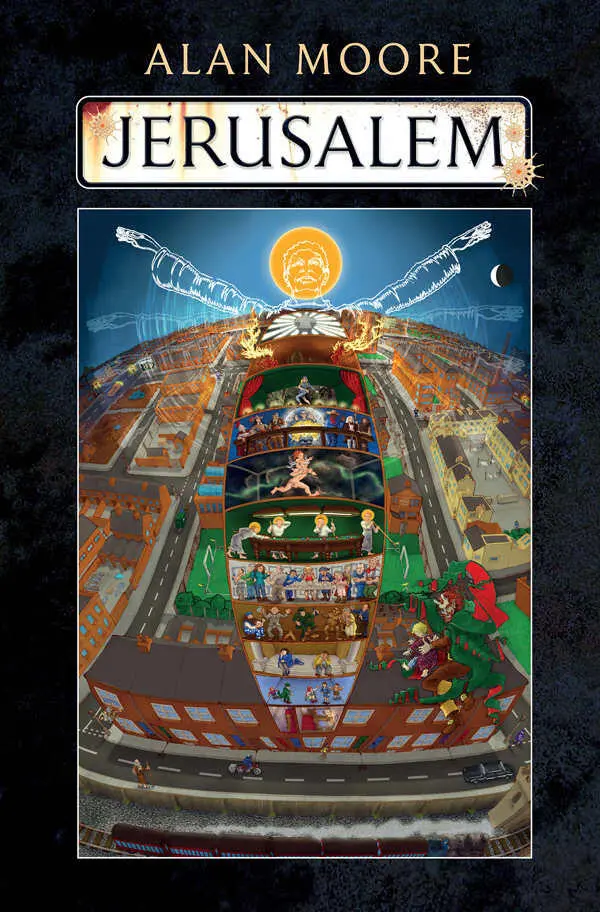
- Название:Jerusalem
- Автор:
- Издательство:Liveright Publishing Corporation
- Жанр:
- Год:2016
- ISBN:нет данных
- Рейтинг книги:4 / 5. Голосов: 1
-
Избранное:Добавить в избранное
- Отзывы:
-
Ваша оценка:
Jerusalem: краткое содержание, описание и аннотация
Предлагаем к чтению аннотацию, описание, краткое содержание или предисловие (зависит от того, что написал сам автор книги «Jerusalem»). Если вы не нашли необходимую информацию о книге — напишите в комментариях, мы постараемся отыскать её.
Disappeared lanes yield their own voices, built from lost words and forgotten dialect, to speak their broken legends and recount their startling genealogies, family histories of shame and madness and the marvellous. There is a conversation in the thunderstruck dome of St. Paul’s cathedral, childbirth on the cobblestones of Lambeth Walk, an estranged couple sitting all night on the cold steps of a Gothic church-front, and an infant choking on a cough drop for eleven chapters. An art exhibition is in preparation, and above the world a naked old man and a beautiful dead baby race along the Attics of the Breath towards the heat death of the universe.
An opulent mythology for those without a pot to piss in, through the labyrinthine streets and pages of Jerusalem tread ghosts that sing of wealth and poverty; of Africa, and hymns, and our threadbare millennium. They discuss English as a visionary language from John Bunyan to James Joyce, hold forth on the illusion of mortality post-Einstein, and insist upon the meanest slum as Blake’s eternal holy city. Fierce in its imagining and stupefying in its scope, this is the tale of everything, told from a vanished gutter.
Jerusalem — читать онлайн бесплатно полную книгу (весь текст) целиком
Ниже представлен текст книги, разбитый по страницам. Система сохранения места последней прочитанной страницы, позволяет с удобством читать онлайн бесплатно книгу «Jerusalem», без необходимости каждый раз заново искать на чём Вы остановились. Поставьте закладку, и сможете в любой момент перейти на страницу, на которой закончили чтение.
Интервал:
Закладка:
“Where we are now, it’s the 1640s. Charles the First wiz on the throne, and hardly anybody thinks he’s making a good job of it. For one thing he’s brought in this tax, Ship Money, which wiz paid direct to him and makes him less dependent on the English Parliament. Nobody likes the sound of that, especially since they know Charles wiz matey with the Catholic Church and may be plotting to sneak in Catholicism by the back door. Bear in mind that all of this wiz happening in an England where the rich and poor have grown apart since the beginning of the 1600s, when the gentry had begun enclosing common land and taking people’s livelihoods away. You can imagine how cross and suspicious everybody wiz. England wiz like a powder keg, just waiting to go off.”
John paused here as an image of the detonating man-bomb shuffled weeping and unbidden through his mind, then carried on.
“In the last months of 1641, the whole of Ireland wiz in flames with a rebellion against English rule. The rebels were destroying or else seizing back the land that had been given to Protestant settlers, killing many of these settlers in the bargain. Back in England, this wiz looked on as a Popish plot that Charles the First wiz in collusion with. Rebels in Parliament published a Grand Remonstrance airing all their grievances with Charles, which only served to push both camps further apart. In January, 1642, the King left London to the rebels and began to gather armies for a civil war that by then everybody knew wiz coming. God, that must have been a terror. From one end of England to the other, families must have been on their knees and praying that they’d get through the next years without too many members dying.”
That was certainly how it had been for John’s clan during 1939. He watched the figure at the room’s far end arrest its writings for a moment with quill poised a fraction of an inch above the page, perhaps deliberating over word-choice, before dipping once more to the vellum and continuing its row of Gothic curls and slanting, marching uprights. John supposed that his own family’s prayers upon the eve of war must have been heeded, for the most part. Everyone lived through it, after all, with present company excepted.
Looking round, John realised that the other members of the Dead Dead Gang were waiting patiently for him to carry on. Even Drowned Marjorie, behind her jam-jar lenses, appeared interested.
“Anyway, that fellow over there, Oliver Cromwell, wiz born to a fairly well-off family in Huntingdon. Their name wiz Williams, but they were descended from Henry the Eighth’s adviser Thomas Cromwell and had taken on his name, grateful for all the good he’d done the family as the bloke who’d managed Henry’s great Protestant Reformation, and defiant at the way he’d later been beheaded for his troubles. Ollie over there calls himself ‘Williams, alias Cromwell’ all the way through life, but I suppose that Cromwell has more of a ring to it than Williams.
“He has a wife, a family and a comfortable life, but I suspect he’d always wanted more than that. In 1628, aged twenty-nine, he entered politics as the MP for Huntingdon, and by the time the Civil War wiz brewing some fourteen years later he wiz one of the King’s sternest critics in what they called the Long Parliament. When Charles requested help from Cambridge, Cromwell stormed straight down there with two hundred armed men, bullied his way into Cambridge Castle and grabbed all their armaments. Not only that, he also stopped them from transferring any silver to help out the Royalists — and this was at a time when almost everybody else was dithering about what should be done. By seizing the initiative, Cromwell began to look like good material for the Parliamentary cause, and was promoted from a captain to a colonel.
“He was busy, in them next few years, dealing with Royalists in King’s Lynn and Lowestoft and then securing all the bridges on the River Ouse. With that done, he went on to fortify the Nene — we can go outside in a minute, and I’ll show you what I mean. Anyway, Cromwell proved himself in scraps like Gainsborough in Lincolnshire, and battles like the one on Marston Moor near Manchester in 1644, where Cromwell led the cavalry. Bouts like that led to Parliamentary General Sir Thomas Fairfax making Cromwell the lieutenant-general of horse at a war-council that took place …”
Here John paused and pretended, for effect, to search his memory for some venerable date before continuing with, “… ooh, it must have been an hour or two ago. Today, June 13 th, 1645. For Mister Cromwell over there, today’s the turning point of his whole life. He’s finally been given power enough to carry out the task he’s got in mind, and straight away he’s been sent to Northamptonshire to deal with Royalist Forces under King Charles’s son, Prince Rupert. Rupert has just taken Leicester by siege from the Parliamentary forces, and when Cromwell turned up at the Roundhead camp near Kislingbury this morning, just a mile or two southwest of here, they greeted him with cheers. Last night a Parliamentary advance guard surprised some Royalists close to Naseby village, five miles south of Market Harborough on the edge of Leicestershire. Before that happened neither side had realised quite how close their armies wiz to one another, but now everybody’s worked out that they’re in for an almighty battle come tomorrow morning. That’s why all the Roundhead troops wiz overjoyed when Cromwell turned up: he’s the only bugger within hundred mile of here that’s looking forward to it.”
On an impulse, John detached himself from the grey cluster of the Dead Dead Gang and crossed the varnished floorboards to the room’s far side, so that he stood behind the seated figure, raven-hunched over its writings. The unusually sharp sight that being dead afforded John detected three or four fat lice that foraged in the greasy undergrowth of the lieutenant-general’s thinning scalp. He’d never been as close as this to Cromwell, having only seen him gallop past during his previous visits to the actual field of battle. He could almost feel the thrumming dynamo-vibrations of the future Lord Protector’s personality filling the air between them, and wished he could breathe in Cromwell’s scent without the odourless encumbrance of the ghost-seam being in the way, just to determine what variety of animal the man might truly be. Bill interrupted John’s close-up inspection here by calling from the chamber’s far side, where he stood with Phyllis and the others.
“What’s ’e writin’?”
It was a good question, and John transferred his attention from the escapades of Cromwell’s head-lice to the page across which the man’s crow-quill moved. It took John several moments’ scrutiny before he had the hang of the peculiar cursive script, then he glanced up as he addressed the gang.
“It looks like it’s the first draft of a letter to his wife. I’ll read you what I can of it.”
Placing his hands on his bare knees John angled himself forward, leaning over Cromwell’s shoulder to peruse the missive’s contents.
“ ‘My most dear Elizabeth — I write with what I trust is welcome news. Your fond and constant husband is this day appointed to lieutenant-general of horse by Sir Tom Fairfax, and at once despatched to attend some small matter in Northamptonshire, from whereabouts I pen these lines. I am, you may be sure, of a good humour and feel certain we shall have a fair result upon the morrow, but please do not think that this promotion tempts me to vainglory. Any victory is surely that of God alone, nor is my elevation of importance, save in that I am enabled to more vigorously work His will.
“ ‘Now, let us have no more of your unworthy husband’s bragging, and instead hear tidings of more estimable things. How fares our humble Huntingdonshire cot, that is forever in my thoughts with you and all our little ones about your skirts, stood at its door? Bridget, I know, will scoff at being called a little one, and so will Dick, but they are as such in my thoughts and ever shall be. Oh, Elizabeth, that I might have you by me now, for your sweet presence lifts my soul more than all laurels and high office ever could. All that I do, I do for God and in the same kind do for you, my pretty Beth, that you and our dear children might live in a godly land, safe from the tyrannies of Antichrist. I know that our young Oliver would say the same, were it not for the cruel camp-fever this last year. Please God that by my efforts shall his sacrifice, with those of many more Parliamentarian lads, be made worthwhile.
Читать дальшеИнтервал:
Закладка:
Похожие книги на «Jerusalem»
Представляем Вашему вниманию похожие книги на «Jerusalem» списком для выбора. Мы отобрали схожую по названию и смыслу литературу в надежде предоставить читателям больше вариантов отыскать новые, интересные, ещё непрочитанные произведения.







Обсуждение, отзывы о книге «Jerusalem» и просто собственные мнения читателей. Оставьте ваши комментарии, напишите, что Вы думаете о произведении, его смысле или главных героях. Укажите что конкретно понравилось, а что нет, и почему Вы так считаете.