Alan Moore - Jerusalem
Здесь есть возможность читать онлайн «Alan Moore - Jerusalem» весь текст электронной книги совершенно бесплатно (целиком полную версию без сокращений). В некоторых случаях можно слушать аудио, скачать через торрент в формате fb2 и присутствует краткое содержание. Год выпуска: 2016, Издательство: Liveright Publishing Corporation, Жанр: Современная проза, на английском языке. Описание произведения, (предисловие) а так же отзывы посетителей доступны на портале библиотеки ЛибКат.
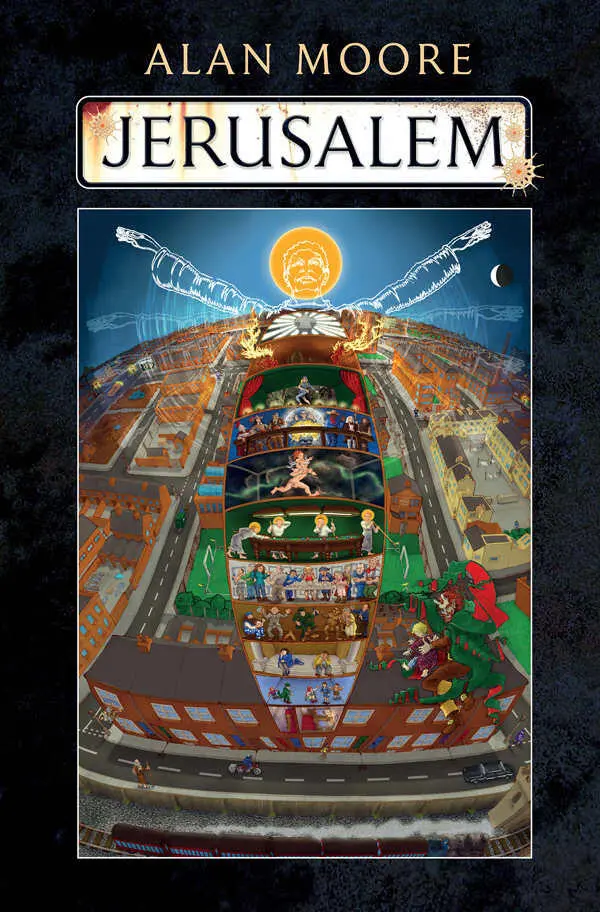
- Название:Jerusalem
- Автор:
- Издательство:Liveright Publishing Corporation
- Жанр:
- Год:2016
- ISBN:нет данных
- Рейтинг книги:4 / 5. Голосов: 1
-
Избранное:Добавить в избранное
- Отзывы:
-
Ваша оценка:
Jerusalem: краткое содержание, описание и аннотация
Предлагаем к чтению аннотацию, описание, краткое содержание или предисловие (зависит от того, что написал сам автор книги «Jerusalem»). Если вы не нашли необходимую информацию о книге — напишите в комментариях, мы постараемся отыскать её.
Disappeared lanes yield their own voices, built from lost words and forgotten dialect, to speak their broken legends and recount their startling genealogies, family histories of shame and madness and the marvellous. There is a conversation in the thunderstruck dome of St. Paul’s cathedral, childbirth on the cobblestones of Lambeth Walk, an estranged couple sitting all night on the cold steps of a Gothic church-front, and an infant choking on a cough drop for eleven chapters. An art exhibition is in preparation, and above the world a naked old man and a beautiful dead baby race along the Attics of the Breath towards the heat death of the universe.
An opulent mythology for those without a pot to piss in, through the labyrinthine streets and pages of Jerusalem tread ghosts that sing of wealth and poverty; of Africa, and hymns, and our threadbare millennium. They discuss English as a visionary language from John Bunyan to James Joyce, hold forth on the illusion of mortality post-Einstein, and insist upon the meanest slum as Blake’s eternal holy city. Fierce in its imagining and stupefying in its scope, this is the tale of everything, told from a vanished gutter.
Jerusalem — читать онлайн бесплатно полную книгу (весь текст) целиком
Ниже представлен текст книги, разбитый по страницам. Система сохранения места последней прочитанной страницы, позволяет с удобством читать онлайн бесплатно книгу «Jerusalem», без необходимости каждый раз заново искать на чём Вы остановились. Поставьте закладку, и сможете в любой момент перейти на страницу, на которой закончили чтение.
Интервал:
Закладка:
To Michael’s eye Phyllis was being much more careful in her digging, wiping patiently away at the accumulated ages like a cautious archaeologist rather than scrabbling frantically, which was the only technique that he’d seen her use before. It looked as if she were attempting to bore through to a specific year or even a specific morning, so precise and delicate were the progressions of her ghostly multiplicity of fingers, scratching in the dark.
At last she seemed to have achieved exactly the degree of penetration she was seeking, with a sizeable breach in the fabric of the tunnel that afforded a restricted view up into what appeared to be the shadowy and laughably low-ceilinged room above. With a delighted and triumphant chortle, Phyllis scrambled up and through the opening she’d fashioned, reappearing moments later crouched beside the time-hole’s rim and grinning down towards them from above. She called to Michael, holding out her hand and telling him that he should come up next. Obediently, the toddler hopped up into John’s linked hands and allowed Phyllis to manhandle him up through the rend in the stone roof, into the dusky chamber overhead.
He found himself not in a crawlspace with its wooden ceiling only three feet overhead, as he’d believed he would, but underneath a table. As he kneeled with Phyllis by the aperture, helping first Marjorie then Bill to struggle up beside them, Michael noticed that beneath the near side of the tabletop the lower reaches of a seated man were visible. Perched on a stately hardwood chair, his most prominent feature was the pair of high, soft boots with dull iron buckles just below the ankle and a flap of leather rising to obscure each knee. The man was obviously alive, since when he moved one foot it left no after-images behind it, which meant that probably he couldn’t hear them. All the same, Michael tried not to make a noise as Reggie and then John were hauled up through the time-trapdoor, whereupon the entire gang crawled like bear-cubs out between the table-legs into a large and quiet room with long slanted rays of afternoon light falling through its criss-cross leaded windows.
Standing there to one side of the high-roofed quarters with his spectral playmates, Michael gazed across the polished oaken tabletop towards the top half of the man whose high boots he’d already seen, sitting at the far end and writing with a quill pen in some sort of log or ledger.
Dark hair, lank and greasy-looking, hung down to the dusty mantle of the man’s old-fashioned tunic, and his bowed head, bent above his writings, had a poorly-concealed bald spot. It was hard to judge his stature, seated as he was, although he didn’t look to be unduly tall. Despite this, his broad chest and shoulders fostered an impression of solidity and bulk. Skin grey in the drained radiance of the ghost-seam, the man looked like a lead soldier scaled up for the play of giants.
Coming to the end of a long paragraph the fellow sat back in his chair to read what he had written, so that the ghost-children could more clearly see his face. To Michael, the grave countenance looked almost thuggish, even though the general bearing of man suggested rank and prominence. His features were like thick-cut bacon, broad and fleshy and possessed of what might almost be an earthy sensuality if not for the expressionless grey eyes like flattened musket balls that dominated the arrangement, staring down unblinking at the page of cramped but ornate script that he’d just authored. A fat wart jewelled the depression between lower lip and chin, with a much smaller growth just over his right eyebrow. There was a nerve-wracking stillness to him that Michael imagined to be like the stillness of a bomb the moment after it’s stopped ticking.
Standing in the silent room beside him, Phyllis nudged him gently in his phantom ribs. She looked pleased with herself.
“There. See ’im? That’s the Lord Protector, that wiz.
“That’s Oliver Cromwell.”
SLEEPLESS SWORDS
That blowing-up bloke on the balcony had rattled John. He liked to think that generally he kept an even keel but the two-legged fireball had upset him, there was no denying.
For a kick-off, John had never seen before what an exploding person looked like, not in all that frozen detail and not from outside. When John himself had copped his lot over in France he hadn’t even realised it had happened for a good few minutes. He’d just taken it for a near miss and had gone running up the road with all the other lads. He’d noticed that the shell-fire was now muffled and that he was seeing everything in black and white, but just assumed the bang had made his eyes and ears go funny. Only when he’d realised he was leaving pictures in his wake, unlike his strangely unresponsive squadron-mates, had John begun to take in what had happened.
Once he’d understood his circumstances he’d been overcome by horror, which was only normal: it had been a gruesome way to perish. So to see that fellow on the landings at the Works, inside his lethal halo with that forced smile and the tears turning to steam upon his cheek, remaining in that awful second for eternity because that was the way that he remembered himself best … John couldn’t make it out. When Bill had told them that these human bombs were doing it as part of their religion, waging holy war as you might say, that had just made John even more bewildered.
John had been a Christian while he was alive. Never a good one, mind you, nowhere near as serious about religion as his eldest brother had been, but more serious than his sister, mam, or either of his other brothers were. He’d gone to church up College Street most Sundays, where he’d been a member of the Boy’s Brigade. That was where John had prayed, sung hymns, been taught to march, and learned to see this combination as entirely natural. Onward Christian soldiers and all that.
There had been no religious books to speak of in the family home where he’d grown up except the Bible, which John was ashamed to say he’d found as dry as dust, and an old copy of The Pilgrim’s Progress , which he’d fared a little better with. He’d not had much idea, back then, what Bunyan’s allegorically-named characters were meant to represent, but found that he enjoyed the tales and fancied that he’d caught their basic moral gist. He’d even got halfway through Bunyan’s Holy War , the first place that he’d come across the name “Mansoul”, before he’d given up in bafflement and boredom. All of this had only underlined the notion that had been instilled in him by Boy’s Brigade — ten minutes’ prayer after an hour’s drill practice in the upper church hall, blue-black military caps on bowed young heads — the sense that Christianity and marching were bound up together inextricably. He was no stranger, then, to the association between warfare and religion, but that, surely, was a thing for proper wars, with soldiers who had proper uniforms. The fellow on the landing, a civilian blowing himself up and taking others with him in the name of God, that was a different matter. That was neither warfare nor religion as John comprehended them.
Also, whatever Boroughs-of-tomorrow the perpetually exploding man had wandered back to 1959 from, that was not a future that John comprehended either. How could his scuffed, peaceful neighbourhood produce something like that in only sixty years or so? Though John had been on various sorties into the twenty-first century with the Dead Dead Gang since first hooking up with them, he realised that he’d no more than the barest understanding of how people felt and thought and lived during those future decades, anymore than he could claim to know much about France simply because he’d died there. All he knew was that the sight of that half-man, half-Roman candle made him fearful for the Boroughs, and the England, and the whole world that was yet to come. Throughout the fight between the builders and the drama in the billiard hall, John had found that he couldn’t take his mind off that illuminated and fragmenting figure, shuffling on the wooden walkways of a Heaven that it couldn’t have conceived of or anticipated, wrapped forever in the flames of its own savage martyrdom.
Читать дальшеИнтервал:
Закладка:
Похожие книги на «Jerusalem»
Представляем Вашему вниманию похожие книги на «Jerusalem» списком для выбора. Мы отобрали схожую по названию и смыслу литературу в надежде предоставить читателям больше вариантов отыскать новые, интересные, ещё непрочитанные произведения.






Обсуждение, отзывы о книге «Jerusalem» и просто собственные мнения читателей. Оставьте ваши комментарии, напишите, что Вы думаете о произведении, его смысле или главных героях. Укажите что конкретно понравилось, а что нет, и почему Вы так считаете.