Alan Moore - Jerusalem
Здесь есть возможность читать онлайн «Alan Moore - Jerusalem» весь текст электронной книги совершенно бесплатно (целиком полную версию без сокращений). В некоторых случаях можно слушать аудио, скачать через торрент в формате fb2 и присутствует краткое содержание. Год выпуска: 2016, Издательство: Liveright Publishing Corporation, Жанр: Современная проза, на английском языке. Описание произведения, (предисловие) а так же отзывы посетителей доступны на портале библиотеки ЛибКат.
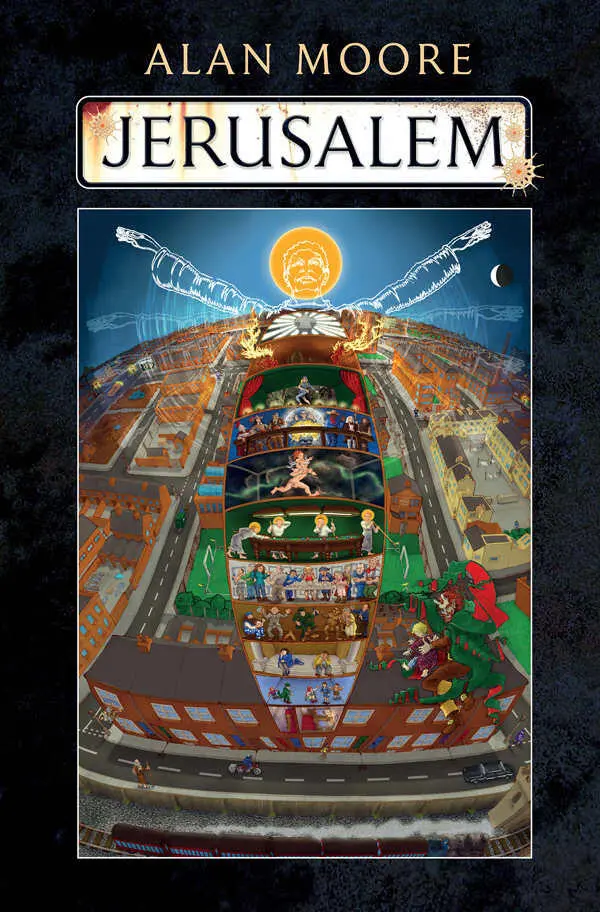
- Название:Jerusalem
- Автор:
- Издательство:Liveright Publishing Corporation
- Жанр:
- Год:2016
- ISBN:нет данных
- Рейтинг книги:4 / 5. Голосов: 1
-
Избранное:Добавить в избранное
- Отзывы:
-
Ваша оценка:
Jerusalem: краткое содержание, описание и аннотация
Предлагаем к чтению аннотацию, описание, краткое содержание или предисловие (зависит от того, что написал сам автор книги «Jerusalem»). Если вы не нашли необходимую информацию о книге — напишите в комментариях, мы постараемся отыскать её.
Disappeared lanes yield their own voices, built from lost words and forgotten dialect, to speak their broken legends and recount their startling genealogies, family histories of shame and madness and the marvellous. There is a conversation in the thunderstruck dome of St. Paul’s cathedral, childbirth on the cobblestones of Lambeth Walk, an estranged couple sitting all night on the cold steps of a Gothic church-front, and an infant choking on a cough drop for eleven chapters. An art exhibition is in preparation, and above the world a naked old man and a beautiful dead baby race along the Attics of the Breath towards the heat death of the universe.
An opulent mythology for those without a pot to piss in, through the labyrinthine streets and pages of Jerusalem tread ghosts that sing of wealth and poverty; of Africa, and hymns, and our threadbare millennium. They discuss English as a visionary language from John Bunyan to James Joyce, hold forth on the illusion of mortality post-Einstein, and insist upon the meanest slum as Blake’s eternal holy city. Fierce in its imagining and stupefying in its scope, this is the tale of everything, told from a vanished gutter.
Jerusalem — читать онлайн бесплатно полную книгу (весь текст) целиком
Ниже представлен текст книги, разбитый по страницам. Система сохранения места последней прочитанной страницы, позволяет с удобством читать онлайн бесплатно книгу «Jerusalem», без необходимости каждый раз заново искать на чём Вы остановились. Поставьте закладку, и сможете в любой момент перейти на страницу, на которой закончили чтение.
Интервал:
Закладка:
Indeed, not until John had realised where Phyll Painter meant to take the gang after escaping from the snooker parlour had he started to pay much attention to their present undertaking, unable to banish the compelling vision of the man-explosion from his thoughts. The English Civil War, though, was John’s hobby in the afterlife, much in the same way Reggie Bowler had a craze for cars or Marjorie liked books. If anything could stop the image of the walking detonation from preoccupying him, it was the thought of tunnelling into the evening of June 13 th, 1645, here in Marefair at Hazelrigg House, or, as locals called it, Cromwell House.
In the brief interlude between his death and his encounter with the Dead Dead Gang, a few subjective years at most, John had pursued his interest independently. He’d twice been out to Naseby, once an hour or two before the battle and once during, and he’d travelled up the Wellingborough Road to Ecton for a look at how the Royalist prisoners were treated afterwards. He’d never previously paid a visit, though, to the occasion he was currently observing: fresh from his promotion to lieutenant-general, rising Parliamentary star Oliver Williams-alias-Cromwell, bivouacked in Marefair on the night preceding the decisive battle of the English Civil War.
John could remember how alone he’d felt in those years following his death, before encountering Phyll and the gang. His journey back from France had been accomplished with surprising speed. One moment he’d been standing in the shell-pocked mud, staring appalled at his own offal, glistening as it spilled from the burst body at his feet, desperately wishing that he’d lived to see his home again. The next, he’d found himself stood in the middle of the green behind St. Peter’s Church, now grey and silvery in the colourless expanses of the ghost-seam. Spilled-milk clouds drifted at anchor in a sky of blazing summer platinum, and John had bounded down the grassy slope towards the terrace at the bottom, leaving a parade of muddy soldiers in the air behind him.
Yes, he’d seen his mam and even seen his sister who was visiting with her two little girls, but since they’d not been able to see John he’d found the whole encounter both frustrating and depressing. What had made it worse was that his mam and sister, obviously, didn’t know that he was dead yet. When his sis had started reading out a letter John had sent home to her daughter Jackie, talking about all the fun he’d have the next time he was home on leave, with all of them sat round the family dinner table, tucking into mam’s bake pudden, John had broken down. His mam, sat in her armchair up the corner, had smiled fondly as her only daughter read the letter, scrawled in pencil on the tiny pages of a jotter, clearly looking forward to bake pudden with her sons as much as John had been the night he’d written to his niece. She didn’t know that the reunion feast would never come. She didn’t know that her son’s ghost was sitting on the lumpy horsehair sofa next to her, weeping with helplessness for her and for himself and for the entire rotten business of that bloody war. Unable to take any more, John had streamed through the closed front door, away along Elephant Lane towards Black Lion Hill, commencing his short-lived career as a rough sleeper.
Not that John had been as rough as most of that sort were, by any means. He’d always kept himself presentable while he was still alive, and thus approached the afterlife with a Boy’s Weekly sense of military discipline. He’d made himself a den in the unused round tower jutting incongruously from condemned Victorian business premises upon the far side of Black Lion Hill. He’d chosen the location partly from a sense that proper ghosts should haunt somewhere that looked appropriately creepy like a turret, and partly because his previous choice, St. Peter’s Church, seemed to be overrun by ghosts already. John had met at least fifteen on his first tentative excursion to the Norman-renovated Saxon building. By the gate in Marefair there had been the spectre of a crippled beggar-woman, talking in a form of English so archaic and so thickly accented that John could barely understand a word of it. Around the church itself John had met phantom pastors and parishioners from several different eras, and encountered a geologist named Smith who claimed to have identified the limestone ridge that stretched from Bath to Lincolnshire, called the Jurassic Way. According to the affable and chatty soul, it was the way that this primordial cross-country footpath met the river Nene which had determined where Northampton would be most conveniently situated. Smith himself, coincidentally, had died here in Marefair while passing through the town and was commemorated by a plaque fixed to the church wall, which he’d proudly pointed out to John.
After that limited exposure to the ghost-seam’s other occupants, John had decided on a policy of keeping for the most part to himself. He’d watched the wraiths coming and going from the window of his tower-room, but they’d seemed to him peculiar things, some of them monstrous, so that he’d not felt inclined to seek their company. For instance, John had one day spotted the giant wading-bird made out of stilts and rushes that he’d seen again just recently, up on the balconies outside the Works. Upon that first occasion he had watched it striding round St. Peter’s Church in a full circuit before struggling through a wall of thousand-year-old stones and out of sight. Back then he hadn’t had a clue what it might be, and was no wiser now. The wood-beaked creature that left puddles of ghost-water everywhere it set its spindly legs served only as an illustration of the half-world’s oddness, which had prompted John to take an isolated, self-sufficient path in all his dealings with the afterlife.
He’d found that he liked his own company, liked planning expeditions such as those he’d made to Naseby, even though his second visit halfway through the actual battle had been horrible and made him glad that he’d been done in by a shell and not a pike. In general, he’d felt lively and adventurous during those early months of being dead, and it had been around then John had realised that he was no longer wearing his army uniform. He’d just looked down one day and found that he was in black knee-length shorts, a jumper that his mam had knitted and the shoes and socks he’d worn when he’d been twelve. He realised now, of course, that his ghost-body had been slowly gravitating to the form that it had been the happiest with in life, but at the time he’d simply been delighted to discover that he was a lad again, and didn’t care to speculate how this had come about.
He’d thrown himself into his solitary escapades with renewed vigour, always choosing the most daring situations to investigate, fancying himself as a dead Douglas Fairbanks Junior. When that British bomber had crashed at the top of Gold Street, John had watched it passing overhead from his tower’s window at the foot of Marefair and had straight away gone racing through the sparkling dark along the east-west avenue, chased by a scrum of after-image schoolboys as he’d rushed to see if anyone was dead, if there were any new ghosts stumbling about confused, needing advice.
As it had turned out, nobody was killed by the huge aeroplane’s astonishing descent, the crew and pilot having already bailed out and the sole casualty being a late-night Gold Street cyclist who’d sustained a broken arm. The only ghost other than John upon the scene that evening was that of the plane itself. Amazingly, although its substance had been almost totally destroyed on impact, the ethereal framework of the aircraft had been driven down into the misty topsoil of the ghost-seam, so that underneath the surface of the street a phantom bomber was at rest and perfectly intact. It had been while John sat there in its cockpit, shouting out commands to his imaginary crewmen and pretending he was on a bombing-mission that, embarrassingly, he had found himself surrounded by four snickering ghost-children who had introduced themselves as the Dead Dead Gang.
Читать дальшеИнтервал:
Закладка:
Похожие книги на «Jerusalem»
Представляем Вашему вниманию похожие книги на «Jerusalem» списком для выбора. Мы отобрали схожую по названию и смыслу литературу в надежде предоставить читателям больше вариантов отыскать новые, интересные, ещё непрочитанные произведения.







Обсуждение, отзывы о книге «Jerusalem» и просто собственные мнения читателей. Оставьте ваши комментарии, напишите, что Вы думаете о произведении, его смысле или главных героях. Укажите что конкретно понравилось, а что нет, и почему Вы так считаете.